

Rising political uncertainty in the U.S. likely triggered a short-term risk-off move. The probability of another government shutdown has climbed to 78% in prediction markets, with funding set to expire on January 30, 2026. As bipartisan negotiations stall, political risk has once again become a near-term drag on market sentiment.
In this environment, Bitcoin fell below $87,000. Around $170 million in leveraged long positions were liquidated within 60 minutes, and roughly $320 million over four hours. Nearly $40 billion in total crypto market value disappeared in a short period. The move occurred during thin liquidity, suggesting a derivatives-led deleveraging rather than broad spot selling.
Liquidations occur when futures positions fall below maintenance margin and are forcibly closed by exchanges. Leveraged longs—commonly used by short-term traders and hedging or arbitrage participants—had been built on expectations of a 2026 uptrend. During downturns, these forced closures hit the market as market orders, which can accelerate price declines when order books are shallow.
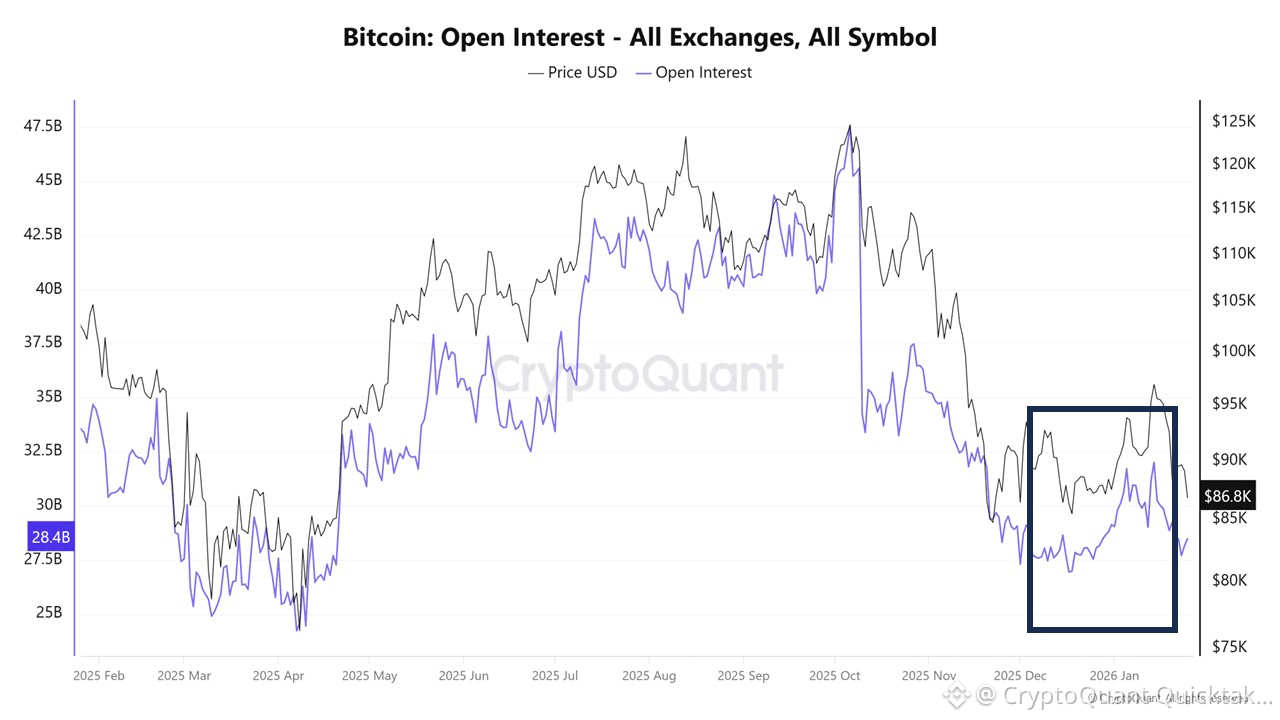
Open Interest (OI) helps clarify this phase. OI measures the total size of outstanding futures positions and reflects how much leverage is embedded in the market. When prices fall alongside declining OI, it indicates that liquidations and position unwinds are driving the move rather than a shift in fundamentals.
On-chain data shows aggregate OI near $28.4B, well below the ~$47B peak in late 2025, indicating that leverage had already been reduced. Still, OI has stabilized and slightly rebounded in early 2026, leaving room for further volatility during corrections.
The key focus is not the price level itself, but what follows: whether selling pressure fades after liquidations, whether spot demand absorbs supply as participants return, and whether leverage metrics normalize. Observing time and participation remains critical for assessing the next phase.
Written by XWIN Research Japan
