

The most successful crypto protocols are not defined by price charts.
They are defined by developers.
Ethereum won because it attracted builders. AWS dominates because startups default to it. The same dynamic will shape decentralized storage: the networks that integrate cleanly into applications, tooling, and workflows will become indispensable.
Walrus Protocol appears to understand this.
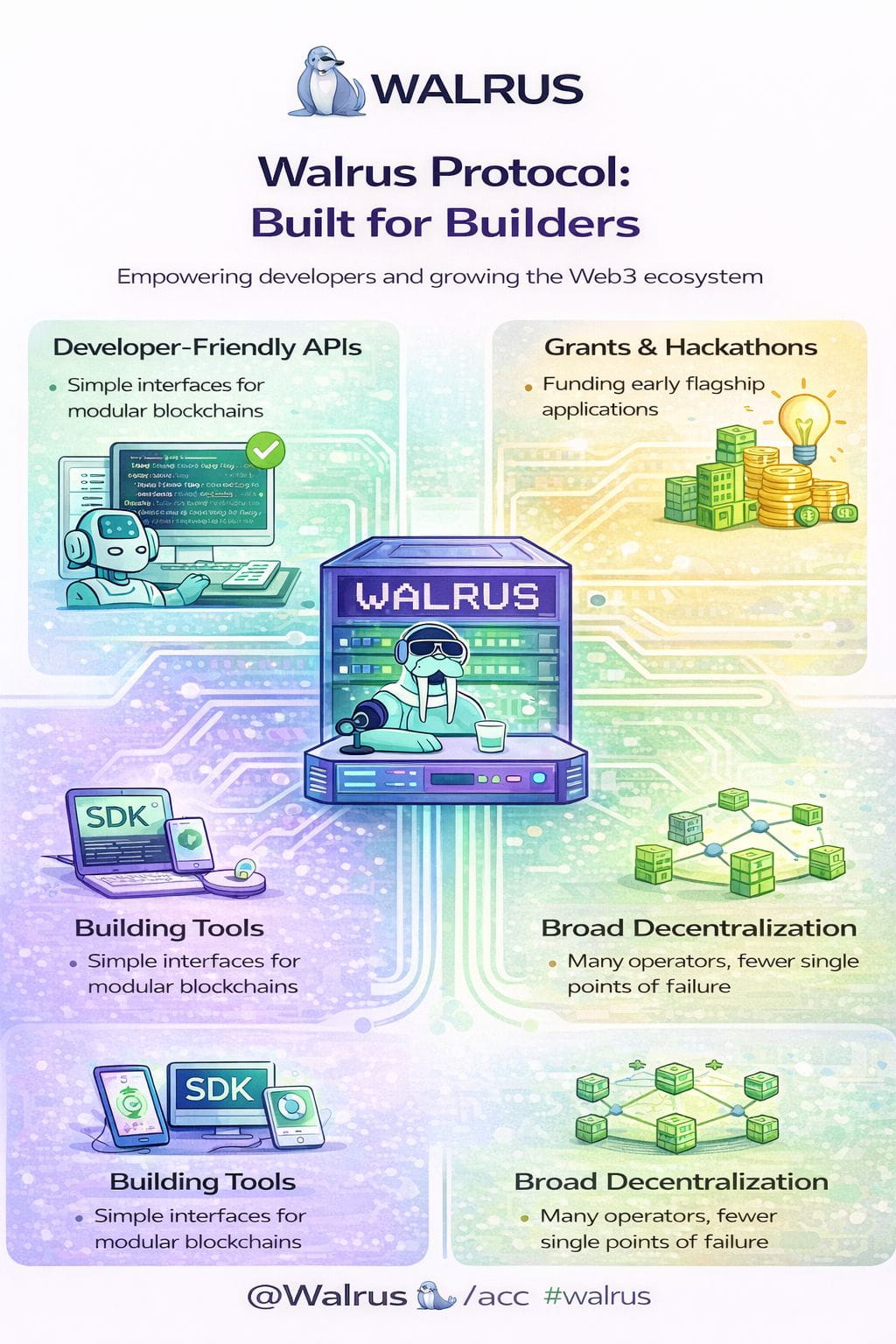
Its design emphasizes developer ergonomics alongside cryptographic rigor. Instead of forcing teams to reinvent data availability layers, Walrus offers simple APIs and integrations that allow apps to store large objects, reference them on-chain, and retrieve them efficiently.
This is particularly powerful in modular blockchain architectures.
Rollups need somewhere to publish transaction data. AI protocols need persistent memory layers. NFT platforms need reliable hosting for media. Gaming worlds need distributed asset pipelines.
Walrus slots into all of these.
Beyond tooling, ecosystem strategy matters. Networks grow when foundations fund grants, sponsor hackathons, and cultivate early flagship applications. Walrus is signaling a long-term commitment to ecosystem development — not chasing quick narratives, but seeding the infrastructure layer slowly and deliberately.
Decentralization also factors into adoption.
If a network is controlled by a handful of operators, enterprises hesitate to rely on it. Walrus’s focus on broad operator participation and scalable decentralization makes it easier for businesses, DAOs, and developers to treat it as neutral infrastructure rather than a vendor.
In the long run, the winners in Web3 will be the protocols that fade into the background.
The ones developers stop talking about because everything already runs on them.
Walrus is building toward that future.

