@Walrus 🦭/acc Walrus exists because a large portion of DeFi quietly fails at something fundamental: preserving ownership under uncertainty. Most protocols are optimized around activity, not resilience. They assume constant liquidity, rational actors, and benign market conditions. When those assumptions break as they inevitably do the result is forced selling, reflexive liquidations, and capital structures that collapse precisely when they are needed most.
At the core of this problem is how DeFi treats assets. Tokens are framed as instruments to be deployed, rehypothecated, and leveraged for yield. Storage, custody, and data availability are treated as background concerns, abstracted away behind smart contracts. Yet in practice, the ability to hold data, state, and assets privately and reliably is inseparable from financial sovereignty. Walrus approaches DeFi from this quieter layer, where control over information and persistence matters as much as execution.
Forced selling in DeFi is rarely ideological; it is mechanical. Positions unwind because collateral becomes illiquid, oracle prices lag reality, or liquidity pools thin out under stress. These failures are not only about volatility but about infrastructure fragility. When data availability is centralized, expensive, or censorable, the system introduces hidden points of failure. Walrus treats decentralized storage not as an auxiliary service but as a prerequisite for reducing these cascading risks. By distributing data across erasure-coded blobs, the protocol accepts redundancy and inefficiency at the storage layer to reduce brittleness at the financial layer.
Liquidity fragility is another underexamined issue. DeFi liquidity is often transient, migrating toward short-term incentives and away from long-term utility. This creates markets that look deep until they are tested. Walrus implicitly acknowledges that not all liquidity should be mobile. Some capital benefits from being patient, anchored to systems that prioritize persistence over velocity. Designing around blob storage and long-lived data structures aligns incentives toward durability rather than constant churn.
Short-term incentives distort behavior not because participants are irrational, but because protocols make patience expensive. Emissions schedules, yield wars, and mercenary capital create environments where exiting early is often the dominant strategy. Walrus reduces reliance on these dynamics by focusing on utility that is orthogonal to yield. Storage demand does not spike and vanish with market cycles in the same way liquidity mining does. This shifts economic behavior from extraction toward maintenance, a subtle but meaningful change.
Capital inefficiency is typically framed as a flaw to be engineered away. In reality, some inefficiency is the price of optionality. Over-collateralization, redundancy, and conservative throughput limits reduce headline metrics but increase survivability. Walrus’s use of erasure coding exemplifies this trade-off. Storing more fragments than strictly necessary appears inefficient on paper, yet it lowers the probability of catastrophic data loss, which in financial systems often manifests as sudden insolvency rather than gradual degradation.
Privacy within Walrus is not positioned as a moral stance but as a risk management tool. Transparent systems leak information that sophisticated actors can exploit, often at the expense of less resourced participants. By enabling private transactions and interactions, the protocol reduces adverse selection and front-running pressures. This does not eliminate risk, but it redistributes it more evenly, which is essential for long-term participation.
Borrowing and liquidity, in this framework, are not engines for leverage but instruments for balance sheet flexibility. Access to liquidity without liquidating core holdings allows participants to navigate short-term obligations while preserving long-term exposure. Stablecoins, when used conservatively, serve as accounting tools buffers against volatility rather than speculative assets. Walrus’s infrastructure supports these uses by emphasizing data integrity and availability, ensuring that positions and obligations remain verifiable even under stress.
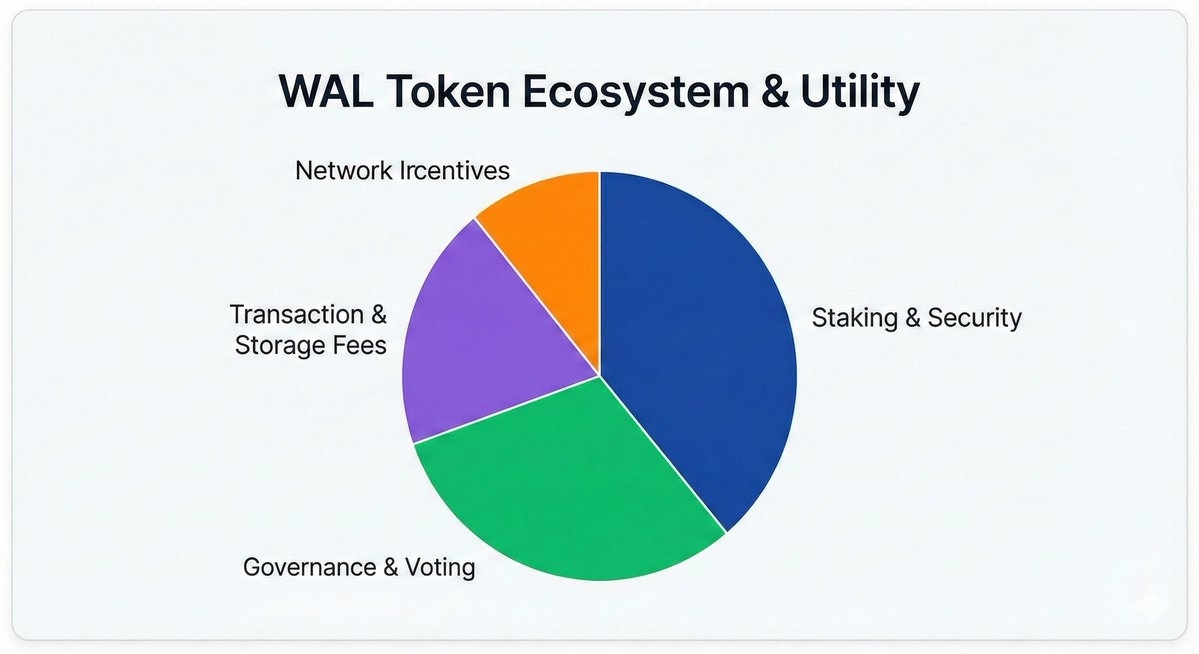
Governance and staking within Walrus are similarly restrained. Rather than encouraging constant intervention, the system benefits from predictable rules and slow-changing parameters. This reduces governance risk, which is often underestimated in DeFi despite being a major source of protocol failure. Conservative governance is not a lack of ambition; it is an acknowledgment that frequent change introduces operational risk.
Yield, in this context, becomes a byproduct rather than a goal. When a system is designed to preserve ownership, manage risk, and reduce forced actions, returns emerge from sustained utility rather than incentives. This is less exciting in the short term, but it aligns with how durable financial systems have historically functioned.
Walrus does not attempt to solve every problem in DeFi. It accepts trade-offs: higher storage overhead, slower adaptability, and fewer speculative hooks. These choices limit rapid growth but enhance relevance during periods when growth narratives collapse. In an ecosystem that often equates progress with acceleration, Walrus represents a different axis of development one measured in persistence rather than momentum.
Over time, protocols that endure are rarely those that promised the most, but those that failed the least. By addressing overlooked structural weaknesses data fragility, incentive misalignment, and forced liquidation dynamics Walrus positions itself not as a centerpiece of speculation, but as infrastructure for continuity. Its relevance will not be determined by cycles, but by whether DeFi eventually values systems that remain standing when incentives fade.