
One night I found myself staring at the mempool and the fee table, not hunting for a quick flip, but asking a question that shouldn’t still hurt after all these years: why does crypto still force users to guess every time they press a button. And then I thought of Dusk Network again, a name that isn’t loud, yet keeps drifting back to the same old obsession: stable fees and a predictable flow.
I think stable fees aren’t a “feature.” They’re a moral promise to users and to builders. It’s truly ironic, the market always falls for whatever spikes, while products only survive on the things that don’t thrill anyone.
A fee system that’s cheap today, expensive tomorrow, congested one moment and empty the next, eventually turns UX into a dice roll. With Dusk, the impression is that they’re trying to do something different: treating “predictability” as a foundation, not a decoration. When fees and network behavior become more stable, builders finally dare to design clean transaction flows, dare to set SLAs for applications, dare to tell users that clicking today will feel like clicking tomorrow.
Honestly, I’ve seen too many chains chant “cheap and fast,” then burn their own credibility the moment real load arrives. Dusk caught my attention because it leans into discipline, where speed only matters if it comes with the system’s calm.
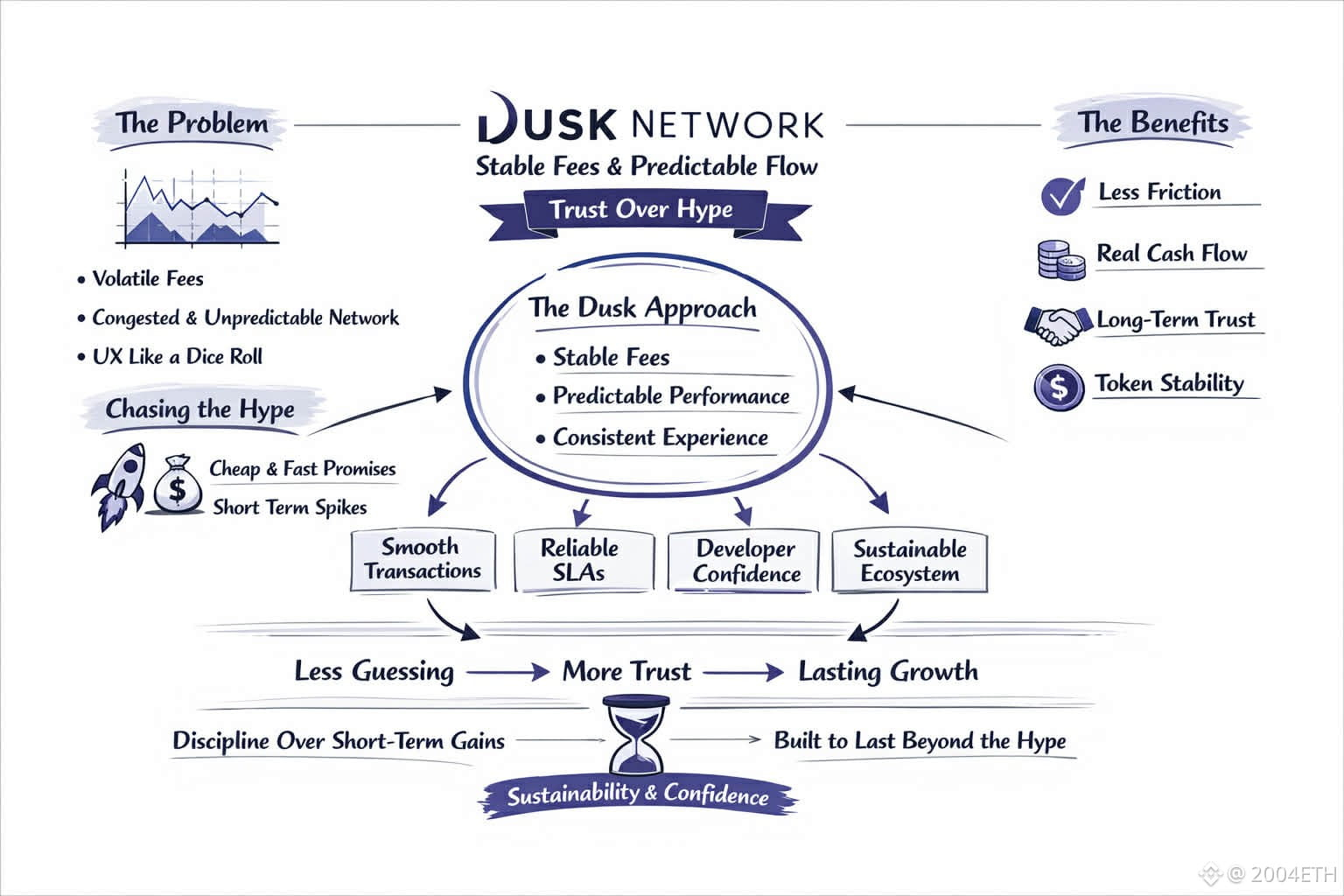
Maybe you’ve felt that same irritation: users don’t care about TPS, they remember the stuck trade, the sudden fee spike, the dApp error that nobody explained. Stable fees, predictable flow, it sounds like operations rather than marketing, and that’s exactly why so few people have the patience to chase it all the way.
If you look through the lens of tokenomics, the story gets even more sensitive. Few would expect something as “technical” as fees to shape token demand so directly, in such an unglamorous way. When fees are predictable and usage is predictable, fee revenue actually has a chance to become real cash flow, instead of flaring for a few weeks and dying like stage lights. I’m not saying stable fees automatically create demand, the market isn’t that simple. But it opens a loop many projects lack: users pay fees because the product is usable, fees feed back into security and operations, builders stay because the environment is less surprising, and the ecosystem has a reason to accumulate rather than only explode.
Or to put it bluntly, Dusk is betting that long term trust won’t come from eye catching metrics, but from reducing how many times people have to “pray” before sending a transaction. In DeFi and finance, those small frictions are existential. A financial app can’t tell users “sometimes it works, sometimes it doesn’t,” and it can’t keep hiding behind a messy explanation like “fees are high because the network is busy.”
I think if Dusk is truly serious about serving financial flows, prioritizing predictability is a necessary form of self restraint, like a builder forcing themselves into a frame to resist the temptation of hollow growth.
Still, I keep my familiar skepticism. The market can bend anything into a story, even discipline can be turned into a slogan. Stable fees sound good, but maintaining them through different load regimes, multiple upgrades, and liquidity shocks requires deeply human operational competence, not just code. And the community too: when prices bleed for long enough, will they stay calm enough to protect the “predictable” vision, or will they demand short term pumps just to dull the pain.
The biggest lesson Dusk brings back to me is this: in crypto, sustainability often starts with choices that make you less flashy. Choosing stability over performance theater, choosing consistent experience over “peak moments,” choosing forecastable flow over wild waves that look great in a recap. I’ve lived through enough cycles to learn that the biggest reward isn’t always a price breakout, it’s building a system that makes people forget they’re still “fighting” the infrastructure.
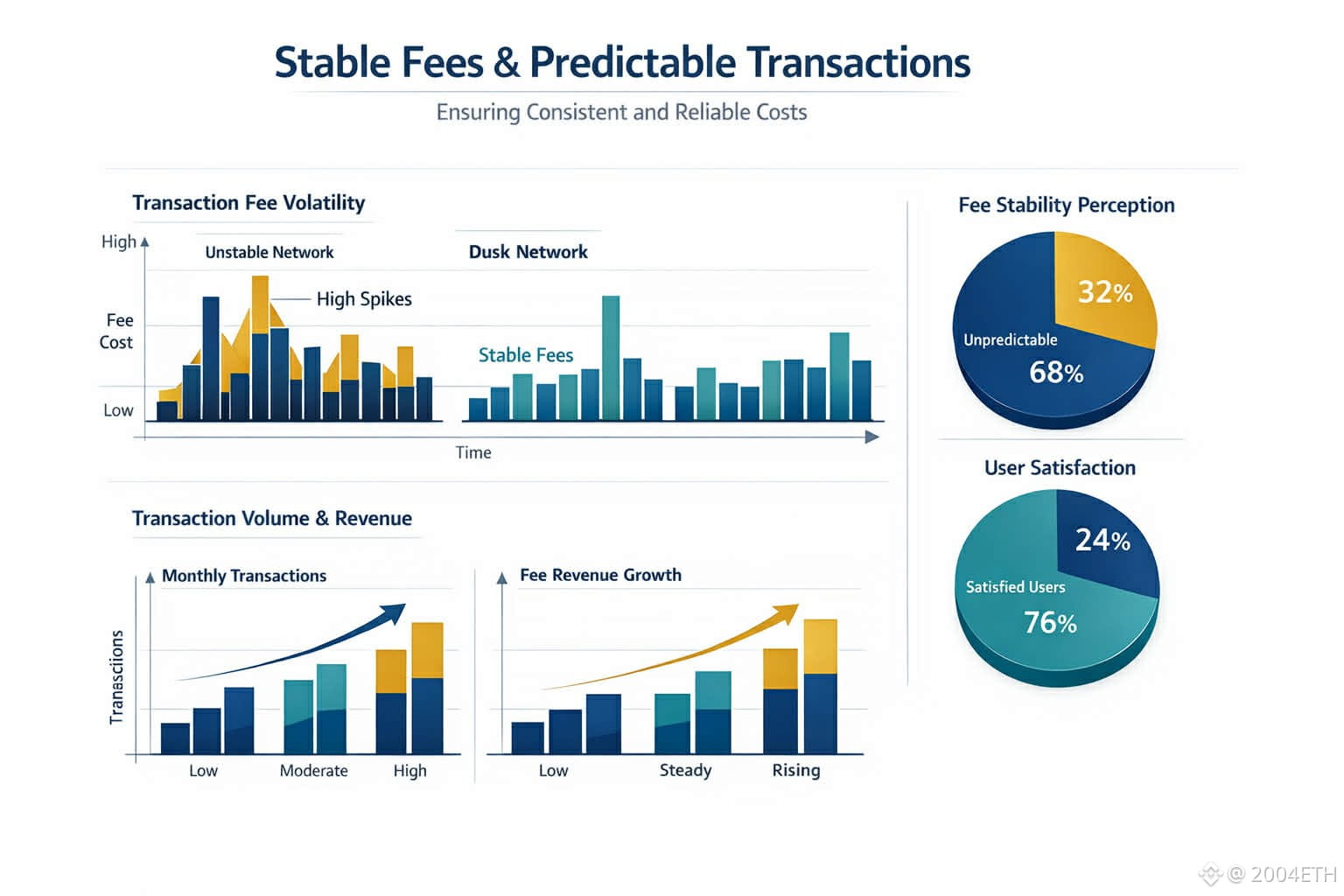
And if Dusk can truly hold stable fees and predictable flow when real users and real money finally rush in, could this be one of those rare foundations that both investors and builders can trust for longer than a single hype season.
