

The Plasma ecosystem is currently entering a new phase where the XPL token is moving beyond a simple asset into a foundational tool for network stability and growth. For professionals in the space, understanding how governance and staking interact is essential to seeing the full picture of this Layer 1 blockchain.
The Architecture of Security
At the center of the Plasma network is a specialized consensus model known as PlasmaBFT. This system allows the network to handle over 1,000 transactions per second while maintaining sub-second block finality. Unlike older chains that struggle with congestion, Plasma uses a Proof of Stake (PoS) mechanism where validators must lock up XPL to verify transactions.
These validators do more than just hold tokens; they produce "proof blocks" that ensure every transaction is accurate. If a validator tries to act dishonestly, their staked XPL is slashed. This creates a high-stakes environment where the financial health of the validator is tied directly to the technical health of the network. For professionals looking at the ecosystem, this alignment of incentives is what provides the stability needed for large-scale financial applications.
Staking as a Stability Engine
Staking XPL is the primary way the community protects the network from attacks. When you stake, you are essentially providing a security deposit that keeps the ledger honest. In exchange for this service, stakers receive rewards from network emissions.
A key feature arriving in 2026 is the activation of staking delegation. This allows users who do not want to run their own hardware to delegate their XPL to professional validators. This process helps decentralize the network by spreading voting power across more participants. It also creates a "locking effect" on the token supply, which can help stabilize the economy as the ecosystem grows.
Governance and Community Control
Governance is where XPL becomes a "voice" rather than just a currency. Holders of XPL have the power to vote on critical protocol changes. This includes:
* Adjusting fee structures for complex smart contracts.
* Voting on new asset integrations.
* Deciding how the community treasury is spent to grow the ecosystem.
This model moves away from a centralized team making every choice. Instead, it places the future of the network in the hands of those who have "skin in the game." In the Plasma ecosystem, the users and the owners are one and the same. This ensures that the platform evolves in a way that serves the people actually using it for stablecoin transfers and DeFi.
Ecosystem Growth in 2026
The growth of the Plasma ecosystem is currently driven by real-world utility. While many blockchains focus on speculation, Plasma is focusing on "Money 2.0." With over $13 billion in cross-chain funds flowing into the system by early 2026, the demand for stable, low-cost rails has never been higher.
Projects like Plasma One are leading the way by offering virtual cards and zero-fee USDT transfers. This brings blockchain technology to everyday users who may not even know they are using a decentralized network. For the XPL holder, this means the token is constantly being used behind the scenes to settle fees and secure these global transactions.
As the network shifts from simple scaling to value accumulation, the role of XPL will only deepen. It is the fuel for the Paymaster module, the anchor for security through proof blocks, and the tool for community-led governance. By participating in staking and voting, you are not just watching the ecosystem grow; you are actively building the stability it needs to become a global standard for digital payments. 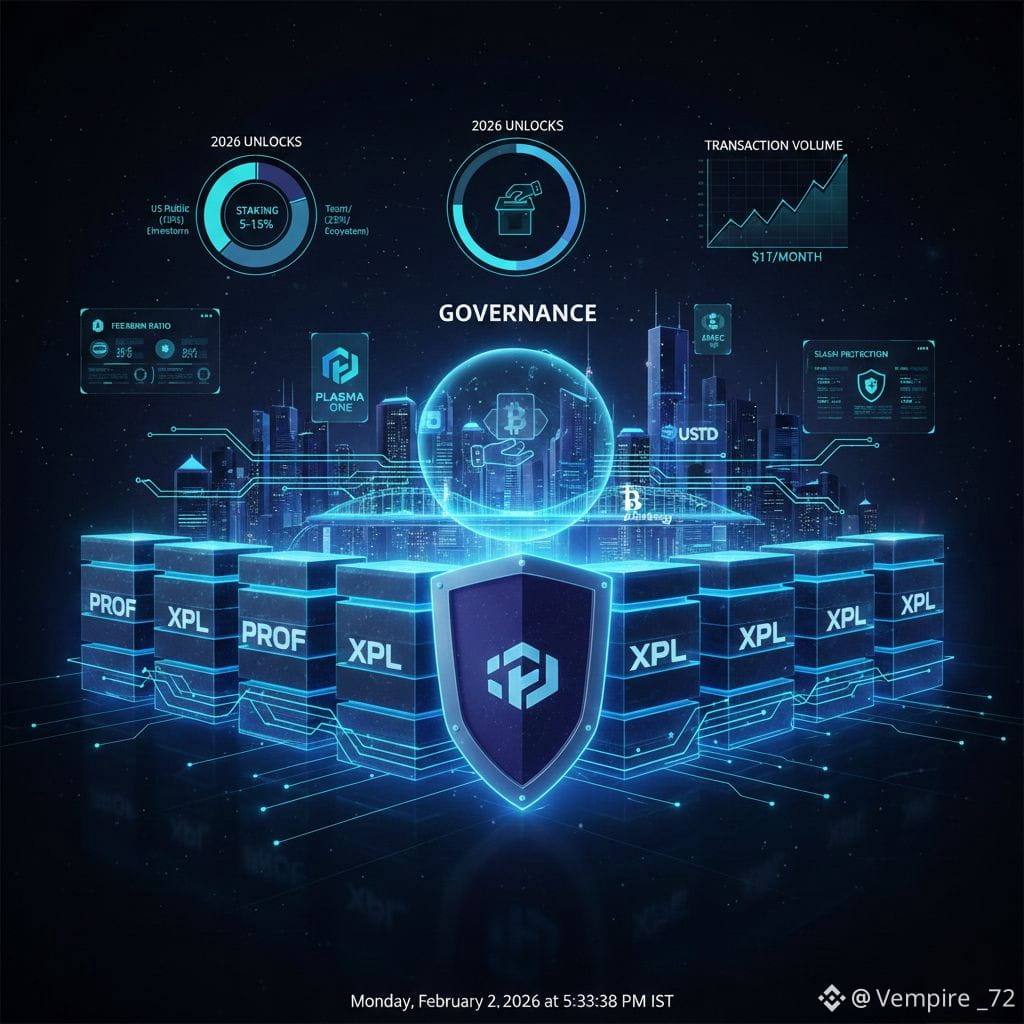
staking rewards.
The 2026 Unlock Roadmap
The total supply of XPL is 10 billion tokens, but the circulating supply has remained low during the first year. This changes in the second half of 2026.
The September 25 cliff is the most significant milestone. After a one-year lockup, 25% of the total supply begins a 24-month linear vesting schedule. While this increases the liquid supply, the ecosystem is designed to "catch" this liquidity through new staking incentives.
Staking Yields and Rewards
Plasma uses a controlled inflation model to reward validators and stakers. In Q1 2026, the network is scheduled to activate Validator Delegation, allowing any XPL holder to earn yield without running a node.
Initial Inflation Rate: The network starts with a 5% annual inflation rate.
Decay Schedule: This rate will decrease by 0.5% each year until it reaches a baseline of 3%.
Projected Staking APY: Current estimates for 2026 suggest a gross yield between 5% and 15%, depending on the total percentage of the network that is staked.
If a large portion of the July and September unlocks are moved directly into staking contracts, the "sell pressure" is effectively converted into "security collateral," stabilizing the token’s market value.
Governance as a Risk Hedge
For professionals, governance isn't just about voting; it's about protecting the value of the staked asset. In 2026, XPL holders will gain control over:
Fee-Burn Ratios: Adjusting how much USDT/gas revenue is permanently removed from circulation (similar to EIP-1559).
Slash Protection: Implementing "reward slashing" instead of "capital slashing" to lower the risk for institutional stakers.
Bridge Security: Voting on the collateralization ratios for the pBTC (Bitcoin) bridge.
Strategic Outlook
The growth of the ecosystem in 2026 depends on whether the demand from Plasma One (the neobank integration) and cross-chain USDT settlements can outpace the inflation from unlocks. If transaction volume hits the projected $1 trillion monthly mark by year-end, the fee-burning mechanism could turn XPL into a deflationary asset despite the scheduled unlocks.
Any investment before Reserch must.

