
After spending enough time around Layer 1 infrastructures, you start to notice that most failures do not come from hacks or obvious bugs. They come from something quieter. Systems allowing things to happen that should never have been allowed in the first place.
In many blockchains, invalid actions are tolerated early and corrected later. Transactions execute, states change, and only afterward does the system decide whether something should be reverted, penalized, or socially resolved. That approach looks flexible on the surface, but over time it becomes expensive. Not just in fees or governance overhead, but in trust.
Dusk takes a noticeably different stance. It treats invalid actions as something that should die before they ever touch the ledger.
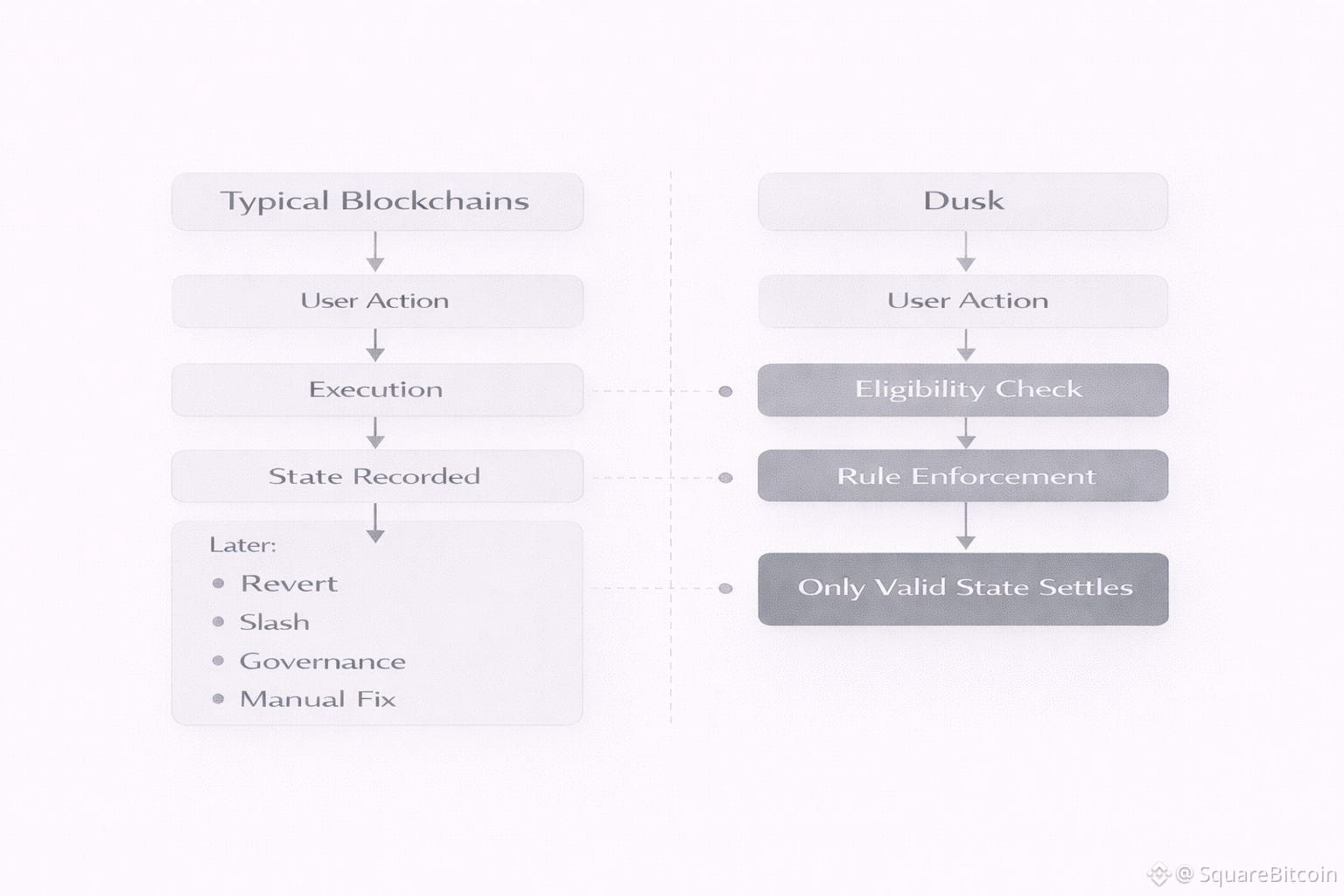
This is not a philosophical preference. It is a structural one.
Most chains implicitly assume that recording activity is cheap and interpretation can happen later. That assumption works fine when the cost of being wrong is low. It breaks down quickly in environments where eligibility, timing, and compliance actually matter. Once assets represent regulated securities or institutional positions, “we will fix it later” stops being acceptable.
Dusk is built around the idea that the ledger should only ever record states that deserve to exist.
That idea shows up very clearly in how the network enforces rules before execution. Eligibility checks are applied upstream. Conditions are verified before state transitions occur. By the time something settles, it is no longer provisional. It is a commitment.
This is where many people misunderstand Dusk and assume inactivity. Fewer visible transactions, fewer corrections, less public drama. But what is missing is exactly the point. Invalid actions never become data. They never inflate the ledger. They never need to be explained away months later during an audit.
From an infrastructure perspective, this is a disciplined choice.
In traditional financial systems, a huge amount of cost lives off chain. Compliance teams, reconciliation processes, exception handling, and post trade reviews exist because systems allow questionable actions to pass through and only investigate them afterward. The more questionable actions you allow, the more expensive your back office becomes.
Dusk attempts to shift that cost curve.
Instead of absorbing failure downstream through human processes, it absorbs it upstream through protocol enforcement. This is where components like Hedger become relevant. Privacy on Dusk is not about hiding activity from everyone. It is about allowing verification without exposing unnecessary detail, while still enforcing rules before execution.
This distinction matters more than it sounds.
In many public systems, privacy is treated as an afterthought layered on top of execution. On Dusk, confidentiality and enforceability are intertwined. The system does not ask participants to trust that rules were followed. It forces compliance at the moment when it is cheapest to verify, before the state becomes authoritative.
The result is a ledger that grows slower, but cleaner.
That trade off is intentional. Dusk is not optimized for high velocity experimentation. It is optimized for environments where invalid actions carry real consequences. When DuskTrade launches with regulated partners like NPEX and brings hundreds of millions in tokenized securities on chain, the cost of allowing invalid activity is no longer theoretical. It becomes legal, reputational, and financial.
In that context, throughput is not the primary constraint. Correctness is.
From a market perspective, this also explains why Dusk can be difficult to value using standard crypto metrics. Transaction count, short term activity, and visible usage do not capture what the system is actually optimizing for. The more effective Dusk is at preventing invalid actions, the less noise it produces.
That quietness can be misleading.
What matters more is how much uncertainty is removed before execution ever happens. Every enforced rule reduces the need for reconciliation later. Every rejected invalid action avoids downstream cost that never shows up on chain, but would otherwise compound off chain.
This is also where the trade offs become clear.
By enforcing strict pre execution rules, Dusk limits flexibility. Some behaviors that are tolerated on other chains simply do not fit here. Debugging can be harder. Experimentation is slower. The system is less forgiving.
But that is the price of discipline.
In infrastructure built for regulated assets, forgiveness often becomes a liability. Systems that rely on social coordination to resolve mistakes eventually hit scale limits. Someone has to decide. Someone has to approve. Someone has to explain. Those human loops do not scale cleanly.
Dusk is trying to remove as many of those loops as possible before they form.
After watching enough Layer 1s struggle under the weight of exceptions, governance patches, and retroactive fixes, this approach feels less restrictive and more honest. It acknowledges that not all actions deserve to be recorded. Not all flexibility is healthy. And not all speed creates value.
Dusk is not competing to be the most expressive chain. It is positioning itself as a selective one. A ledger that records decisions, not experiments. Outcomes, not attempts.
That choice will never generate loud metrics. But in markets where correctness compounds and mistakes linger, it may turn out to be the more durable path.
