

In a world where finance is increasingly becoming digital, the need for privacy and compliance has never been more pressing. Traditional financial systems, with their centralized structures and complex regulations, often create barriers for both institutions and individuals trying to navigate the digital economy. Dusk Network, launched in January 2025, is striving to change this dynamic. It stands at the intersection of blockchain innovation and the real-world needs of finance, offering a solution that brings together the best of decentralized finance (DeFi) and traditional financial institutions—while prioritizing privacy.
Unlike other blockchains that focus on a wide range of applications, Dusk has a clear purpose: to serve as a bridge for regulated decentralized finance and real-world assets (RWAs). At its core, Dusk’s mission is to unlock economic inclusion by making institution-level assets accessible on the blockchain, allowing anyone, anywhere, to engage with them. But what sets Dusk apart is not just its focus on bridging these worlds, but how it tackles privacy and regulatory compliance in a way that other blockchains simply don’t.
The Privacy-First Blockchain
One of Dusk’s standout features is its ability to ensure privacy while remaining fully compliant with regulatory standards. Traditional blockchains like Ethereum are transparent by design, meaning that anyone can see the details of a transaction—something that works for some use cases but doesn’t always fit well with financial services. Dusk, on the other hand, is built from the ground up with privacy in mind. It uses advanced zero-knowledge proofs (ZKPs) to protect transaction details, allowing users to maintain privacy without sacrificing auditability for regulatory authorities.
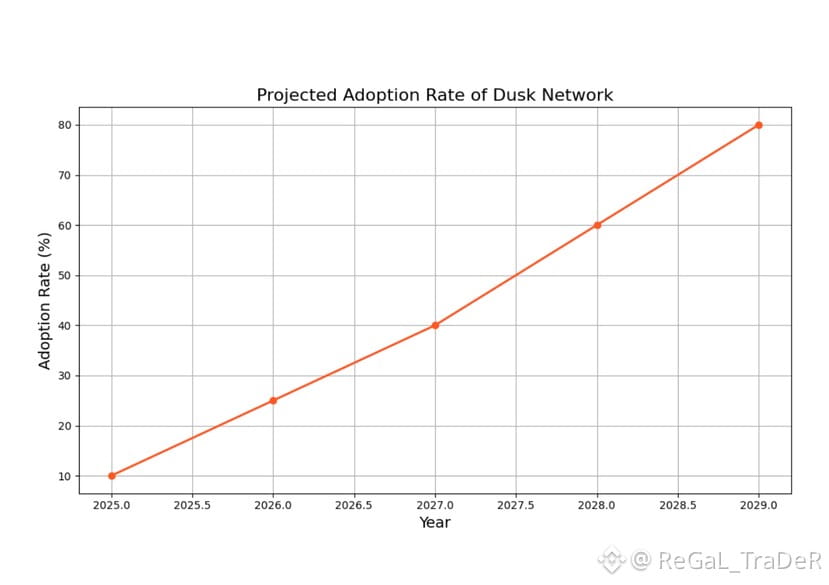 This is crucial for financial institutions, which need to comply with regulations like know-your-customer (KYC) and anti-money laundering (AML) laws. Dusk achieves this balance by offering privacy-preserving smart contracts and a modular design that can adapt to various use cases. For example, it can handle confidential securities, tokenize real-world assets, and enable DeFi applications—all while ensuring that data privacy is preserved.
The protocol’s modular approach enables Dusk to serve both traditional and crypto-native users, allowing institutions to launch markets and financial products with real regulatory obligations, such as eligibility checks, trading limits, and on-chain reporting, all enforced through the blockchain. This approach brings the security and transparency of blockchain technology to markets that are often hesitant to adopt it due to regulatory concerns.
Modular Architecture for Scalable Solutions
Dusk’s architecture is carefully designed to prioritize performance, security, and scalability. The network is powered by two primary layers: DuskDS and DuskEVM. The DuskDS layer is responsible for settlement, consensus, and data availability. It’s built using Rust, which powers the protocol’s core components, including the Rusk Universal Event System (RUES) that manages the chain state, network, and external APIs. This layer supports foundational contracts like transfer and stake, alongside advanced technologies like PLONK for ZKPs and Kadcast for peer-to-peer networking.
The DuskEVM layer, an Ethereum-compatible execution environment, allows developers to deploy smart contracts just like they would on Ethereum, making it easy for developers already familiar with Ethereum’s ecosystem to build on Dusk without needing to learn an entirely new system. This means that the platform is not only privacy-focused but also developer-friendly, ensuring that it can scale quickly and efficiently.
A Unique Consensus Mechanism
The consensus mechanism that Dusk uses, called Succinct Attestation (SA), is a key differentiator. Traditional Proof-of-Stake (PoS) systems, like those used in networks like Cosmos, rely on a committee of validators to agree on blocks. Dusk’s SA protocol, however, separates participants into two distinct groups: Generators and Provisioners. Generators propose blocks, while Provisioners validate them. This separation of duties, coupled with a privacy-preserving leader extraction process, ensures that Dusk’s network remains secure while maintaining high throughput and low latency.
The Succinct Attestation protocol is designed for performance and scalability, making it a good fit for high-stakes financial markets where transaction finality is crucial. The protocol operates under synchronous network assumptions, which helps ensure security and scalability, with fewer nodes required to achieve the same level of security as traditional PoS systems. This means that Dusk can scale infinitely without compromising on security or decentralization, a vital feature for the growing world of tokenized assets.
Privacy and Compliance: A Fine Balance
At the heart of Dusk’s technology is its ability to offer two types of transaction models, Phoenix and Moonlight. Phoenix is a privacy-preserving, UTXO-based model that uses ZKPs to hide transaction details while still allowing for compliance with regulations. Moonlight, on the other hand, is a more public, account-based model that facilitates seamless integration with exchanges.
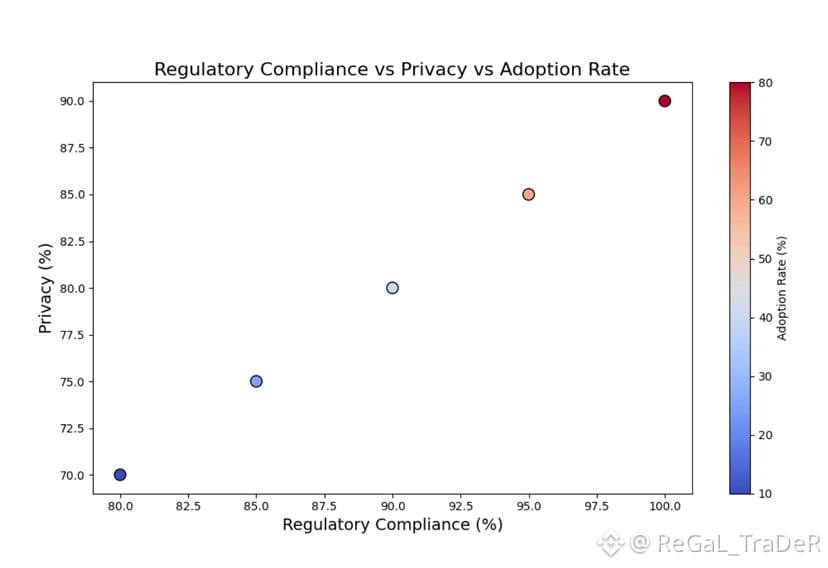
For asset tokenization, Dusk offers the Zedger/Hedger framework, which combines UTXO and account models to ensure private balance logging while still providing full transparency when necessary. This allows for the entire lifecycle of an asset—issuance, trading, and settlement—to be conducted on-chain, in a way that meets both privacy and regulatory requirements.
The Tokenomics and Governance of Dusk
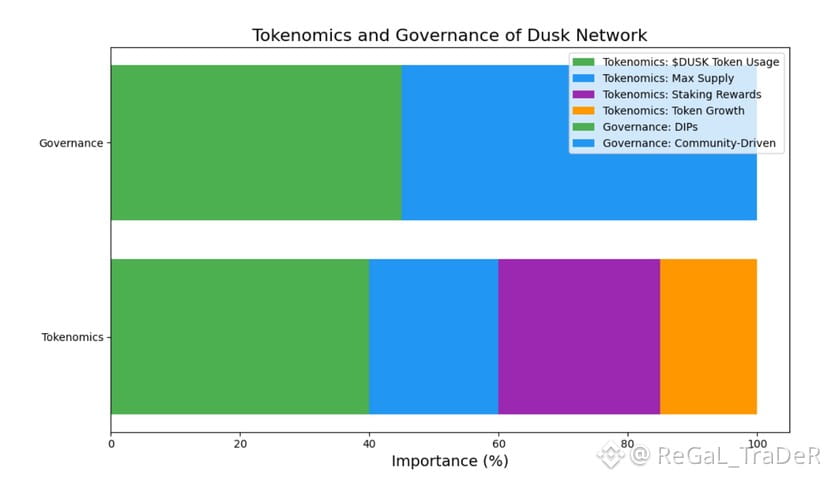
Dusk’s native token, $DUSK, serves as the fuel for the network, being used for staking, paying gas fees, and participating in governance decisions. With a maximum supply of 1 billion tokens, $DUSK plays a central role in maintaining the network’s security and incentivizing participation. The tokenomics are designed to ensure the long-term sustainability of the platform, with staking rewards and emissions structured in a way that encourages early participation and long-term staking.
The governance of Dusk is decentralized, with decisions made through Dusk Improvement Proposals (DIPs), which allow the community to contribute to the future development of the network. The project’s team, consisting of blockchain and finance experts, is dedicated to ensuring that the network remains cutting-edge while meeting the needs of its users.
The Road Ahead
Looking forward, Dusk is poised for continued growth. The project has already secured important partnerships, including integrations with Chainlink for oracles and NPEX for stock exchange integration. The roadmap for 2026 includes further enhancements to scalability, interoperability with Ethereum, and additional privacy features, all of which will help Dusk position itself as a leader in the $140 trillion market for real-world assets.
Dusk’s future is bright, but it is not without challenges. Scaling for mass adoption while maintaining decentralization and privacy will require careful navigation. Regulatory compliance, particularly with evolving laws like MiCA, will also be an ongoing task. But with its strong foundation in privacy, compliance, and scalability, Dusk is well-equipped to address these challenges and carve out a lasting role in the evolving digital finance ecosystem.
Conclusion: A Future Built on Privacy and Trust
Dusk Network is more than just another blockchain. It’s a privacy-first solution for regulated finance, designed to bridge the gap between traditional finance and decentralized systems. By offering privacy, compliance, and scalability in a single package, Dusk is redefining what is possible in the world of decentralized finance and tokenized assets. While challenges remain, Dusk’s technology, governance, and vision position it as a key player in the future of global finance.
