

They look like pauses.
A transfer that should feel routine stretches just long enough for someone to check twice. A balance exists, but not in the right form. A confirmation sits in limbo while the sender wonders whether to wait or retry. Nothing is technically broken, yet the interaction already feels unreliable.
That’s the point where money stops feeling like money.
Stablecoins have moved far beyond their original niche. In many places, they function as working capital, savings, remittance rails, payroll tools. People use them because they expect steadiness. But the networks underneath often still treat every transaction like a technical operation that deserves attention and preparation.
Plasma takes a narrower stance. It’s a Layer 1 shaped around stablecoin settlement as the primary workload, not a side case. That choice shows up less in what the network advertises and more in what it removes.
Gas is the first thing that disappears from the user’s mental checklist. Gasless USDT transfers aren’t a convenience feature in this context. They eliminate a structural contradiction: holding spendable value but being unable to move it due to a separate requirement. Stablecoin-first gas extends that logic. The system stops asking for preconditions unrelated to the transfer itself.
The result isn’t dramatic. It’s quieter than that. Fewer stalled attempts. Fewer small corrections. Fewer moments where someone has to pause mid-action to adjust.
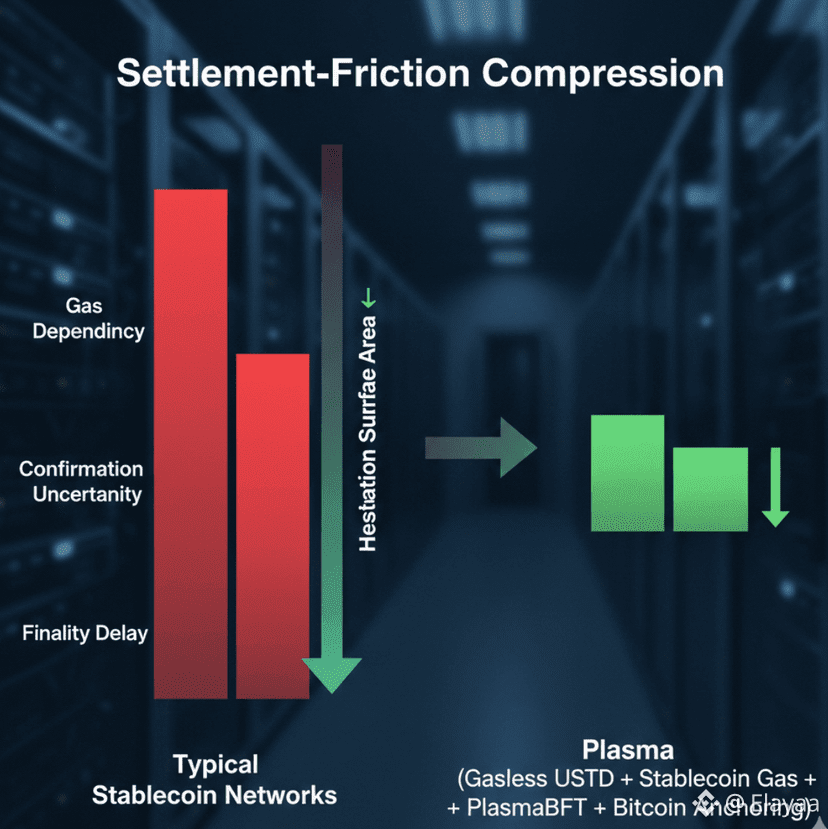
Payments rarely happen in perfect focus. They happen between other tasks, in motion, sometimes under mild stress. Every extra dependency increases the chance that the action gets delayed or abandoned. Removing those dependencies doesn’t make a network flashy. It makes it harder to notice.
Finality plays a similar role. PlasmaBFT’s sub-second finality doesn’t change how fast a person can click a button. It changes how long uncertainty lingers after they do. The transfer settles before attention shifts toward doubt. No hovering over a status page. No second transaction sent “just in case.”
Closure arrives early.
There’s a pattern across payment systems that persist. They minimize the number of times a user has to check whether something worked. They don’t reward observation. They reward completion. Plasma’s settlement behavior aligns with that pattern, even if the mechanics behind it stay out of view.
Security enters differently here. Bitcoin-anchored security isn’t framed as a headline upgrade. It’s more like a background condition. Anchoring to Bitcoin signals that settlement integrity is meant to remain neutral over time, less exposed to short-term governance shifts or rapid policy turns.
For a network focused on stablecoins, neutrality isn’t philosophical. Stable value moves through unpredictable environments. The settlement layer being resistant to abrupt change reduces one more variable in a system already exposed to many.
Ethereum compatibility through Reth fits without fanfare. It keeps execution familiar for builders while the chain’s priorities diverge from general-purpose platforms. Compatibility becomes a bridge rather than a statement of identity.
There’s also something notable in the restraint. Plasma doesn’t present itself as a canvas for everything. Payment-focused infrastructure tends to degrade when it accumulates too many parallel objectives. Optionality can be a strength in some contexts. In settlement layers, it often becomes surface area for failure.
Retail usage exposes these edges quickly. In regions where stablecoins are already woven into daily financial life, users don’t want to learn network rules. They want transfers to behave consistently. When transactions complete without explanation, behavior stabilizes around them. The network fades into routine.
Institutions encounter different frictions. Delayed finality affects accounting. Ambiguity in settlement status creates reconciliation overhead. Operational teams don’t celebrate flexibility; they measure predictability. Systems that resolve cleanly reduce internal noise.
Plasma seems positioned where those two perspectives overlap. Not by offering everything, but by narrowing what can go wrong during settlement. Payments that hesitate shift from being actions to becoming questions. Questions slow systems down.
There’s a broader recalibration happening in how blockchain infrastructure gets judged. Early cycles rewarded expressive capability. Current pressure highlights behavioral reliability. What happens when the system is used in ordinary, repeated ways.
Infrastructure earns trust through repetition without incident.
Plasma doesn’t appear designed to hold attention. It’s designed to release it quickly. The transaction finishes, and the user moves on. No lingering interaction, no visible drama.
That absence is easy to overlook. It doesn’t chart well. But over time, it shapes habits. Systems that don’t interrupt become defaults. Systems that don’t surprise become embedded.
Most networks optimize for activity. Plasma’s settlement layer seems optimized for finality as an endpoint, not as an event.
There’s no grand signal when that kind of design works. Just fewer pauses. Fewer corrections. Fewer moments where someone wonders if their money is actually moving.
And then, eventually, fewer reasons to think about the network at all.


