


Introduction
In the rapidly expanding world of digital finance, stablecoins have become a foundational pillar, enabling trillions in global transactions and connecting traditional finance with blockchain ecosystems. Amid this growth, Plasma emerges as a purpose-built Layer 1 (L1) blockchain with a clear mission: to become the premier settlement layer for stablecoins worldwide. Launched in 2025, Plasma addresses the persistent challenges of current stablecoin networks—high transaction fees, slow confirmation times, and fragmented liquidity across chains. By optimizing for stablecoin-native operations, Plasma enables instant, secure, and cost-effective payments at a global scale, forming the invisible infrastructure that could power the digital dollar economy of the future.
With billions in stablecoin deposits and rapid adoption, Plasma has already positioned itself as a leading network for digital payments. Its strategic approach combines technological innovation, institutional-grade security, and broad compatibility, making it an attractive platform for issuers, exchanges, fintechs, and end-users alike. This article explores Plasma’s mission, the market opportunity it targets, its architecture, key features, partnerships, tokenomics, roadmap, and long-term potential.
The Stablecoin Opportunity: A Trillion-Dollar Market
Stablecoins, digital assets pegged to fiat currencies like the USD, have transformed value transfer. In 2024 alone, stablecoins facilitated over $32 trillion in transactions—surpassing traditional payment giants—with total circulating supply exceeding $235 billion. They dominate on-chain activity, underpinning global remittances, cross-border B2B payments, international trade settlements, and acting as a safe haven in inflation-prone regions.
Looking ahead, stablecoins are projected to grow exponentially, with opportunities spanning on-chain Eurodollar markets, emerging economy remittances, and export credit settlements. Yet, existing infrastructures struggle to meet this demand. High gas fees and network congestion on general-purpose chains, combined with centralization risks on others, leave large-scale stablecoin adoption fragmented and inefficient. Plasma addresses these pain points by providing a neutral, high-performance settlement layer capable of unifying global stablecoin flows.
Plasma’s Mission Explained
At its core, Plasma is designed to be the backbone of stablecoin settlement, treating stablecoins as first-class assets rather than secondary tokens. Its goal is to make stablecoin payments as seamless and predictable as sending a text message—fast, reliable, and devoid of speculative friction.
Plasma positions itself at the base of the stablecoin ecosystem: supporting issuers, liquidity providers, fintechs, and end-users. By delivering high-performance rails, the network leverages scalability and network effects, particularly in regions where stablecoins drive financial inclusion. Its principles of neutrality, decentralization, and multi-stablecoin support set it apart from competitors and ensure that no single issuer can dominate the network.
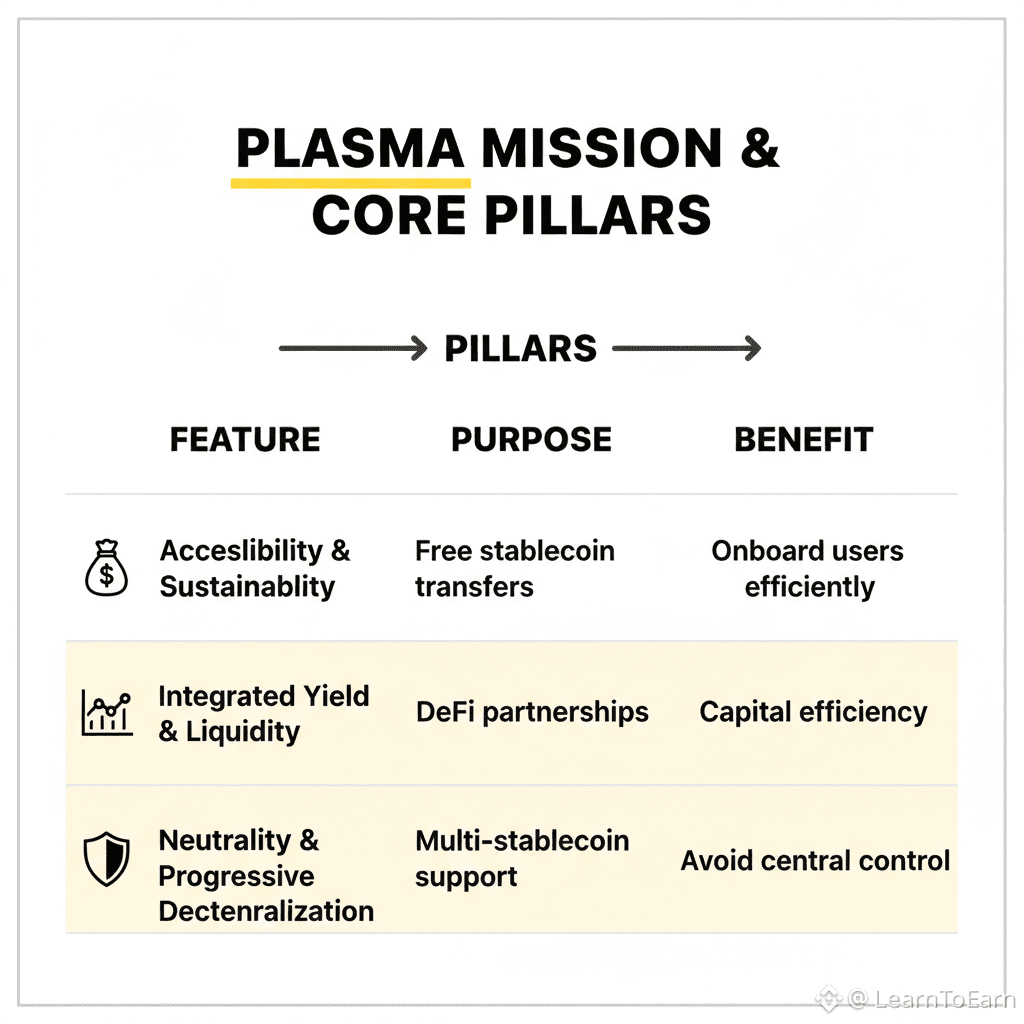
Three pillars underpin Plasma’s mission:
1. Accessibility and Sustainability: Free stablecoin transfers to onboard users efficiently.
2. Integrated Yield and Liquidity: Productive balances through DeFi partnerships, enabling capital efficiency.
3. Neutrality and Progressive Decentralization: Supporting multiple stablecoins, avoiding centralized control, and expanding validator participation.
Plasma targets retail users (remittances), DeFi protocols (on-chain finance), and institutional entities (FX settlements, treasuries), aiming to replace legacy platforms as the preferred settlement infrastructure.
Technical Foundations
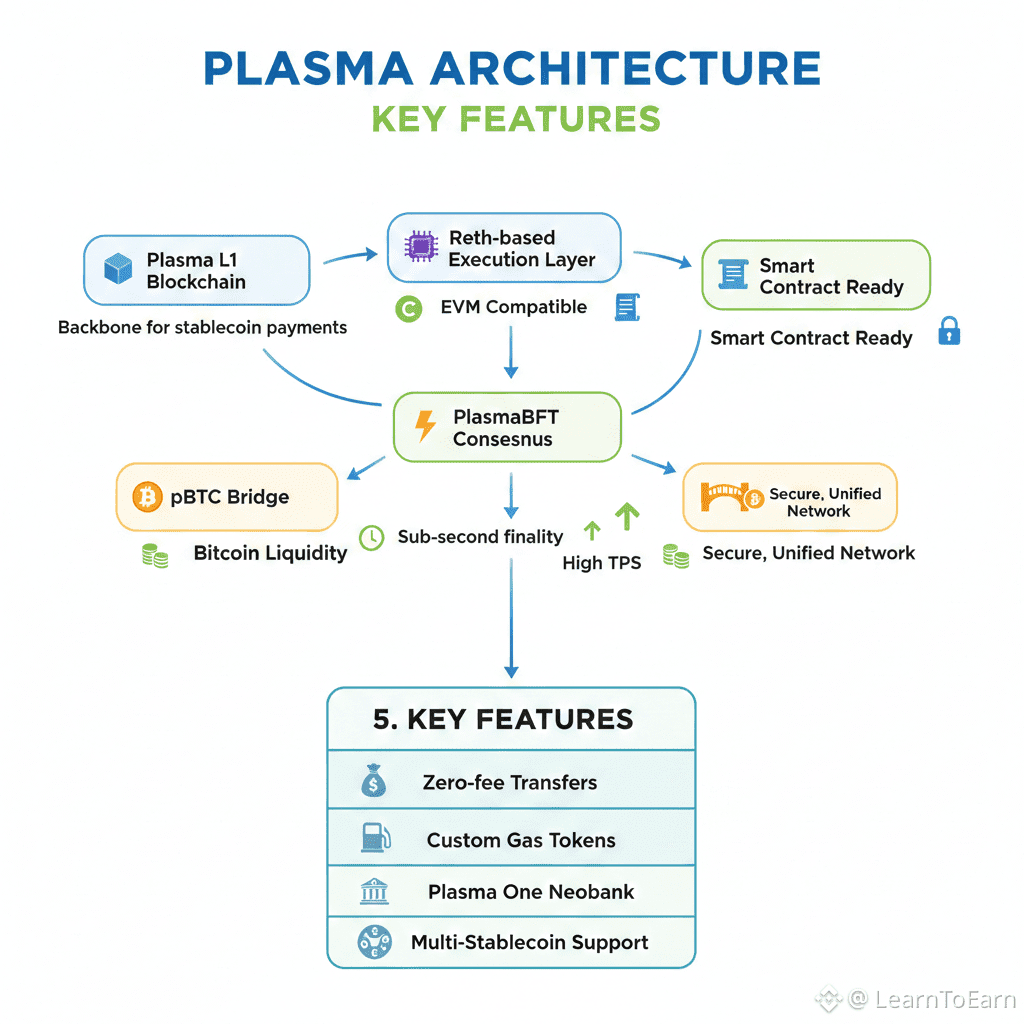
Plasma’s architecture is modular, built on a Reth-based execution layer for full EVM compatibility and seamless smart contract deployment. It functions as a Bitcoin sidechain, anchoring state roots to Bitcoin’s Proof-of-Work for enhanced security and censorship resistance. The trust-minimized pBTC bridge allows Bitcoin liquidity to integrate directly into Plasma without fragmentation, using advanced multi-party computation (MPC) to secure assets.
The network’s consensus, PlasmaBFT, is a custom Byzantine Fault Tolerant (BFT) protocol inspired by Fast HotStuff. It delivers sub-second finality, thousands of transactions per second, and resilience against up to one-third faulty nodes. Unlike punitive PoS models, PlasmaBFT avoids slashing, encouraging broad validator participation while maintaining high throughput. Block times are under 1 second, transaction fees are minimal, and stablecoin transfers are optimized for efficiency.
Key Features Driving the Mission
Plasma’s features are purpose-built for stablecoin adoption:
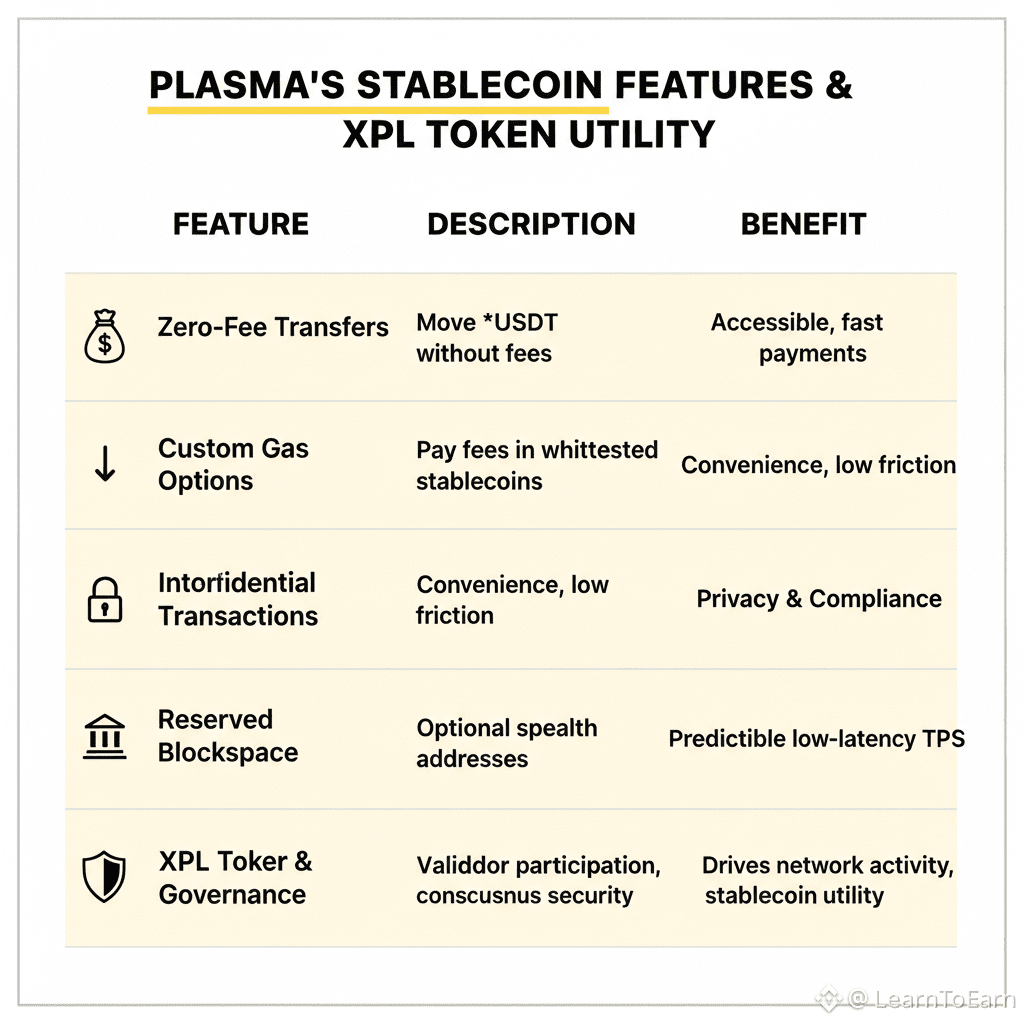
Zero-Fee USDT Transfers: Gasless payments via a protocol-controlled system, making everyday stablecoin use accessible.
Custom Gas Tokens: Fees payable in whitelisted stablecoins, with automated swaps and no hidden costs.
Confidential Transactions: Opt-in privacy through stealth addresses with verifiable proofs, ideal for payroll and sensitive payments.
Plasma One Neobank: Offering 10%+ yield on USDT without lockups, 4% cashback on debit cards, borderless spending across 150+ countries, and zero-fee transfers.
Multi-Stablecoin Support: Integration with 25+ stablecoins reduces reliance on a single issuer and enhances neutrality.
These capabilities combine high throughput, low friction, and institutional-grade security, directly supporting Plasma’s settlement layer mission.
Partnerships and Adoption
Plasma’s ecosystem is expansive, with over 100 partnerships and billions in deployed liquidity. Key collaborations span:
DeFi & Yield Platforms: Lending, liquidity, and productive stablecoin applications.
Payments & On/Off-Ramps: Remittances and regional fiat gateways.
Infrastructure Providers: Wallets, custody solutions, and omnichain connectivity.
Strong institutional support and strategic partnerships ensure robust adoption, particularly in emerging markets, while its network design reinforces trust and scalability.
Tokenomics: The XPL Token
Plasma’s native XPL token secures the Proof-of-Stake network with a fixed initial supply. Validators stake XPL to earn rewards while stablecoin users enjoy gasless transactions, maintaining a separation between network security and everyday usage. This model incentivizes decentralization and stability while keeping stablecoins at the center of the ecosystem.
Roadmap and Outlook for 2026
Plasma’s roadmap emphasizes progressive decentralization, enhanced Bitcoin integration via the pBTC bridge, expansion of multi-stablecoin support, and advanced privacy/programmable features for institutional use. By 2026, the network aims to scale globally, incorporate region-specific stablecoins, and expand validator participation to distribute consensus power.
As Layer 1 blockchains increasingly specialize, Plasma’s stablecoin-centric approach positions it for leadership in global settlement infrastructure, driving financial inclusion and market adoption.
Plasma’s mission to become the ultimate settlement layer for stablecoins is a strategic response to the trillion-dollar opportunity in digital finance. Through innovative features, specialized architecture, and strong partnerships, it is redefining how stablecoins move and settle globally. As it advances toward greater decentralization and adoption, Plasma has the potential to unify fragmented ecosystems, enhance financial inclusion, and solidify stablecoins as the backbone of the digital economy. For developers, businesses, and users, Plasma offers a secure, high-performance platform to unlock the full potential of stablecoins worldwide.
Plasma Leverages Bitcoin’s Security Through a Trust-Minimized Bridge and Anchoring System
In today’s rapidly evolving blockchain ecosystem, Plasma emerges as a high-performance Layer 1 (L1) blockchain engineered specifically for stablecoin payments and settlements. Since its launch in 2025, Plasma has combined full Ethereum Virtual Machine (EVM) compatibility with lightning-fast transaction finality, handling thousands of transactions per second (TPS) and offering zero-fee stablecoin transfers.
What truly sets Plasma apart is its deep integration with Bitcoin — the most secure and decentralized blockchain in existence. By functioning as a Bitcoin sidechain, Plasma inherits Bitcoin’s security model while maintaining speed and usability. This is achieved through two key innovations: a trust-minimized bridge for seamless BTC transfers and a periodic anchoring system that records Plasma’s state on the Bitcoin blockchain. Together, these mechanisms deliver institutional-grade security, censorship resistance, and a neutral foundation for global stablecoin flows, bridging Bitcoin’s reserve power with stablecoins’ transactional efficiency.
This hybrid architecture addresses critical challenges in the crypto space: Bitcoin’s limited throughput for everyday payments and the risk of centralization or high fees in many stablecoin platforms. By early 2026, Plasma had already attracted billions in liquidity and strategic partnerships, validating the strength of its Bitcoin-secured framework.
Why Bitcoin Security Matters for Stablecoins
Bitcoin continues to be the benchmark for blockchain security, with the highest hash rate, an unparalleled uptime record, and strong economic incentives deterring attacks. Its Proof-of-Work (PoW) system makes it highly resistant to censorship, chain reorganizations, and tampering. For a high-volume payment chain like Plasma, inheriting Bitcoin’s security is essential.
Most general-purpose blockchains rely solely on their internal validators, which introduces potential risks such as collusion or economic attacks. Plasma mitigates these vulnerabilities by anchoring its state to Bitcoin, providing an independent, immutable audit trail. This ensures that even in the event of issues on Plasma, users retain access to Bitcoin’s tamper-proof ledger, achieving reliable settlement finality.
The Trust-Minimized Bitcoin Bridge: Native BTC Integration
Plasma’s Bitcoin bridge is non-custodial and decentralized, enabling users to move real BTC into Plasma’s EVM-compatible environment without relying on centralized custodians or synthetic wrappers.
How Deposits Work:
Users send BTC to a Plasma-controlled deposit address on the Bitcoin blockchain.
A network of independent verifiers, each running full Bitcoin nodes, monitors and confirms the transaction.
After confirmation, verifiers submit attestations on-chain.
Plasma-wrapped BTC (pBTC) is minted 1:1, fully backed by the deposited BTC.
pBTC follows a cross-chain compatible standard, allowing seamless transfers without liquidity fragmentation.
This design ensures pBTC remains transparent, interoperable, and compatible with decentralized finance (DeFi) applications such as lending, collateralization, and trading — enabling programmable Bitcoin while maintaining verifiability at the base layer.
How Withdrawals Work:
Users burn pBTC on Plasma and initiate a withdrawal request.
Verifiers confirm the burn and validate the request.
A threshold of verifiers collaboratively signs the Bitcoin transaction using Multi-Party Computation (MPC) or threshold signatures.
No single verifier holds the complete private key, eliminating centralized points of failure.
BTC is released securely back to the user’s wallet.
Security and Trust Minimization
The bridge is secured by the same decentralized validators that operate Plasma’s consensus, relying on a two-thirds majority assumption for safety. Future upgrades are planned to further minimize trust, including advanced on-chain verification techniques. Unlike custodial bridges, this model distributes trust among decentralized validators and Bitcoin’s PoW, providing multiple layers of security and full auditability.
The Anchoring System: Recording Plasma State on Bitcoin
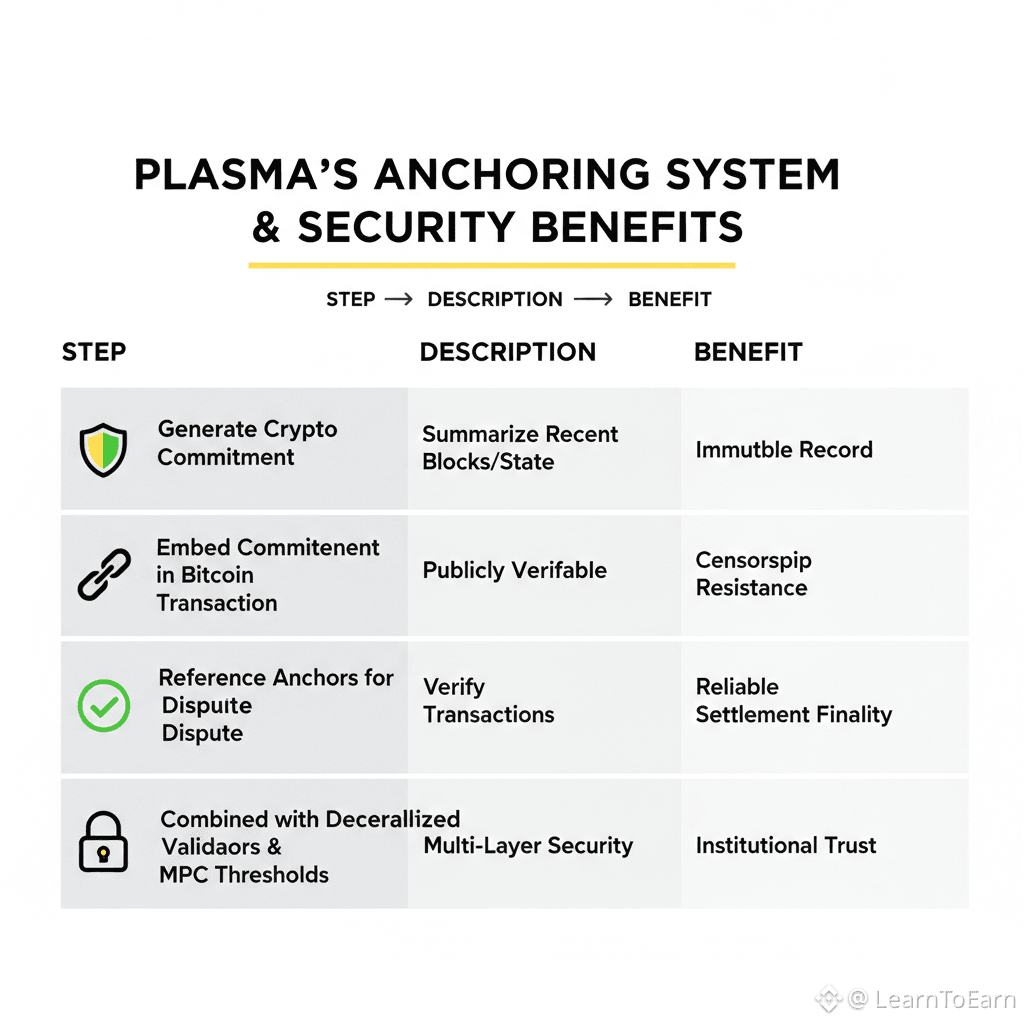
Beyond asset bridging, Plasma strengthens its long-term security through state anchoring. This process involves periodically committing cryptographic summaries of Plasma’s transactions and state to the Bitcoin blockchain.
How Anchoring Works:
Plasma generates a compact cryptographic commitment representing recent blocks or state changes.
The commitment is embedded in a Bitcoin transaction.
Once confirmed, this anchor becomes immutable and publicly verifiable.
Benefits:
Censorship Resistance: Anchors prevent malicious reorganization attempts on Plasma.
Dispute Resolution: Users can reference anchors to verify transactions or resolve conflicts.
Institutional Trust: Provides a Bitcoin-backed neutral settlement layer that appeals to regulated entities.
This approach balances Plasma’s high-speed operations with Bitcoin’s finality, offering robust security without compromising daily performance.
Advantages Over Traditional Bridges and Sidechains
Compared to Custodial Bridges: Eliminates single custodian risks.
Compared to Other Bitcoin Sidechains: Combines decentralized validators, MPC thresholds, and planned trust-minimizing upgrades.
Compared to Pure Proof-of-Stake Chains: Adds Bitcoin’s PoW as an external, verifiable security layer.
Roadmap and Future Enhancements
Following its mainnet launch, Plasma continues to decentralize its verifier network and explore advanced cryptography to further reduce trust assumptions. These improvements will expand BTC utility within stablecoin ecosystems while maintaining the highest security standards.
Plasma’s trust-minimized Bitcoin bridge and anchoring framework create a powerful fusion of Bitcoin’s legendary security with the speed and programmability required for modern stablecoin transactions. By enabling native BTC integration and providing immutable state commitments, Plasma delivers a censorship-resistant, scalable foundation for global finance.
As stablecoins continue to dominate on-chain activity, Plasma’s Bitcoin-secured design positions it to capture significant market share, offering developers, institutions, and users a reliable path toward the future of digital payments. This architecture not only enhances security but also unlocks new possibilities for BTC in DeFi and everyday transactions, establishing Plasma as a leading settlement layer for stablecoins worldwide.
Plasma: Pioneering a New Era for Stablecoin Payments Worldwide
As blockchain technology continues to evolve, stablecoins have emerged as a central component of the digital economy, powering trillions in transactions and bridging traditional finance with decentralized networks. In this landscape, Plasma distinguishes itself as a dedicated Layer 1 blockchain built exclusively for stablecoins, with a singular focus: making global stablecoin payments instant, affordable, and reliable.
Launched in 2025, Plasma brands itself as the “stablecoin-native L1,” intentionally designing its infrastructure around high-volume, low-cost stablecoin transactions rather than attempting to serve every blockchain use case. By prioritizing stablecoins like USDT (Tether), Plasma addresses one of cryptocurrency’s most practical applications: fast, predictable, and globally accessible digital money.
Plasma combines sub-second block times, zero-fee transfers for qualifying users, and support for over 1,000 transactions per second (TPS) with Bitcoin-sidechain security and full Ethereum Virtual Machine (EVM) compatibility. This hybrid approach blends Bitcoin’s Proof-of-Work (PoW) immutability with Ethereum’s programmable flexibility, enabling secure, scalable payments across 100+ countries, 100+ currencies, and 200+ payment methods. By early 2026, Plasma had already accumulated billions in stablecoin deposits, ranking as the fourth-largest network by USDT balance and establishing over 100 strategic partnerships.
Why Stablecoins Are Core to Plasma
Stablecoins are rapidly reshaping global finance. USDT, with a market capitalization exceeding $140 billion and commanding more than 60% of the market, generated billions in profits last year alone. They serve as the backbone for remittances, payroll systems, cross-border commerce, and hedges in volatile economies.
Plasma capitalizes on this momentum by providing a blockchain optimized for stablecoin transfers—prioritizing speed, low fees, and accessibility. Unlike general-purpose chains, where stablecoins are secondary assets, Plasma treats them as first-class participants in the network, ensuring payments are seamless, cost-efficient, and ready for real-world adoption.
Founding Vision and Key Supporters
Introduced in early 2025, Plasma quickly attracted attention from the crypto and finance communities. Backed by visionary investors and high-profile supporters—including leaders in stablecoin issuance, financial regulation, and tech entrepreneurship—Plasma gained credibility as a project capable of delivering scalable stablecoin infrastructure.
Investors highlighted Plasma’s potential to redefine stablecoin interactions at the base-layer level, enabling high TPS and minimal transaction costs while remaining secure and censorship-resistant. This positioning makes it particularly relevant in regions like the Middle East and North Africa (MENA), where stablecoins are increasingly adopted for everyday transactions and as a financial hedge.
Architectural Overview
Modular Design for Performance
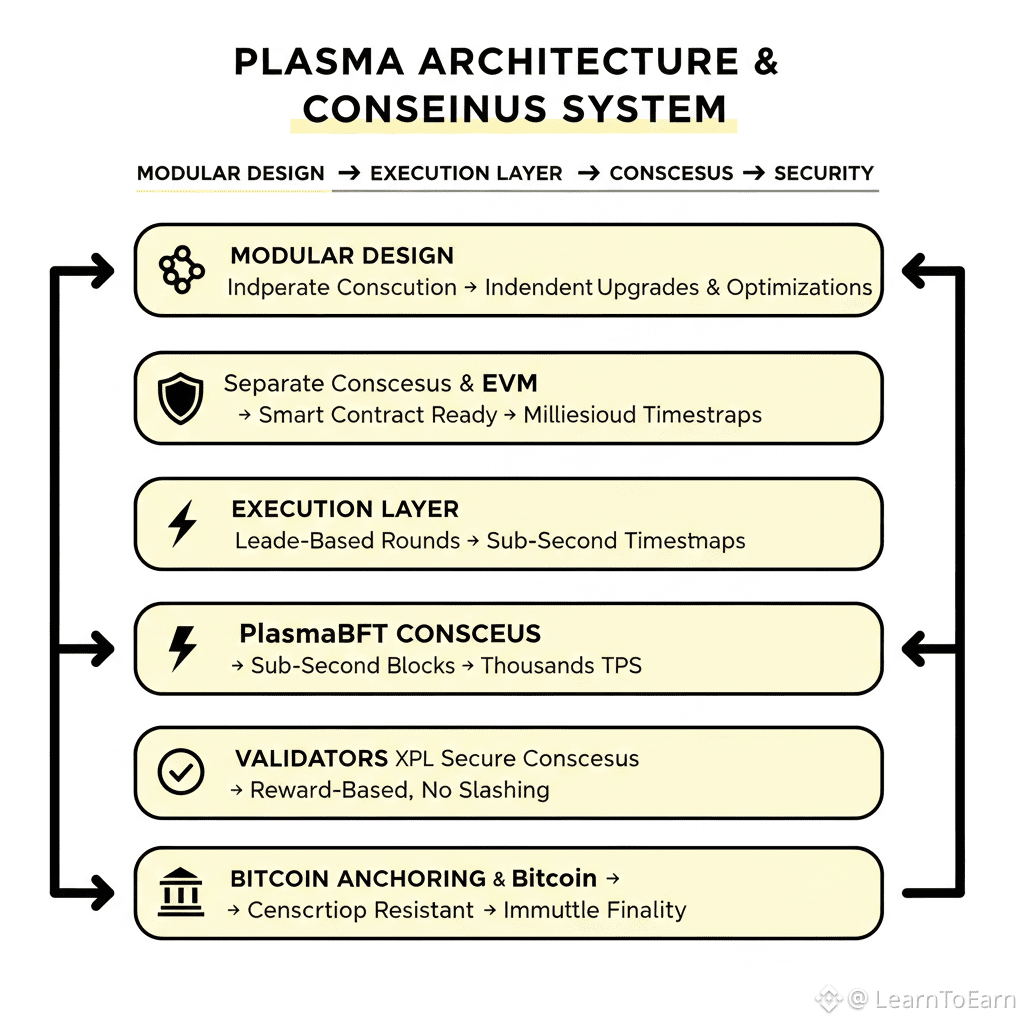
Plasma’s architecture separates consensus from execution, allowing independent upgrades and optimizations without compromising performance.
Execution Layer – High-Performance EVM Compatibility
Powered by a Rust-based Ethereum client, Plasma’s execution layer supports full EVM functionality, enabling developers to deploy smart contracts in Solidity or Vyper using familiar frameworks. Advanced features like millisecond-level timestamping improve transaction sequencing, critical for time-sensitive payments.
Nodes are structured for horizontal scaling: validators secure consensus through XPL token staking, while non-validator nodes manage read-only requests. This separation prevents high-traffic applications from impacting the network’s core operations.
Bitcoin Integration for Security
As a Bitcoin sidechain, Plasma anchors its state to Bitcoin’s PoW ledger, inheriting censorship resistance and settlement finality. A trust-minimized bridge facilitates cross-chain asset transfers through pBTC (Plasma-wrapped Bitcoin), with decentralized verifiers ensuring transparency. Withdrawals employ multi-party computation and threshold signatures, eliminating single points of failure and maintaining security integrity.
PlasmaBFT – Consensus for Scale and Speed
At the heart of Plasma is PlasmaBFT, a custom Byzantine Fault Tolerant protocol built on Fast HotStuff. Optimized for low latency and high throughput, PlasmaBFT supports sub-second block times and thousands of TPS.
By utilizing a leader-based round structure, quorums achieve consensus efficiently, with pipelining allowing simultaneous proposal, voting, and commitment to maximize throughput. During leader failures, aggregated Quorum Certificates (AggQCs) enable fast recovery and uninterrupted progress.
Validators are selected via stake-weighted randomness in a Proof-of-Stake framework, ensuring fairness while maintaining safety thresholds. Misbehavior results in reward forfeiture rather than punitive slashing, encouraging broad participation. The result is a scalable, user-friendly consensus mechanism suited for institutional adoption and high-frequency payments.
Stablecoin-Focused Features
Plasma’s unique design provides several advantages for stablecoin users:
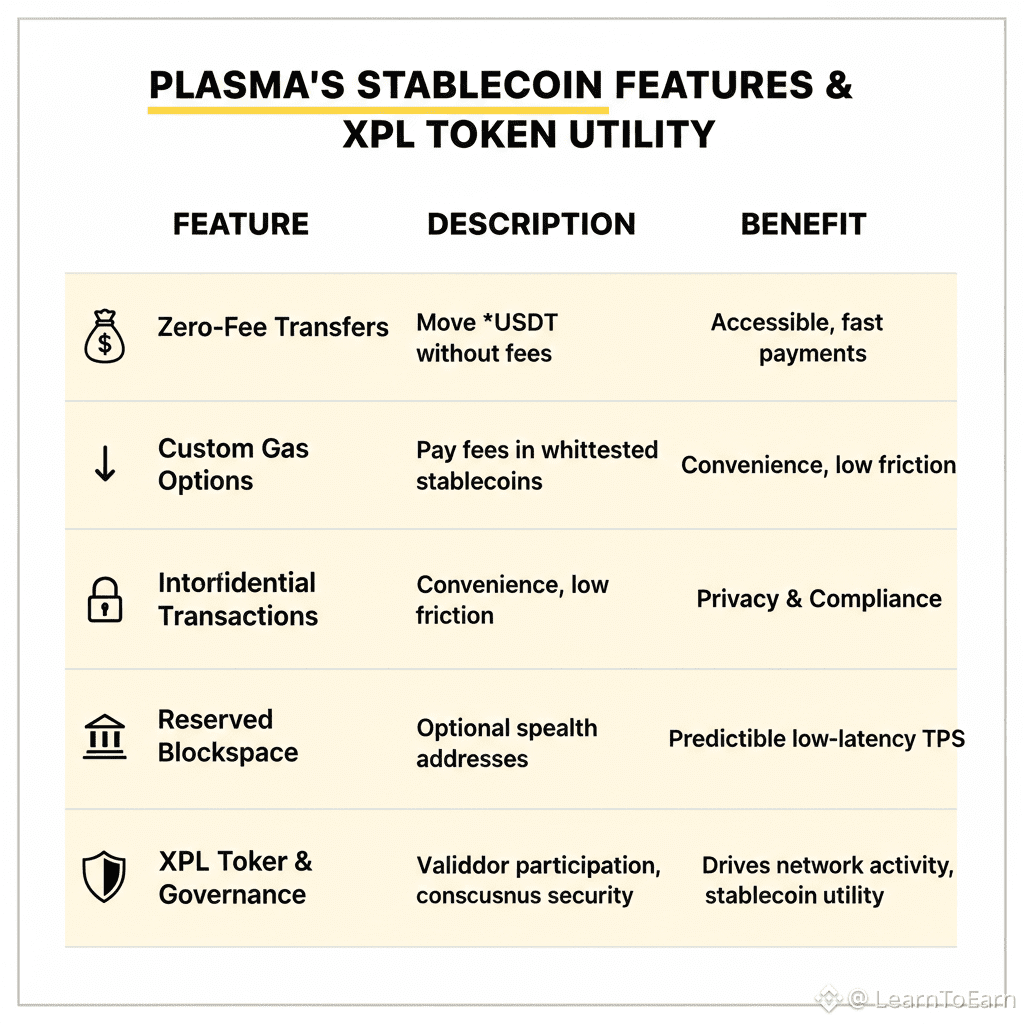
Zero-Fee Transfers: Selected users can move USDT without paying fees through a protocol-managed system with safeguards to prevent misuse.
Custom Gas Payment Options: Users can pay fees in whitelisted stablecoins, converted automatically via decentralized oracles.
Confidential Transactions: Optional stealth addresses provide privacy for payroll and sensitive transfers while maintaining verifiable compliance.
Reserved Blockspace: Future updates will prioritize sponsored stablecoin transfers to ensure consistent low-latency processing.
Supporting over 25 stablecoins and integrating with oracles, indexing solutions, and cross-chain interoperability protocols, Plasma ensures frictionless adoption for both retail and institutional users.
XPL Token – Powering the Network
The native XPL token secures Plasma’s PoS network while incentivizing participation:
Staking and Rewards: Validators stake XPL to earn network rewards, supporting consensus without imposing fees on stablecoin users.
Utility: XPL serves for gas, governance, and staking, while network activity from stablecoins indirectly drives demand and value.
Allocation: A portion was reserved for public sale, ecosystem growth, and team distribution, ensuring balanced incentives.
Performance and Security
Plasma delivers ultra-fast performance: block times under 1 second, thousands of TPS, and predictable micro-fees. Its BFT consensus tolerates up to one-third faulty nodes, complemented by Bitcoin anchoring for finality and security.
Roadmap for 2026
Following its mainnet beta in 2025, Plasma continues expanding validator participation, integrating more stablecoins, implementing confidential payments, and rolling out the pBTC bridge. These upgrades aim to enhance decentralization, global reach, and network programmability.
Plasma represents a transformative evolution in blockchain infrastructure, designed around the practical needs of stablecoins and global payments. By combining high-speed consensus, Bitcoin-backed security, and stablecoin-centric features, Plasma offers a specialized, scalable platform ready for mass adoption.
As the network matures in 2026, it is poised to redefine how stablecoins are used in everyday finance, bridging traditional and decentralized systems while enabling instant, low-cost, and globally accessible digital payments. Plasma is more than a blockchain; it is the foundation for the next generation of digital money.


