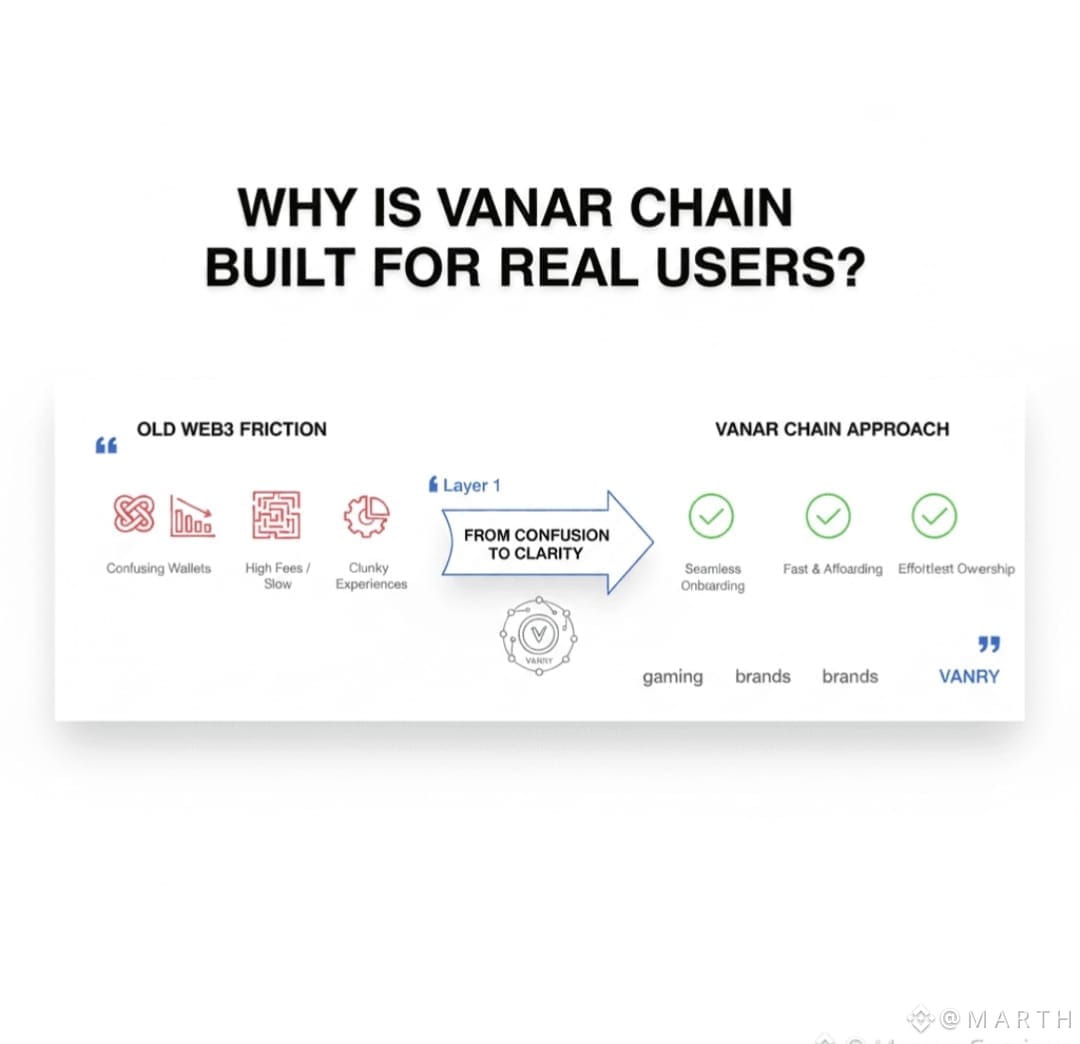
Vanar did not begin as a chain that wanted to impress crypto insiders and it did not grow from a desire to chase whatever the market was shouting about this week because the starting point was much more personal and much more practical and I’m talking about the feeling you get when you try to ship a real product for gamers and creators and big audiences and you realize that most blockchain infrastructure still behaves like a prototype that expects everyone to adapt to it instead of adapting to them so the early question was never how to build something that looks clever on paper and the real question was how to build something that feels normal when a user taps a button and expects an instant response and expects the cost to be stable and expects the experience to stay smooth even when thousands of people show up at once and that is where Vanar begins to make sense because it is built around the belief that adoption is not a slogan and adoption is a lived experience and the moment a user feels fear or confusion or regret the moment they see unpredictable fees or slow confirmations or complicated onboarding the moment they feel like they are being tested instead of welcomed that is the moment they leave and they do not come back easily and this is why the whole Vanar direction leans toward removing friction so the technology can fade into the background while the experience stays front and center
If you trace the way Vanar is presented you can feel a team that is anchored in gaming and entertainment and brand reality where the rules of success are unforgiving because players will not wait and audiences will not study manuals and brands will not tolerate chaos and that lived pressure shapes the chain choices because Vanar commits to EVM compatibility so builders can work with tools and contracts and mental models they already know while the chain itself is tuned for responsiveness and cost control that matter in consumer environments and the story here is not that EVM compatibility is fashionable and the story is that builders cannot afford to rebuild everything just to join a new ecosystem and the best way to invite developers is to meet them where they already stand and then improve what they struggle with most which is why Vanar is described as being built on the Go Ethereum codebase and then adjusted to fit a consumer adoption mission where speed and predictable cost are treated as product requirements rather than optional upgrades
The chain design is often explained through a few clear decisions that keep coming back because they are meant to protect the user experience under pressure and one of those decisions is the target of very fast block production with a maximum block time described around three seconds so interactions can feel immediate rather than delayed and when you connect that to the way games and live digital experiences work you see why it matters because latency is not an abstract number and latency is the moment the experience loses its magic and then there is the fee philosophy which is where the emotional side becomes obvious because Vanar emphasizes fixed fee behavior that aims to keep the cost a user feels stable even when token prices move and even when the market becomes noisy and the reason that matters is not because cheap fees look good on a website and the reason it matters is that surprise costs destroy trust and trust is the true currency of mainstream adoption and Vanar also presents a simple fairness principle in how transactions are ordered through a first come first served approach where the idea is that ordinary users should not feel like they are constantly being outbid or pushed aside during busy moments and even though any network can face congestion the feeling of fairness can decide whether people see the system as a public place or as a private club
When you arrive at consensus you meet the most honest tradeoff in the Vanar story because the network direction is described as Proof of Authority governed by Proof of Reputation and that choice is not hard to understand when you have built consumer platforms since operational stability is the first requirement for products that must work every day for large audiences but it is also a choice that carries weight because authority based validation concentrates responsibility and influence especially in early phases and Vanar describes a model where the foundation runs validators at the start while external validators are onboarded through a reputation driven process and community involvement and staking participation which creates a path that is meant to widen over time and this is where the long term credibility test lives because people will watch how that validator set evolves and they will watch whether the reputation rules are clear and fair and they will watch whether governance becomes more open in practice rather than only in narrative and this is not a criticism and it is simply the reality that any chain that prioritizes reliability early must then prove its commitment to wider participation later and that proof is earned through transparent decisions and consistent onboarding and real community power that grows steadily
VANRY sits at the center of this system as the network token that powers activity and participation and the deeper idea is that a chain can only become a living place when its token has jobs that connect to real usage rather than only to speculation so VANRY is described as the gas token that supports transactions and it is also tied to staking and network participation mechanics and governance pathways that link users to the future of the network and there is also an important identity chapter that shaped how many people first discovered Vanar because the ecosystem moved from the earlier TVK identity to VANRY through a one to one swap as part of a broader rebrand and evolution and that transition matters because it signals that the project wanted a token identity that matches the chain identity and that move also ties together an existing consumer ecosystem history with a new Layer one direction that aims to scale much further
The part that makes Vanar feel like more than infrastructure is that it keeps pulling the conversation back to products and mainstream verticals because the project message is not only about building a base layer and it is about building a bridge for ordinary users to cross without fear and that is why Virtua and its metaverse direction remains closely associated since it offers a real context where ownership can be used and where digital assets can do something beyond sitting in a wallet and where marketplaces and experiences can connect to the chain in a way that people actually feel and the same spirit shows up in the idea of a games network like VGN where onboarding is meant to feel familiar and where the dream is that a player can enter through a normal sign in flow and then gradually discover Web3 value without being forced to learn everything on the first day and this is the kind of design that respects the psychology of mainstream adoption because most people do not want a new lifestyle and they want a better experience and They’re far more likely to stay when the product feels welcoming and when the benefits arrive quietly through access and ownership and progression rather than through lectures about decentralization
We’re seeing the industry shift in a way that also explains why Vanar has begun to speak more loudly about AI native layers and semantic systems because the next wave of applications is moving from simple actions toward context aware experiences where software behaves more like an assistant than a tool and Vanar presents a broader stack vision that includes components described as semantic memory and on chain reasoning which in plain human terms is an attempt to store meaning not only data and to make that meaning usable by applications and agents in a verifiable way and this vision is ambitious and it raises expectations because it asks the network to do more than settle transfers and it asks the network to become a place where information and permission and policy can live with structure so systems can act with more intelligence and less fragile off chain glue and the reason it fits the Vanar mission is that consumer adoption is not only speed and cost and it is also confidence and clarity and users want systems that feel like they understand what is allowed and what is owned and what is verified without forcing the user to manage complexity
If you want to judge whether Vanar is truly moving toward real world adoption there are metrics that matter because they map directly to human experience and the first is responsiveness which means block time and practical finality and how often an interaction feels instant rather than delayed and the second is fee stability which means whether cost remains predictable across calm days and chaotic market days and the third is reliability which means uptime and consistency and how the network behaves under bursts from games and mints and events and the fourth is developer velocity which means whether builders can deploy and iterate without fighting unfamiliar tooling and the fifth is retention which is the hardest metric and the most honest one because retention is where hype fails and only real value survives and retention is the sign that users are returning because the experience matters to them
No story like this is complete without naming the risks clearly because a chain built for mainstream adoption has to protect trust and trust can be fragile and the most visible risk is that an authority leaning validator model can create centralization concerns until the participation path proves itself through real validator diversity and transparent governance behavior and another risk is that reputation based systems can drift into insiders choosing insiders If the criteria are not clear and measurable and consistently applied and another risk is that any ecosystem that touches interoperability and bridges must treat security as a discipline rather than a checkbox because cross chain movement has been a painful lesson across the industry and another risk is expectation risk because ambitious AI native narratives can disappoint if they do not become usable tools that developers actually adopt and that is why the healthiest future for Vanar depends on shipping and integration and practical developer support and not only on vision
Still when you step back the Vanar direction carries a kind of quiet optimism because it is not trying to win by making users feel like they must become experts and it is trying to win by making the technology disappear at the right moments so the user feels safe and the builder feels empowered and the brand feels comfortable and the experience feels alive and that is how mainstream adoption truly begins because it begins when people stop asking what chain they are using and they start caring about what they can do and what they can keep and what they can share and what becomes possible when ownership is not a promise and it is a feature you can actually feel and If Vanar continues to strengthen its reliability while widening participation in a way that the community can verify and If it keeps turning its ecosystem into places where people genuinely want to spend time and If it can translate its broader stack vision into tools that reduce friction instead of adding complexity then It becomes possible that the next wave of users will not enter Web3 with fear or confusion and they will enter with curiosity and comfort and that is the moment when Web3 stops being something you have to explain and it becomes something people simply use and that kind of future is not built by noise and it is built by consistency and care and the patient work of turning hard technology into an experience that finally feels like home