Dusk began in 2018 with a decision that feels more important the longer you watch the industry repeat the same mistakes, because most systems either expose too much or hide too much, and both outcomes eventually hurt real people, since total transparency can turn into permanent surveillance where balances, behaviors, relationships, and business strategies become public forever, while total secrecy can turn into a black box where trust depends on faith instead of evidence, so Dusk set out to build a layer one blockchain for regulated and privacy focused financial infrastructure where privacy is treated as a form of safety and compliance is treated as a form of stability, and I’m describing it this way because the mission is easiest to understand when you connect it to how finance actually feels, since money is not just math, it is reputation, family security, negotiations, and the quiet fear of being exposed at the wrong moment, and Dusk is trying to remove that fear without removing accountability by using cryptographic proof to replace forced disclosure, meaning the network aims to confirm that actions are valid and rule compliant without broadcasting sensitive details to everyone, which is the heart of the promise, because it offers a future where you can participate without becoming public data and where institutions can adopt open settlement rails without risking compliance collapse.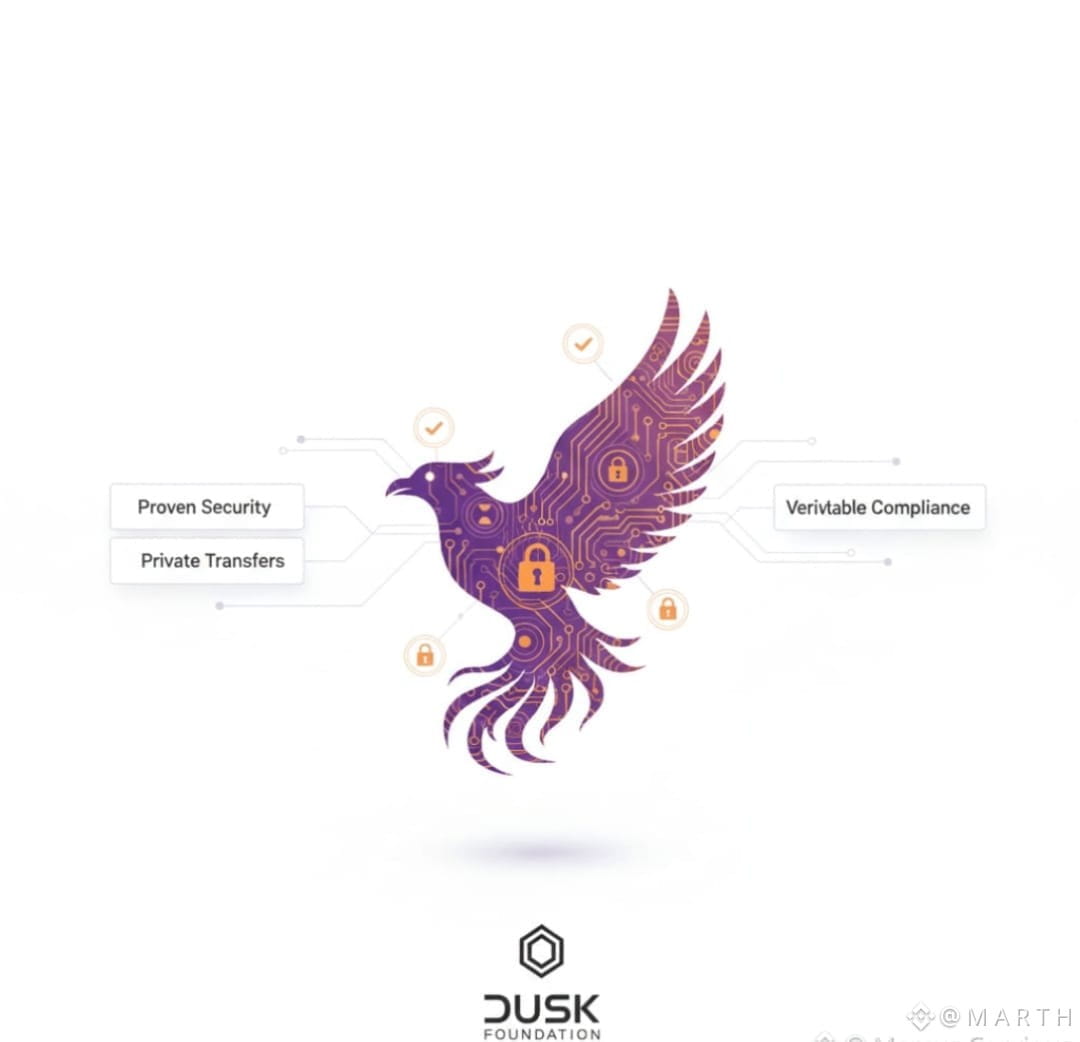
The way Dusk approaches this is practical rather than dramatic, because it recognizes that finance is not one single activity, so the chain supports different ways of moving value depending on what the situation demands, including a public experience when openness is appropriate and a privacy preserving experience when confidentiality is essential, while still settling those outcomes on the same base layer so the network does not split into disconnected worlds, and this matters because a serious financial ecosystem needs both modes in real life, since a simple transfer between two parties is not the same as a sensitive trade, an issuance event, a custody workflow, or a regulated settlement process, and Dusk tries to make privacy normal instead of exceptional by designing shielded transfers that can be verified without revealing the underlying details, which is where the project’s use of modern zero knowledge techniques becomes emotionally meaningful, because it is not just about hiding, it is about keeping people safe while still keeping the system honest.
Under the surface, Dusk is built with a modular architecture because regulated markets demand stability at the foundation while still needing room for innovation above it, so the base layer can focus on secure settlement and dependable guarantees while execution environments and application logic can evolve without constantly threatening the core, and this is why the project leans into modern smart contract execution choices that prioritize portability and disciplined behavior, because institutions do not adopt platforms that feel unpredictable, and builders do not stay on platforms that feel fragile, so Dusk is trying to create an environment where serious applications can be developed with confidence, including compliant DeFi primitives and tokenized real world assets that require privacy by design, not privacy as a marketing add on, and when you look at the project through that lens, you can see that the architecture choice is really a trust choice, because it signals a desire to behave like infrastructure that must work every day, not like a temporary experiment that only works when conditions are perfect.
The consensus and settlement design matters here more than most people realize, because if a blockchain claims it can support financial market infrastructure then finality cannot be vague, since settlement in regulated finance is not a casual event, it is the moment obligations become real, and Dusk places heavy emphasis on reaching reliable settlement outcomes through a staking secured network, because economic security and predictable finality are the foundations that make privacy meaningful at scale, since there is no point protecting transaction details if the underlying system cannot reliably confirm outcomes, and this is where the project’s deeper philosophy becomes clearer, because it is not trying to escape oversight, it is trying to make oversight possible without turning every user into a permanently exposed profile, which is a much more mature interpretation of compliance, because in the real world confidentiality is normal and audits are conditional, meaning information is protected most of the time and only revealed in structured ways when legitimate rules require verification, and Dusk is trying to encode that normal financial behavior into cryptographic rails so selective disclosure becomes a capability rather than a compromise.
When you ask what metrics matter for a network like this, the answer is not the loudest numbers, it is the quiet indicators of reliability, since finality consistency tells you whether settlement can be trusted, validator participation and network health tell you whether security is resilient, privacy proof performance tells you whether confidential activity can grow without becoming slow or expensive, fee stability tells you whether applications can offer predictable user experiences, and developer tooling and documentation quality tell you whether real teams can build and maintain products without constantly fighting the platform, and We’re seeing across the wider blockchain world that long term adoption is won by the networks that prioritize these fundamentals even when attention is chasing easier stories.
At the same time, Dusk carries real risks that cannot be ignored, because combining modular execution environments with privacy preserving cryptography and finance grade settlement guarantees increases complexity, and complexity is where subtle failures can hide, so security work must remain relentless, and institutional adoption can move slowly because regulated markets demand proof of operational maturity over time, not just compelling demos, and privacy systems can be misunderstood or mischaracterized by people who refuse nuance, which means the project must continuously demonstrate that privacy does not equal opacity and that auditability does not equal surveillance, and yet the future vision remains compelling because it is grounded in what the world is actually moving toward, since assets are becoming tokenized, settlement is becoming digital, compliance pressure is not disappearing, and people are becoming more aware of how much of their lives gets exposed through data trails, so a network that can protect confidentiality while still producing verifiable truth is not just nice to have, it becomes necessary.
If It becomes normal for tokenized real world assets, compliant DeFi products, and regulated payment flows to settle on a network where privacy is preserved by default while correctness can still be proven, then the next era of finance will feel less invasive and more humane, because users will not need to sacrifice dignity to access modern tools, institutions will not need to sacrifice compliance to gain efficiency, and regulators will not need to demand total public disclosure just to verify integrity, and that is why the Dusk story feels hopeful, because it points to a future where open infrastructure does not require open vulnerability, where truth can be measured without exposing every detail, and where the financial world can finally evolve without asking people to trade their safety for participation.