

When people talk about congestion on blockchains, they usually talk in abstractions. Blocks filling up. Fees rising. Throughput limits. It’s all very technical, and it all sounds solvable with better engineering. But congestion doesn’t feel technical when you’re on the wrong side of a payment that didn’t clear.
It feels personal.
What struck me while looking at Plasma is that it seems to understand this distinction unusually well. It doesn’t treat congestion as a surprise event or an optimization challenge. It treats it as a predictable condition of real economic behavior. And that single framing choice changes almost everything downstream.
Most networks experience congestion when attention spikes. A price moves. A narrative catches fire. Bots wake up. Traders pile in. The system gets loud, and the congestion feels earned. Users expect it. They’re there for opportunity, not certainty. If a transaction costs more or takes longer, that’s part of the game.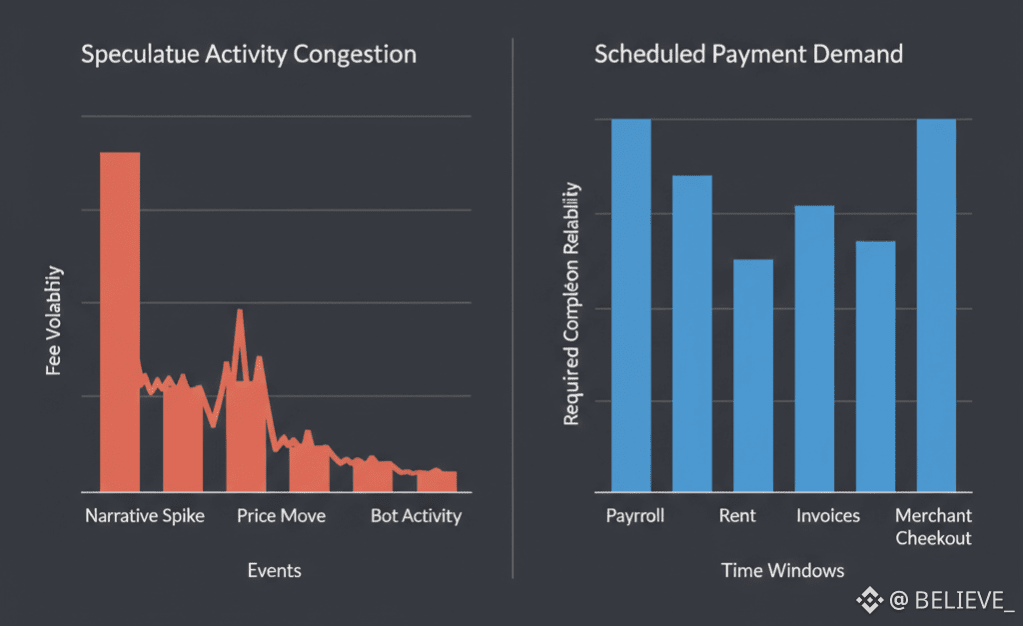
Payments are different. Payment spikes don’t come from excitement. They come from schedules.
Payroll doesn’t care about market sentiment. Merchants don’t wait for gas to calm down. Rent, invoices, remittances, supplier settlements — these flows arrive whether the network is ready or not. When congestion hits during these moments, users don’t rationalize it. They judge it.
Plasma feels like it was designed by starting with that judgment.
Instead of asking how to stretch capacity when demand surges, it asks a quieter question: what behavior do we want the system to preserve when demand concentrates? The answer is not “maximum inclusion” or “fee efficiency.” It’s continuity. The idea that a payment today should behave like a payment yesterday, even if ten times more people are doing the same thing at once.
That’s a subtle shift, but it’s not a cosmetic one.
On many chains, congestion introduces negotiation. Users negotiate with the system through fees, timing, retries, and workarounds. That negotiation is acceptable in speculative environments because users are already making tradeoffs. In payments, negotiation feels like failure. A payment that asks you to negotiate is no longer just money movement. It’s friction disguised as choice.
Plasma avoids pushing that negotiation onto users. It absorbs pressure internally, preserving a consistent surface experience. From the outside, nothing dramatic happens. And that’s the point.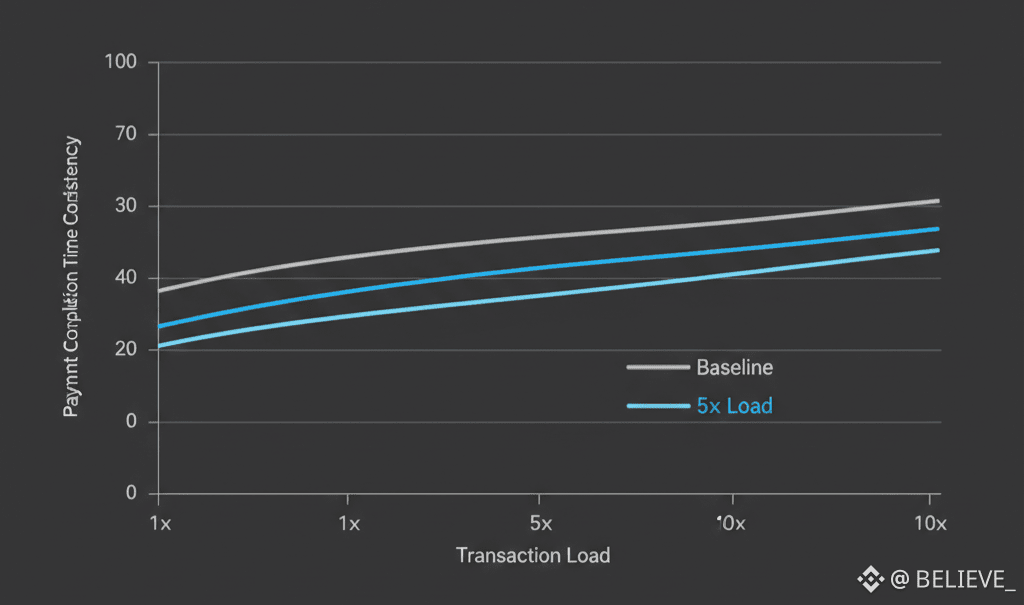
What’s interesting is how this reframes the idea of scaling. In most crypto conversations, scaling is about more — more transactions, more users, more throughput. Plasma seems to frame scaling as sameness. Can the system behave the same way at 10x load as it does at baseline? If not, then whatever growth it achieves is fragile.
This perspective also explains why Plasma doesn’t chase peak performance benchmarks. Peak moments are rarely the moments that matter for payments. The moments that matter are repetitive and unglamorous. The fiftieth transaction of the day. The thousandth merchant checkout. The end-of-day batch that needs to reconcile cleanly.
Congestion reveals whether a system respects those moments.
There’s also a trust dimension that often gets overlooked. Users don’t consciously track uptime charts or congestion metrics. They internalize patterns. If payments work most of the time but fail during predictable high-demand windows, trust erodes quickly. People don’t complain. They quietly adjust behavior — smaller amounts, fewer uses, eventual abandonment.
Plasma seems designed to prevent that slow erosion. By treating payment demand as the primary signal, it aligns system behavior with user expectation during exactly the moments when expectation is highest.
This has implications beyond retail users. Businesses, platforms, and institutions operate on schedules too. Settlement windows, reporting cycles, operational cutoffs. Congestion during those windows creates cascading work that never shows up on-chain. Manual reviews. Delayed releases. Internal escalation. All because the system couldn’t behave predictably when it was needed most.
A system that holds steady under load reduces that hidden cost. It doesn’t just move money. It preserves operational rhythm.
Of course, this approach has tradeoffs. Designing for predictable behavior under load means giving up some flexibility. You can’t easily repurpose block space for speculative bursts without risking payment continuity. You can’t let fee markets run wild without distorting user experience. Plasma appears to accept those constraints intentionally.
That choice won’t appeal to everyone. Traders chasing edge won’t care. Developers building for volatility won’t prioritize it. But payments don’t need excitement. They need reliability.
What I find compelling is how quietly Plasma makes this bet. There’s no dramatic narrative about defeating congestion. No grand claims about infinite scalability. Just an architecture that assumes pressure will arrive — regularly, predictably, and without apology.
If crypto payments are going to mature, congestion won’t be eliminated. It will be managed invisibly. Users won’t celebrate systems that survive pressure. They’ll simply keep using them.
That’s the signal Plasma seems to be optimizing for.
Not applause during quiet times, but silence during busy ones.
And in payments, silence is the highest compliment a system can earn.

