
I didn’t sit down to analyze Vanar.I ended up thinking about it because I stopped thinking while using it.
That’s usually when something stands out for me. Not when a system demands attention, but when it quietly stops asking for it. At first, I didn’t notice anything special. Things worked. Nothing broke. There was no moment where I thought, “Oh, this is different.”
But after a while, I realized I wasn’t doing the usual checks.
I was not waiting for a better time.
I was not watching fees.
I was not hesitating before clicking.
That’s rare in crypto, even for people who’ve been around for a while.
Most chains train you to stay alert. You learn to manage the environment as much as the application. Even when everything functions, there’s a low-level tension. You’re always aware that conditions can change under you.
Vanar felt steadier than I expected.
Not in a flashy way. More like the way a tool feels once you trust it enough to stop thinking about it. The system didn’t disappear, but it stopped interrupting me. That sounds small, but over time it changes how you behave.
I think that’s where Vanar’s design starts to make sense.
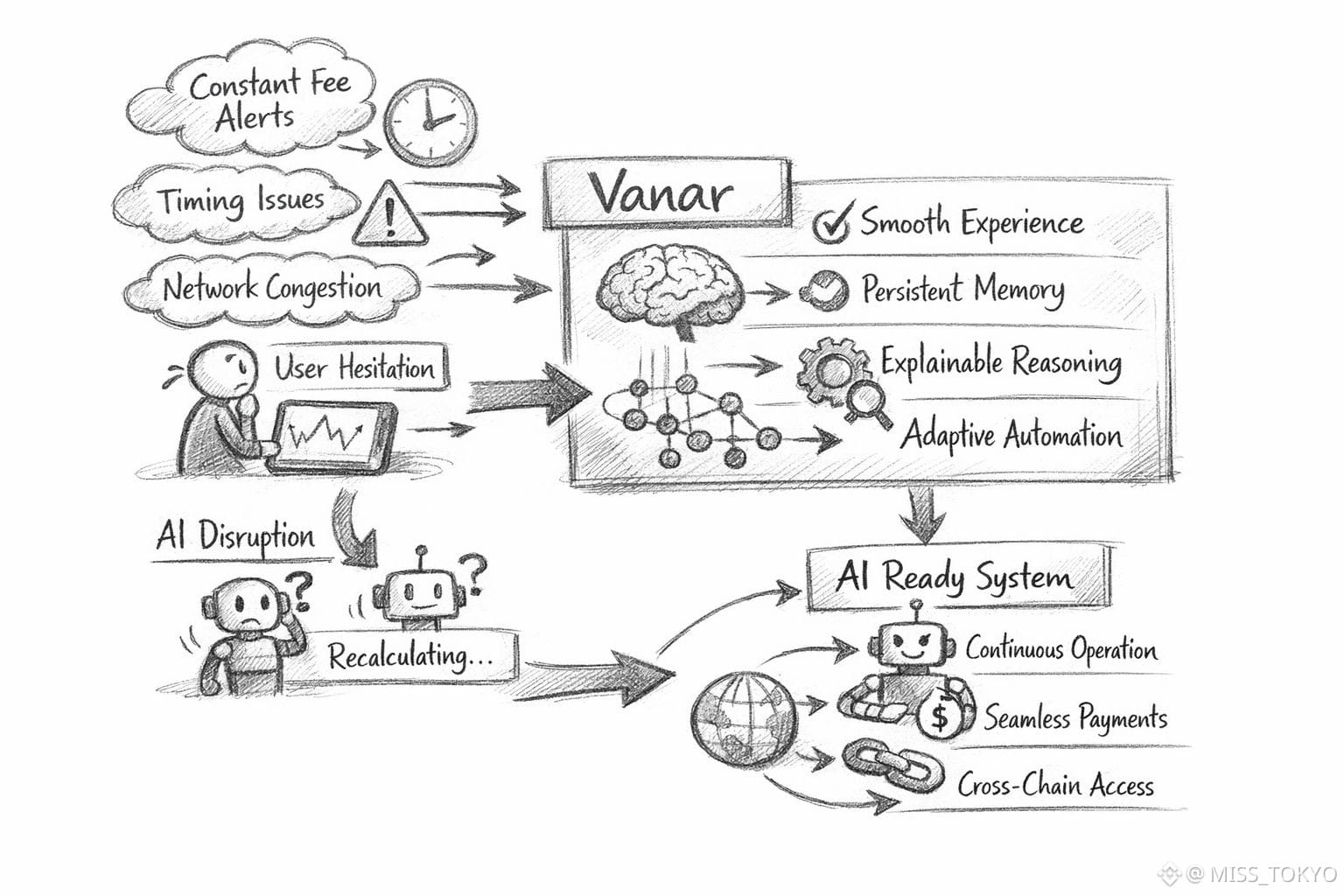
It doesn’t feel like it’s built only for people who show up occasionally. It feels like it assumes something will always be running. Something that doesn’t pause, doesn’t wait, and doesn’t time its actions carefully.
That’s a very different assumption.
AI systems don’t behave like humans. They don’t open apps to do one thing and leave. They keep going. They update context. They act again. Infrastructure that depends on pauses or pricing pressure to manage load works fine for humans. It doesn’t work nearly as well for systems that are meant to operate continuously.
Vanar feels like it was built with that in mind, even if it never says it outright.
You can see it in how memory is treated. On a lot of platforms, persistent context feels fragile. Applications rebuild state constantly. On Vanar, especially with something like myNeutron, memory feels more like an expectation than a workaround. It’s just there, and it stays there. That changes how intelligence behaves. Systems don’t reset as often. They carry context forward.
Reasoning follows the same pattern. I’m usually skeptical when projects talk about explainability, because it often exists only in presentations. Kayon doesn’t feel performative. Reasoning doesn’t announce itself. It’s available when you need to look closer, which is probably how it should be.
Automation is another place where restraint shows. Flows doesn’t feel like it’s trying to automate everything possible. It feels like someone asked where automation actually helps and where it quietly causes problems later. That kind of judgment usually comes from having things break in real environments.
The gaming background explains some of this. Games don’t tolerate friction. If something interrupts flow, users leave immediately. Infrastructure that works in environments like Virtua Metaverse or the VGN games network learns quickly how to stay out of the way. AI systems behave more like games than financial apps anyway. They’re always running. They react in real time. Weak assumptions don’t stay hidden for long.
Payments are where I usually expect the story to fall apart. AI agents don’t use wallets. They don’t approve prompts. If settlement needs attention, autonomy breaks. From what I’ve seen, $VANRY isn’t treated like an add-on. It feels like part of the system’s normal behavior. That matters more than token mechanics ever will.
The move toward cross-chain availability fits into this too. AI doesn’t care where it runs. It cares whether it can run smoothly. Making Vanar’s technology available beyond a single environment, starting with Base, feels less like expansion and more like accepting how systems actually behave.
I don’t think Vanar is finished. I don’t think any infrastructure ever is.
But I do think it’s built with a different level of patience.
It doesn’t try to impress you right away. It waits to be trusted.
And in infrastructure, trust usually comes from the absence of surprises, not the presence of features.
That’s what stayed with me after using it.
Not Promises.
Not Excitment.
Just the feeling that the system didn’t need me to watch it all the time.
That’s not something you notice instantly.
But once you do, it’s hard to unsee.
