
The Build was already live when the decision got made. No banner. No "maintenance window." Live as in thousands of sessions mid-flow. Players moving. Avatars idling. A shared space already rendered for people who never saw the deploy coming. Background state ticking forward without any natural pause to hide behind. On Vanar Chain, that's the default condition, not the edge case.
Someone asked whether we should wait for traffic to thin out. Nobody could answer when that would be, and the Slack thread just sat there for a minute longer than it should've.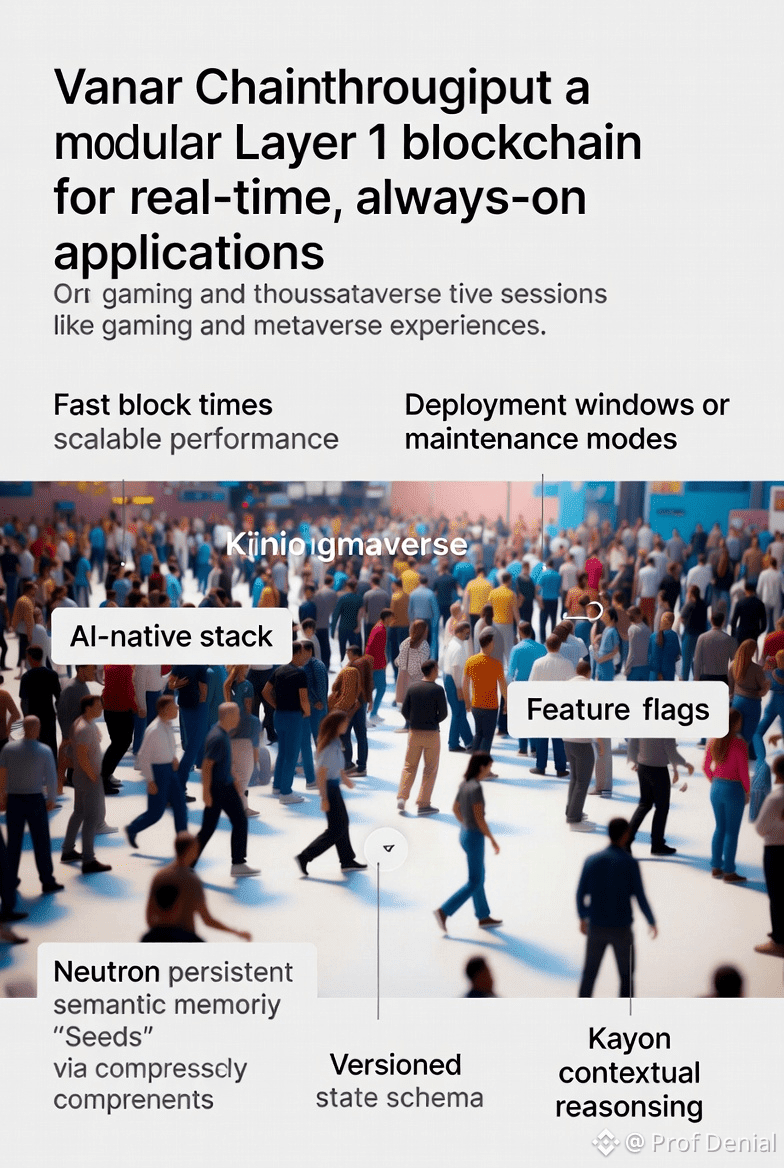
Vanar's sessions don't politely end so you can ship. They persist, overlap, and carry little truths that were valid ten minutes ago and might not be valid after the next push. Not abstract "state assumptions." A quest flag that meant "complete." An inventory slot that used to accept an item. A progression step that used to be counted the old way. Waiting stops being neutral once "later" stops existing.
On Vanar Chain, conflicts appear when states intersect.
On older stacks, deployment windows were real things. Off-peak hours. Maintenance modes. A quiet stretch where nothing important was happening. Consumer chains like Vanar erase that comfort. Entertainment workloads don't respect calendars. They run when users are bored, curious, halfway through something they don't want interrupted... sometimes inside a metaverse event where everyone is watching the same moment. So releases move forward into traffic instead of around it, and that sentence sounds calm until you have to do it.
The risk isn't "bugs." It's ordering.
One session resolves a loop under the old logic while another resolves under the new one. Both look fine in isolation. The conflict shows up later when the two worlds finally touch... inventory counts feel off, progressions skip, somebody swears they already did that step because, in their session, they did. The code path that decides whether progress counts changed while the player never stopped moving.
On Vanar, fast state refresh makes this survivable, but it doesn't give you time to think. The chain keeps committing and closing loops while you're mid-migration. Every deployment becomes a bet on what must stay compatible and what can break quietly without users noticing because if users notice, you don't get a second explanation. You get screenshots.
Entertainment workloads don't respect calendars.
That forces discipline upstream. Feature flags stop being optional. Versioned state stops being theoretical. You design changes that can coexist with their past selves for a while, even if you hate it, because sessions don't end when you want them to. They end when users are done. Or when they rage quit. Same thing, different wording.
There's a specific tension for Vanar. Ship now, and you're deploying into a crowd already mid-gesture. Wait, and the crowd just gets bigger. The system never empties enough to feel safe again. "After traffic" turns into a phrase people say out of habit, like it's still 2019.
Post-deploy, you don't get clean crash reports. You get questions. "Is this supposed to work this way now?" "Did something change?" Nobody can point to the moment it broke, because nothing did. The transition just happened while everything kept moving.
Vanar doesn't give you a clean line between before and after. It gives you overlap in live sessions, with versioned state and old assumptions still in the room.
The deploy lands somewhere in the middle.
Why does this happen on Vanar Chain specifically? Because it's engineered as a high-throughput, modular Layer 1 optimized for real-time, always-on applications especially gaming, entertainment, and metaverse experiences. Vanar Chain delivers fast block times and scalable performance that keeps state updating continuously, with no built-in "pause" for the chain itself. Its AI-native stack (Neutron for persistent semantic memory via compressed "Seeds" and Kayon for contextual reasoning) supports long-lived, adaptive sessions where user progress, inventory, and interactions persist on-chain without resets. This is perfect for immersive gaming or metaverse events, but it means deployments land into living, breathing worlds where thousands of concurrent sessions overlap in real time.
Vanar addresses Web3 gaming challenges by making blockchain "invisible" to users low-friction, high-speed execution so the focus stays on play, not infrastructure. But that same always-live nature forces developers to adopt strict practices: heavy use of feature flags for gradual rollouts, versioned state schemas to handle backward compatibility, and careful migration logic that coexists with legacy assumptions during overlap periods. These aren't optional luxuries they're survival requirements when sessions persist indefinitely.
In 2026, with Vanar's gaming ecosystem expanding (strategic partnerships like Nitro Dome for cutting-edge integrations, and focus on immersive digital environments), this deployment reality becomes even more pronounced. Entertainment doesn't wait for off-peak; it thrives on constant engagement. Vanar Chain embraces that chaos as its strength, pushing builders toward more robust, user-respecting designs.
Shipping into sessions that don't end isn't a bug it's the feature that makes Vanar feel alive. But it demands discipline, foresight, and a tolerance for controlled overlap. The chain keeps moving, and so must you.
