

I did not enter the field of blockchain due to my fondness of technology. I came because I had to have a different option. In my region, cross-border money transfer was cumbersome, costly and was surrounded by paperwork, which never appeared to have a conclusion. My initial encounters with crypto were exasperating, friends discussed crypto as freedom. Transactions failed. The fee was altered without any prior notice. Wallets felt intimidating. I could do without slogans, I wanted simplicity. That is why my initial actual experience with Plasma is so vivid, not due to the fact that I comprehended it, but because it was the first time when blockchain did not represent a threat, but rather a tool.
My application did not have Plasma in any advertisement. No banners describing the layer-two architecture or security models were used. I just happened to see that things worked. I mailed some money and it came near immediately. I had another, yet smaller, which I sent, to see what would become of it. Nothing went wrong. No painful fees. No anxious waiting. It was normal and that was non-normal. Plasma was so quietly doing its job that I had forgotten that something new was going on, until I remembered how it had been such a chore.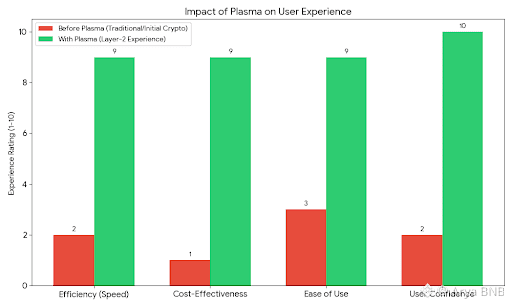
Speed, in itself, was not the most important to me but confidence. The application was overly straightforward and told me in simple terms that in case anything ever felt off, I could transfer my money back to the primary chain. I was not conscious of the mechanics, but I knew what it meant: I was not tied down. That was the only concept and it was a transformer. Plasma brought out an element of security that I did not have previously in a digital world where errors may be everlasting. It did not rebuke my discretion, but rewarded it.
Eventually, I started frequenting the platform more frequently. I paid for services. I tipped creators. I experimented without fear. Friction which previously caused my hesitation had gone. Plasma did not request me to put my faith in it; it gained my trust one deal at a time. The same happened to friends that I introduced to the app. They did not inquire about throughput and validators. They asked why it felt so easy. This time blockchain was made to seem as though it was made to people like us and not only to the experts.
I also had times when I noticed how different this experience was compared to my previous experiences with crypto. Prior to Plasma, each move was as an act of pressure. Was now the right time? Would fees spike? Would something fail? Those were questions that became insignificant with Plasma. The complexity was absorbed by the system and thus the users did not need to. That change can be described as subtle yet behavioral. When individuals feel secure they attend. They participate to enlarge the ecosystems.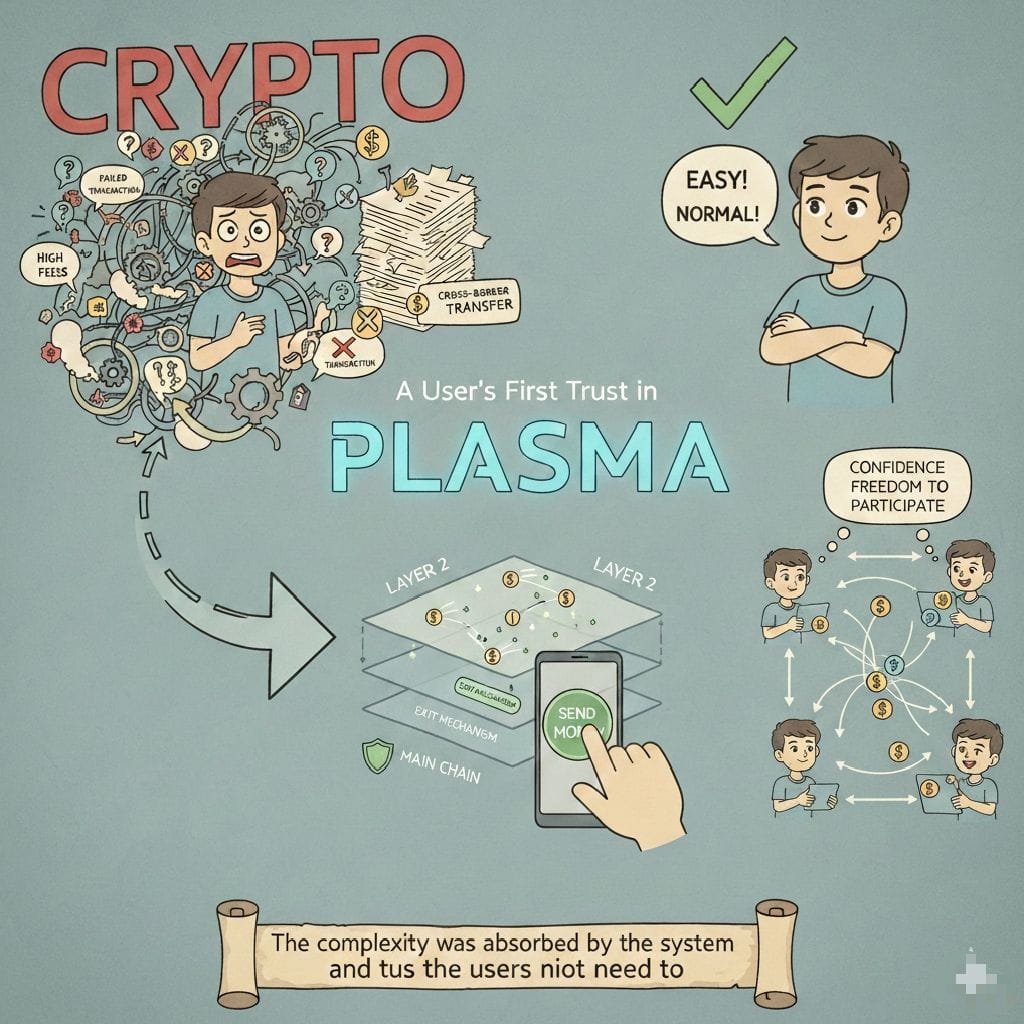
I later on understood that Plasma was created based on such moments moments that users require assurance over more than creativity. It was its exit mechanisms, its stratified form, its deference to the main chain, which were not abstract ideas. They were directly translated into the way I was feeling when using the app: calm rather than anxious, confident rather than doubtful. Such a relationship between architecture and emotion is something that not many technologies can provide.
The argument about scaling solutions brings a smile on my face today. In the eyes of the user, the most desirable technology is usually transparent. Plasma did not change my life at once, yet my attitude to blockchain changed. It substituted indecisiveness with custom and trepidation with familiarity. And by doing so, it was to demonstrate something significant: it does not have to be educational or persuasive to start off the mass adoption. It starts when individuals are confident enough to hit the send button without pressing their breaths.

