

Every blockchain makes a promise. The real question is how it keeps that promise when thousands of participants don’t know or trust each other.
Vanar Chain approaches this challenge with a consensus mechanism designed for performance, reliability, and real-world usability. Instead of reinventing blockchain from scratch, Vanar Chain focuses on refining how agreement is reached across the network, ensuring transactions remain fast, secure, and scalable—without compromising decentralization.
Understanding Consensus in Simple Terms
A blockchain consensus mechanism is the system that allows all participants in a network to agree on one version of the truth. It decides which transactions are valid, who gets to add new blocks, and how the network protects itself from fraud or manipulation.
In traditional systems, trust comes from central authorities. In blockchain systems like Vanar Chain, trust is enforced by code, incentives, and distributed participation. The consensus mechanism is the backbone that holds this entire structure together.
Vanar Chain’s Core Consensus Approach
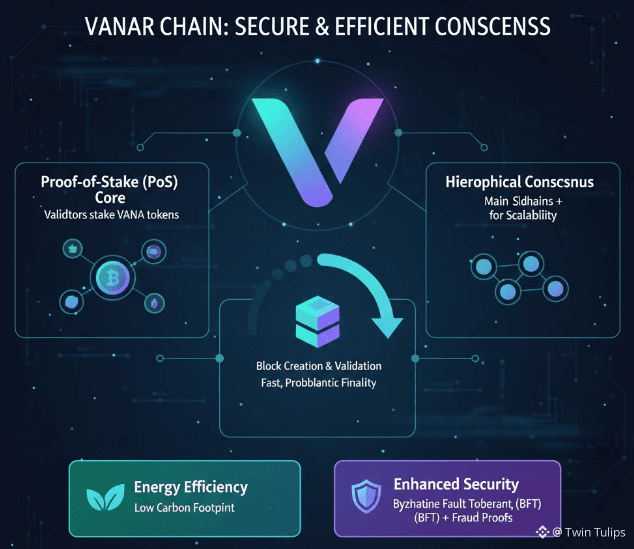
Vanar Chain uses a Proof-of-Stake–based consensus model, optimized for high throughput and low latency. Instead of relying on energy-intensive mining, the network is secured by validators who stake tokens to participate in block production and validation.
This model aligns economic incentives with network health. Validators are financially motivated to act honestly, as malicious behavior risks penalties or loss of staked assets. At the same time, the system avoids the inefficiencies associated with Proof-of-Work, making it more sustainable and scalable.
Validator Selection and Block Production
In Vanar Chain, validators are selected based on staking participation and network rules rather than computational power. This selection process ensures that block producers are economically invested in the network’s long-term success.
Blocks are produced in a predictable and fast cadence, which reduces transaction confirmation times. For users and developers, this means transactions feel responsive and applications can operate smoothly—even under high network activity.
The emphasis here is not just speed, but consistency. Stable block times are critical for decentralized applications, gaming environments, and payment systems built on top of Vanar Chain.
Finality and Network Reliability
One of the key strengths of Vanar Chain’s consensus mechanism is fast finality. Finality means that once a transaction is confirmed, it cannot be reversed or reorganized.
Fast finality improves user confidence. When a user sends assets or interacts with a smart contract, they don’t have to wait through multiple confirmations wondering if the transaction might fail. This is especially important for financial applications, NFT transfers, and real-time use cases.
From a technical standpoint, finality reduces complexity for developers, allowing them to design applications without building elaborate safeguards against chain reorganizations.
Security Through Economic Incentives
Security on Vanar Chain is enforced through staking economics. Validators must lock tokens to participate, and this stake acts as collateral. Honest participation is rewarded, while dishonest or negligent behavior results in penalties.
This model discourages attacks because the cost of compromising the network becomes economically irrational. Rather than burning electricity, attackers would have to acquire and risk a significant portion of the network’s value.
For users, this security model is largely invisible—but essential. It ensures that assets, data, and smart contracts remain protected without relying on centralized oversight.
Scalability Without Sacrificing Decentralization
Many blockchains struggle with a core trade-off: increasing speed often means reducing decentralization. Vanar Chain’s consensus mechanism is designed to balance this tension.
By optimizing validator coordination and reducing unnecessary network overhead, Vanar Chain supports high transaction throughput while keeping validator participation open and distributed. This allows the network to scale without concentrating power in the hands of a few entities.
Scalability here is not just about raw numbers—it’s about maintaining performance as the ecosystem grows.
Energy Efficiency and Sustainability
Because Vanar Chain’s consensus does not depend on mining, it operates with significantly lower energy consumption. This makes the network more environmentally sustainable and economically efficient.
Lower operational costs also reduce barriers to entry for validators, encouraging broader participation. Over time, this strengthens decentralization and network resilience.
Sustainability is no longer a secondary concern in blockchain development—it’s a requirement for long-term viability.
Impact on Developers and Applications
For developers, Vanar Chain’s consensus mechanism translates into predictable performance and reliable execution. Smart contracts can be deployed with confidence, knowing that transaction ordering, finality, and fees remain stable.
This is especially valuable for applications in gaming, entertainment, digital assets, and decentralized finance—areas where Vanar Chain places strong emphasis. A dependable consensus layer allows builders to focus on user experience rather than infrastructure limitations.
Why Consensus Matters More Than Ever
As blockchain adoption expands, consensus mechanisms are no longer just technical choices—they are economic and social frameworks. They determine who participates, who earns rewards, and how trust is distributed across the network.
Vanar Chain’s consensus mechanism reflects a shift toward practicality. It prioritizes speed, security, and efficiency while preserving the core principles that make blockchain technology valuable in the first place.
Final Thoughts
Vanar Chain’s blockchain consensus mechanism is built around a simple idea: decentralization should work at scale. By leveraging a Proof-of-Stake–based model with fast finality, strong economic incentives, and efficient validator coordination, the network creates a foundation that supports real-world use cases.
Consensus may operate behind the scenes, but its impact is felt in every transaction, every application, and every interaction on the chain. Vanar Chain’s approach shows that thoughtful design at this layer can make the difference between a network that merely exists—and one that thrives.
How important is fast finality and low latency to you when choosing a blockchain to build on or invest in? Let’s discuss.@Vanarchain #vanar $VANRY
