

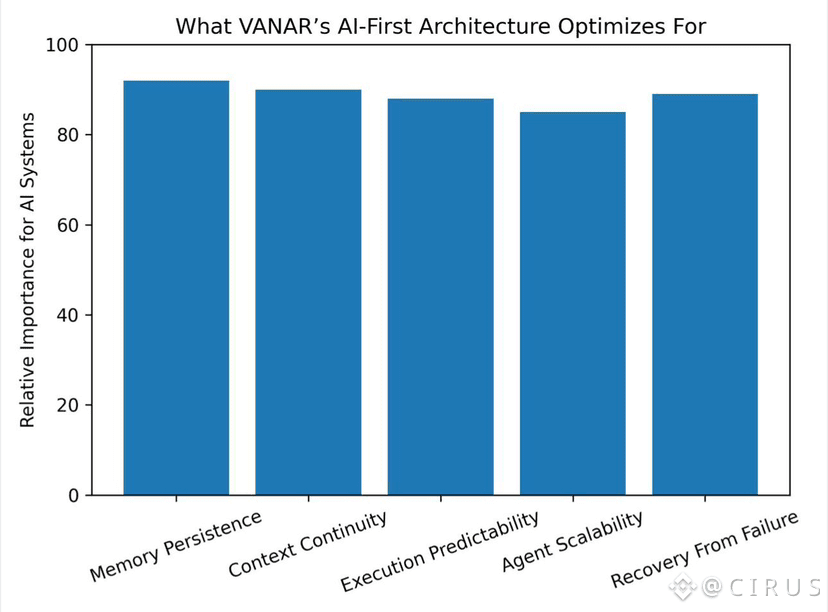
When people hear the phrase “AI-first architecture,” the assumption is usually speed. Faster inference. Faster execution. More automation. In blockchain, this idea often gets reduced even further into surface-level claims about throughput or compute capacity. But AI systems do not fail because they are slow. They fail because they are brittle. They break when context disappears, when state resets, when execution becomes detached from memory, and when systems cannot reason consistently over time.
This is the lens through which VANAR’s AI-first design makes sense. It is not optimized for raw intelligence. It is optimized for continuity.
AI does not behave like traditional software. Traditional software executes instructions and ends. AI systems operate across sessions, decisions, and environments. They rely on accumulated context, evolving state, and predictable execution conditions. If those foundations are unstable, no amount of model sophistication can compensate. VANAR’s architecture reflects a clear understanding of this reality. It does not treat AI as a feature layered on top of a blockchain. It treats AI as a workload that reshapes what infrastructure must prioritize.
The first thing an AI-first system optimizes for is memory that actually persists. Not storage in the abstract, but usable memory. AI agents need to remember past actions, preferences, failures, and outcomes. Without this, every interaction becomes a reset. VANAR’s design acknowledges that persistent memory is not optional for autonomous systems. It is the difference between intelligence and repetition. When memory is stable, agents can refine behavior instead of starting over. When memory is unreliable, intelligence collapses into pattern matching without learning.
Closely tied to memory is context. AI decisions only make sense relative to their environment. Context includes user intent, historical state, permissions, and surrounding system conditions. VANAR’s architecture is built to preserve context across execution layers instead of fragmenting it. This matters because most blockchains treat transactions as isolated events. AI systems cannot operate effectively under that model. They need continuity. VANAR shifts the system toward long-lived state awareness, where actions are part of an ongoing process rather than disconnected calls.
Another critical optimization is predictability. AI agents behave poorly in environments with unstable execution rules. Variable fees, inconsistent ordering, or unpredictable finality introduce noise into decision-making. VANAR’s emphasis on stable performance and deterministic execution reduces this noise. Predictability allows AI systems to plan. Planning is what separates reactive automation from meaningful autonomy. An AI that cannot anticipate outcomes cannot take responsibility for actions. VANAR’s architecture creates conditions where planning becomes viable.
AI-first design also changes how throughput is interpreted. High throughput matters, but not in isolation. AI workloads often involve frequent, small interactions rather than large, singular transactions. VANAR optimizes for sustained throughput under consistent conditions rather than peak performance spikes. This ensures that agents operating continuously do not degrade system reliability over time. Stability at scale matters more than headline metrics for AI systems that never stop running.
Equally important is how VANAR handles execution boundaries. Many AI systems interact across multiple tools, chains, and environments. If execution boundaries are rigid or opaque, agents lose coherence. VANAR positions itself as connective infrastructure rather than a closed destination. Its architecture supports agents that operate across ecosystems while maintaining a consistent internal state. This allows intelligence to travel without fragmentation. Instead of rebuilding logic at every boundary, agents can carry intent forward.
Developer experience is another area where AI-first optimization becomes visible. Building AI-driven applications already involves significant cognitive load. When infrastructure adds unnecessary complexity, innovation slows. VANAR reduces this burden by aligning its primitives with how AI systems are actually designed. Memory, agents, state, and reasoning are not abstractions imposed by the chain. They are reflections of how developers already think when building intelligent systems. This alignment reduces translation overhead and accelerates iteration.
Security also takes on a different meaning in an AI-first environment. Traditional security models focus on preventing unauthorized actions. AI systems require an additional layer: behavioral integrity. Systems must ensure that agents act within defined constraints over time, not just per transaction. VANAR’s architecture supports this by maintaining verifiable state continuity. Actions can be audited, behavior can be traced, and decisions can be contextualized. This is essential for AI systems that interact with real value, governance processes, or sensitive workflows.
One of the most overlooked optimizations in AI-first design is failure handling. AI systems will fail. Models will misinterpret inputs. Agents will make suboptimal decisions. The question is whether the system can recover without collapsing. VANAR’s focus on continuity and state persistence allows failure to become part of learning rather than a terminal event. Systems that can recover gracefully are the ones that scale responsibly.
What VANAR does not optimize for is spectacle. It does not treat AI as a marketing layer. It does not frame intelligence as something that magically emerges from compute alone. Instead, it builds the quiet foundations that allow intelligence to behave consistently over time. This restraint is intentional. AI infrastructure that draws attention to itself is often compensating for instability underneath.
From a broader perspective, VANAR’s AI-first approach reflects a shift in how value is created. The next generation of applications will not be defined by interfaces alone. They will be defined by autonomous systems that manage workflows, assets, identities, and decisions continuously. These systems require infrastructure that understands responsibility, not just execution. VANAR’s architecture is shaped around that responsibility.
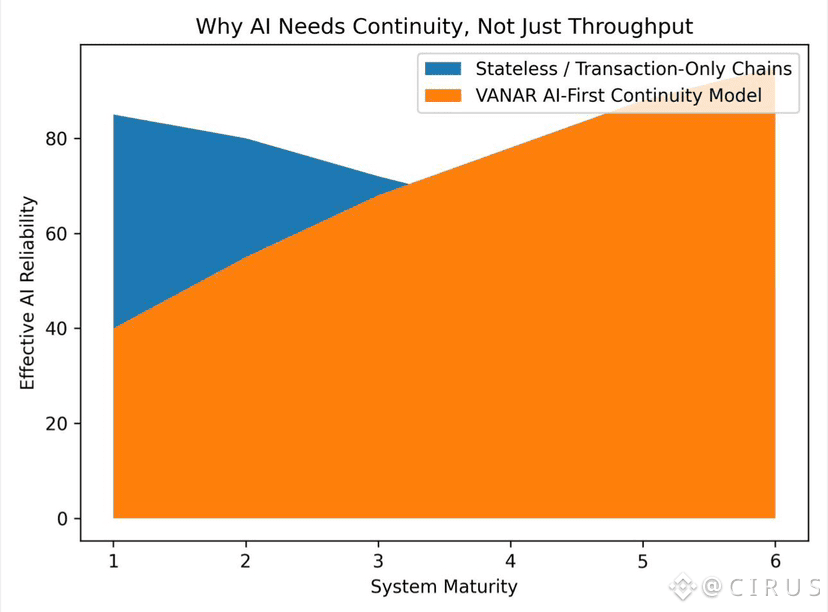
My take is that VANAR’s strength lies in what it chooses not to optimize. It does not chase novelty metrics. It does not overexpose complexity. It does not assume intelligence can be bolted on later. Instead, it treats AI as a first-class citizen whose needs redefine the system from the ground up. If AI is going to move from tools to infrastructure, it will need environments like this. Quiet. Stable. Memory-aware. And built for continuity rather than moments.
That is what an AI-first architecture actually optimizes for.
