

Most financial platforms want your attention all the time.
Notifications, alerts, dashboards, updates — even when nothing really needs action. At first, it feels helpful. Later, it becomes exhausting.
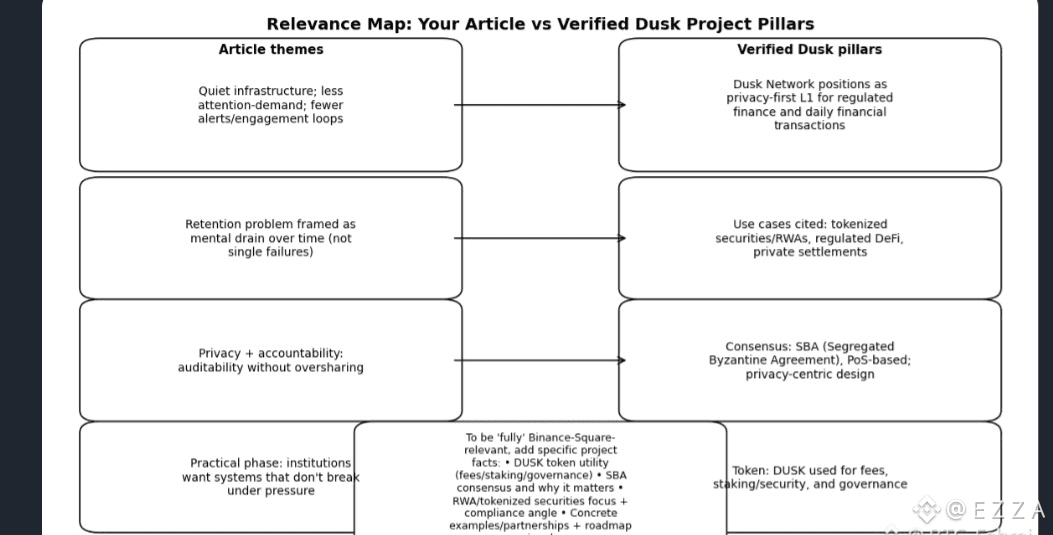
Dusk takes a very different approach.
It’s not loud.
It’s not trying to impress you every minute.
And that’s exactly the point.
Dusk is built to run quietly in the background, doing its job without asking you to constantly watch it. If everything is working properly, you almost forget it’s there. In modern finance, that’s not a weakness — it’s a strength.
The Real Problem Isn’t Volatility — It’s Noise
Anyone who has spent time in markets knows this feeling.
You don’t quit because of one bad trade.
You don’t quit because prices move fast.
You quit because your attention gets drained.
There’s always another update. Another urgent moment. Another reason to react instead of think. Over time, tools that were supposed to help start pulling you into constant decision-making mode. That’s where mistakes grow.
Dusk feels like it was designed by people who understand that mental fatigue is a real cost.
Built for Use, Not Addiction
Most platforms are designed to keep users engaged.
Not focused — engaged.
Dusk doesn’t play that game.
Transactions settle when they should.
Rules are enforced quietly.
Privacy is handled without turning it into a show.
You’re not rewarded for checking it again and again. There’s no pressure to “stay active.” It assumes you have better things to do — and respects that.
This Isn’t About Promising Bigger Profits
Dusk isn’t trying to sell dreams of higher returns or perfect trades.
Its value is simpler and more realistic.
It reduces friction.
Right now, that matters more than excitement.
Markets are tighter. Capital is careful. Regulations are stricter. Institutions are no longer chasing flashy demos — they want systems that hold up in real conditions.
That’s where Dusk fits naturally.
Calm Is an Underrated Feature
There’s something interesting that happens when systems go quiet.
At first, people feel uncomfortable.
No constant feedback. No visual reassurance. Just reports when needed.
Then, over time, the checking stops.
Not because they stopped caring — but because there was nothing to worry about.
That calm changes how decisions are made.
Less reacting.
More planning.
Longer timeframes.
Loud infrastructure amplifies emotion.
Quiet infrastructure reduces it.
Privacy That Actually Makes Sense
Dusk’s approach to privacy isn’t ideological. It’s practical.
Serious investors don’t want everything exposed.
They want accountability without unnecessary visibility.
They want audits without broadcasting every move.
Dusk understands that balance. It doesn’t confuse transparency with oversharing.
Built for the Long Run
Many platforms are great at grabbing attention and terrible at keeping users grounded. Constant stimulation pushes people away eventually.
Dusk avoids that by refusing to compete for attention at all.
It doesn’t try to entertain.
It doesn’t try to impress.
It doesn’t chase trends.
It’s built to last.
And in a space that’s finally growing up, that kind of restraint matters more than hype.
Final Thought
If you’re serious about staying in this market long term, it’s worth asking a simple question:
Not which platform gives me more signals,
but which platform asks less from me.
Sometimes the most valuable part of financial infrastructure isn’t what it shows you —
it’s what it lets you ignore.
