
Plasma XPL was never designed to be the center of attention.
That wasn’t a branding decision or a marketing angle. It came from a simple, practical observation made early in the project: when infrastructure becomes noticeable to users, something has already gone wrong.
Most people don’t praise systems when they work. They only react when something interrupts them. A delay. An unexpected cost. A confusing state. Over time, these small interruptions quietly damage trust even if users can’t explain why.
Plasma XPL is built to prevent those moments from happening in the first place.
Starting From How People Actually Use Products
A lot of blockchain networks start from theory. Plasma XPL started from behavior.
People don’t explore networks. They use products. They click, wait, and expect results. If something feels inconsistent fees change without warning, actions take longer than expected, or outcomes feel unclear they hesitate the next time.
That hesitation is subtle, but it compounds.
Plasma XPL is designed so most users never reach a point where they need to think about the network at all. The fewer decisions someone has to make mid-action, the more natural continued usage becomes.
Why Plasma XPL Pulls Complexity Inward
Traditional Plasma designs exposed a lot of internal mechanics. Users were expected to understand exits, challenge periods, and safety assumptions. That approach might work for experiments. It doesn’t work for everyday products.
Plasma XPL deliberately pulls those responsibilities inward.
State handling, safety logic, and recovery mechanisms are treated as internal obligations of the network. If something is essential to system integrity, it should not rely on user awareness or action to function correctly.
Complexity still exists. It’s just carried by the system instead of the user.
Fees Are Treated as Part of the Experience
Unpredictable cost is one of the fastest ways to break user confidence.
When fees fluctuate sharply or appear at the wrong moment, users pause. They reassess. Sometimes they abandon the action entirely. Plasma XPL treats this as a design problem, not just an economic side effect.
The focus is on stability and predictability so cost does not become a decision point in the middle of user intent. Developers can plan. Users don’t need to time actions.
When fees stop demanding attention, usage becomes routine.
Calm Behavior Matters More Than Peak Performance
Plasma XPL does not optimize for moments when everything goes perfectly. It optimizes for how the system behaves most of the time.
That means consistent performance under load, controlled responses to spikes, and avoiding sudden shifts that users experience as instability. From a user’s perspective, instability and failure feel almost identical.
Plasma XPL is designed so growth does not feel like strain.
This idea is best visualized through a simple flow: user action → Plasma XPL core processing → seamless handling → uninterrupted user experience.
The first visual flowchart reflects this invisible path, where the network quietly absorbs complexity and delivers outcomes without exposing internal mechanics.
Failure Is Expected, Not Feared
No infrastructure avoids failure forever. Plasma XPL doesn’t pretend otherwise.
What matters is how contained those failures are and how much they spill into the user experience. The goal is not to eliminate problems entirely, but to prevent them from becoming events users have to understand or manage.
In practice, failures on Plasma XPL are handled before they ever become visible. System glitches, temporary interruptions, or internal inconsistencies trigger containment and automated recovery paths inside the network itself, while the user experience remains unchanged.
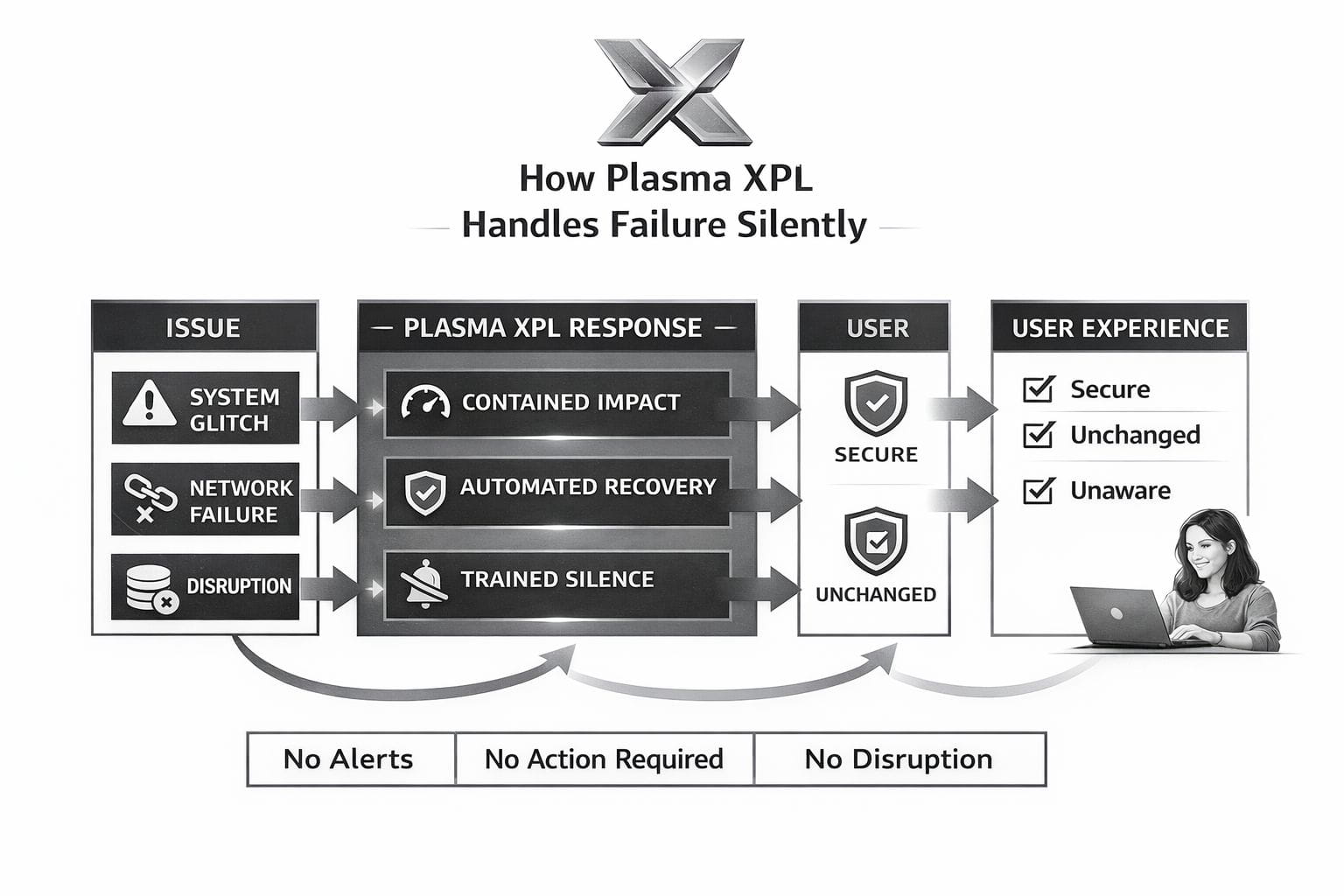
an issue occurs, Plasma XPL absorbs the impact internally, recovery logic is executed, and the user remains secure, uninterrupted, and often completely unaware that anything went wrong. Failure is treated as a background condition—not something that demands attention.
A Network Built for Applications That Stick Around
Plasma XPL is not optimized for short-lived bursts of activity. It is built for applications that operate continuously.
That includes products that grow steadily, serve real users, and remain active regardless of market cycles. These applications need infrastructure that doesn’t punish success or force tradeoffs as usage increases.
Plasma XPL is structured to support this kind of longevity without turning growth into a problem.
What Developers Actually Notice
Developers don’t usually compliment infrastructure. They notice it when it causes friction.
Plasma XPL aims to remove itself from that conversation. When developers stop needing to explain delays, fees, or odd behavior, they shift their attention back to the product itself.
That absence is intentional. Infrastructure that stays quiet is infrastructure doing its job.
Adoption Happens When Systems Become Assumed
People rarely decide to adopt infrastructure. They adopt products that don’t get in their way.
Plasma XPL is designed to become part of the background. Something that works the same way today as it did yesterday. Something users stop evaluating because there’s no reason to.
At that point, the system is no longer a question. It’s an assumption.
Plasma XPL Is Comfortable Staying in the Background
Plasma XPL does not need to be visible to be valuable.
Its role is to support applications without competing for attention, to handle complexity without exporting it, and to behave predictably enough that people stop thinking about it.
If Plasma XPL is doing its job well, most users will never know its name.
And that is exactly the outcome it was built for.

