
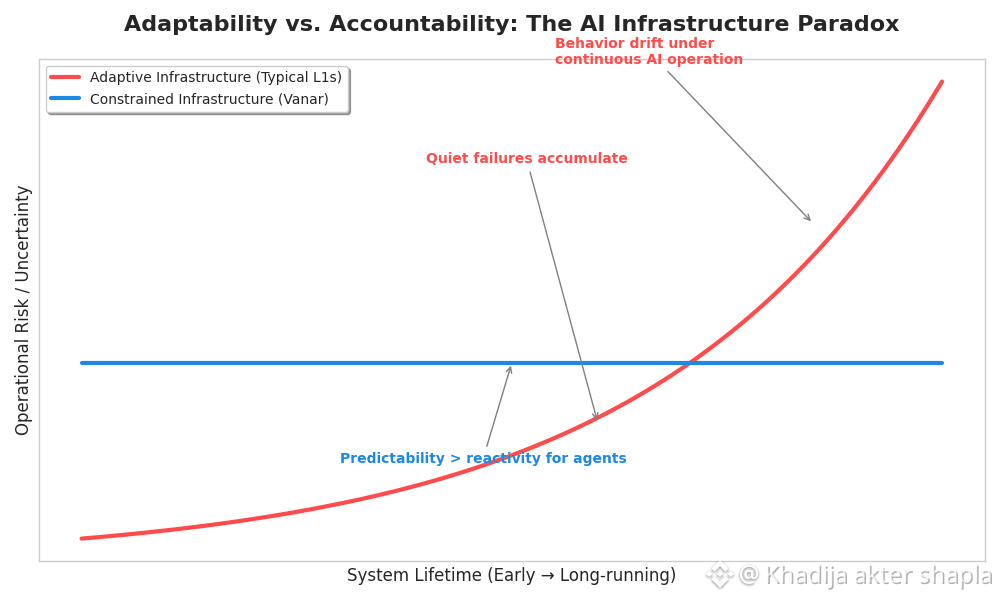
A few days ago, I sat through multiple AI demos back-to-back.
Different chains, different agents, different buzzwords.
They all worked.
They all answered.
They all looked impressive.
And yet, after closing the tabs, I couldn’t remember anything meaningful about them.
That’s when it hit me:
Most AI today is built to perform, not to persist.
It reminds me of stage actors who cry on cue.
Convincing in the moment, empty once the lights go out.
On-chain AI is facing the same illusion.
As long as conditions are perfect, everything looks intelligent.
But intelligence only reveals itself when conditions break.
Vanar is different. It doesn’t optimize for demos; it optimizes for post-mortems, accountability, and persistence. Systems like myNeutron, Kayon, and Flows prove that reasoning, memory, and automation can exist natively on-chain.
What worries me is not that many AI agents will fail.
Failure is normal. Failure is healthy.
What worries me is how many of them were never designed to fail safely.
No audit trail of decisions.
No persistent memory of mistakes.
No way to explain why something went wrong.
When these agents disappear, they don’t leave lessons behind.
They leave wreckage.
And wreckage compounds.
This is why Vanar’s direction feels uncomfortable to many people.
Vanar doesn’t optimize for the demo.
It optimizes for the post-mortem.
The question it keeps asking isn’t:
“Can your agent talk?”
It’s:
“Can your agent be held accountable after a bad decision?”
Production-grade intelligence is not glamorous.
It’s slow.
It’s strict.
It forces developers to expose weaknesses instead of hiding them behind UI.
That’s why it doesn’t go viral.
When hype fades, infrastructure survives. Vanar prepares for that moment. Boring today, critical tomorrow.
I’ve noticed something else during market pullbacks.
When prices fall, meme narratives die first.
Then feature narratives.
Then speed narratives.
What survives are systems that someone is afraid to turn off.
Because once a system becomes critical infrastructure, speculation no longer defines its value — dependency does.
Vanar seems to be building for that moment.
Not the moment of hype, but the moment when turning something off is too risky.
My honest view is simple:
Vanar may look boring right now.
And boring is exactly what you want from infrastructure that plans to exist after the experiment phase ends.
This isn’t about believing Vanar will win everything.
It’s about recognizing which projects are preparing for the day when excuses stop working.
And when that day comes, intelligence without memory, auditability, and consequence will feel less like innovation
and more like negligence.
Not all AI survives the real world — Vanar builds for what lasts.
#vanar #Vanar $VANRY @Vanarchain
