

Hey everyone, Aurion X here.
Lately, I’ve been keeping a close eye on Dusk Network, and honestly, it feels like stumbling across a rare gem in a market full of overpriced rocks. While most people are chasing meme coins or the latest AI trend, Dusk is quietly building infrastructure that could reshape how finance works on-chain.
So the real question is simple: is it worth your time? Let’s walk through it together. My goal isn’t to shill — it’s to help you understand something useful. If you’ve ever wondered how to access real-world assets without losing privacy or drowning in regulations, this might be the missing piece.
Most blockchains today are like open books. Anyone can see your transactions, balances, and activity. That transparency is great in theory, but terrible for serious finance. Institutions, funds, and large investors don’t want their strategies broadcast to the world.
That’s where Dusk comes in.
It’s a Layer-1 blockchain built specifically for bringing global financial markets on-chain, with privacy baked in from the start. Founded in 2018, this isn’t some rushed project. The team spent years building before launching mainnet in early 2025. In crypto, that kind of patience is rare and usually meaningful.
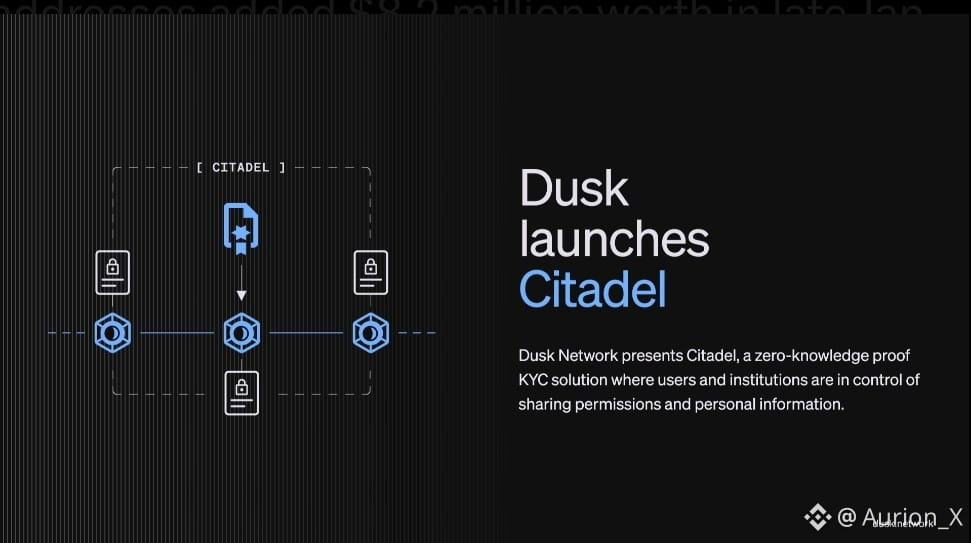
At its core, Dusk uses zero-knowledge proofs to let people trade tokenized assets like stocks, bonds, funds, and even real estate without exposing sensitive information. At the same time, it stays compliant with major regulations like MiCA and MiFID II in Europe. That means you’re not forced to choose between decentralization and legality.
As of February 2026, DUSK sits around a $52–53M market cap, with roughly 500M tokens in circulation out of a 1B max supply. Compared to giants like Ethereum, that’s tiny. And in crypto, small plus real utility often equals opportunity.
One real example: Dusk’s partner NPEX tokenized over €200M in securities. Using Dusk, institutions can do this privately, with instant settlement and no custodians. It solves a big question that has haunted crypto for years: how do we bring traditional finance on-chain without breaking everything?
What really separates Dusk from most chains is what I call “compliant privacy.” Transactions are confidential, but they can still be revealed when needed for audits or regulators. This isn’t anonymous chaos like Monero. It’s structured, professional privacy, designed for businesses.
Their Succinct Attestation consensus system is a Proof-of-Stake variant with under two-second finality, making it both fast and secure. In late 2025, Dusk integrated with Chainlink, bringing real-world data and cross-chain functionality. This made tokenized assets far more practical and scalable.
Platforms built on Dusk have already processed over €300M in tokenized assets. For Europe, where regulation is strict, that’s huge. If you’re a trader who hates broadcasting strategies on public ledgers, Dusk proves that privacy can be a tool, not a risk.
In January 2026, Dusk launched DuskEVM, making it fully EVM-compatible. That means developers from Ethereum can now deploy apps easily, which opens the door to faster ecosystem growth. On-chain data also showed something interesting: in late January, top wallets accumulated around $8.2M worth of $DUSK while smaller holders sold during dips. Classic smart-money behavior.
Now let’s talk about the token itself.
DUSK isn’t just a governance coin. It’s deeply tied to the network’s activity. Every block burns part of the fees, slowly reducing supply over time. Stakers earn rewards, and the foundation has explored buybacks as well.
Right now, price sits around $0.105–0.108, with daily volume above $19M, which is strong for a project of this size. After mainnet in 2025, Dusk rallied nearly 4x before correcting, which is normal in crypto cycles.
Price outlooks vary. Conservative estimates put it near $0.15 by mid-2026. Bull cases go as high as $0.90 if RWAs really take off. Some analysts expect steady 15–20% growth in early 2026. My personal view is simple: a $53M market cap looks cheap when RWAs could become a multi-trillion-dollar sector.
In January 2026, HTX’s Earn campaign boosted exposure and staking participation, giving users solid passive income options. If you’re looking for yield in a privacy-focused ecosystem, Dusk fits that profile.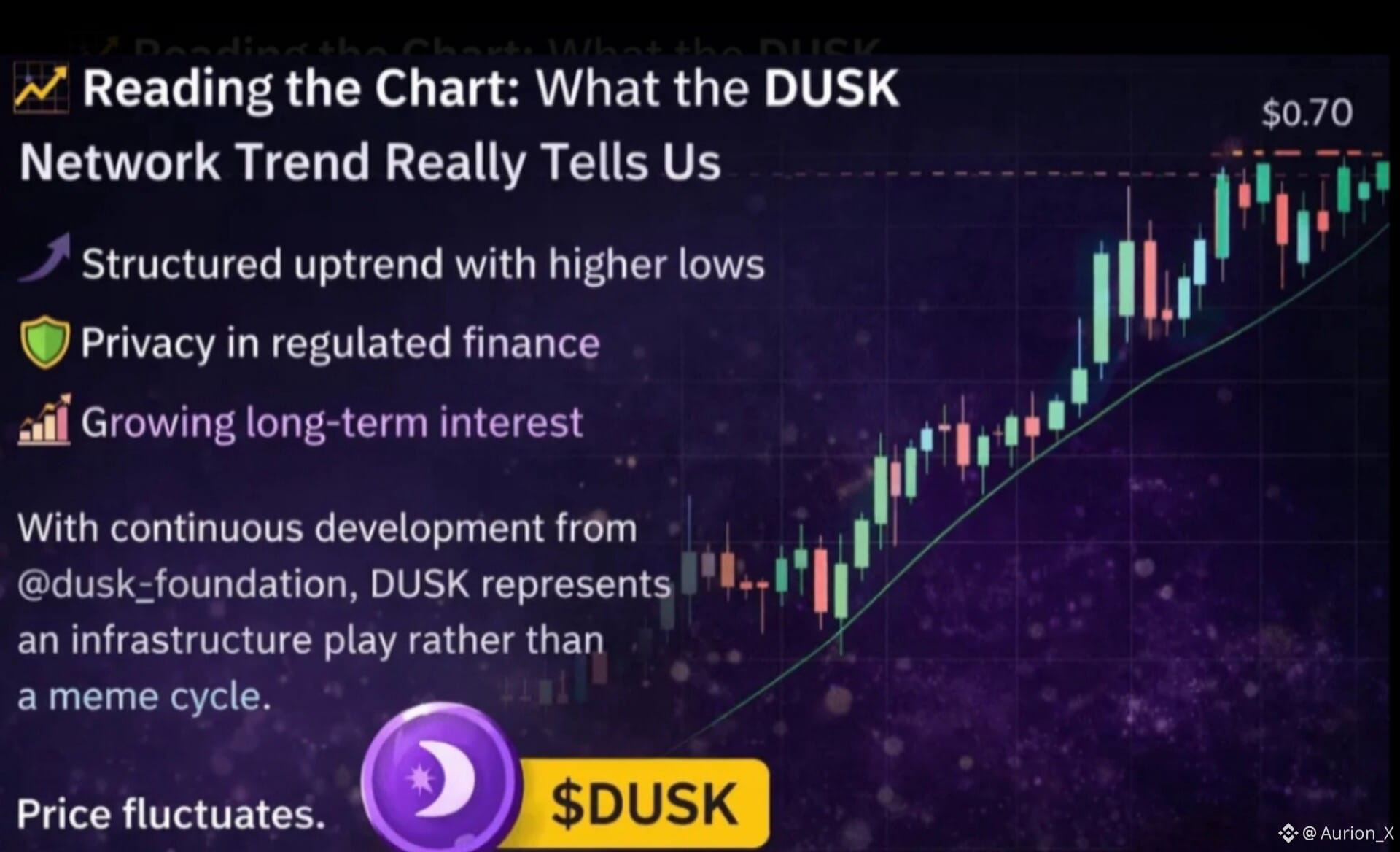
But let’s be honest. No project is perfect.
Dusk is institutional-first. That makes it “boring” for many retail traders. No meme culture, no viral hype, no wild pumps. In early 2026, the token dropped nearly 38%, showing that volatility is still very real.
There were also bridge-related issues in January 2026 that exposed operational weaknesses. The team handled recovery quickly, but it’s still something to watch. Competition is fierce too. Chains like Polygon and Solana are aggressively targeting RWAs and enterprise adoption.
From community data, most Dusk holders are long-term investors, not short-term flippers. That’s good for stability, but bad if you’re hunting quick pumps. This is more of a slow-burn play than a casino bet.
From my perspective, Dusk represents where crypto is heading. Not pure speculation. Not full anonymity. But a blend of privacy, compliance, and real financial utility.
If institutions want to move trillions on-chain, they’ll need infrastructure like this. With EVM compatibility, Chainlink integration, growing RWA adoption, and solid tokenomics, Dusk is positioning itself quietly while most people aren’t paying attention.
And that’s usually where opportunity lives.
It’s not a moonshot meme.
It’s a long-term infrastructure bet.
Sometimes, those are the projects that really change the game.
So now I’m curious — have you looked into $DUSK yet?

