The moment that made me pause came during a small Walrus meetup on Sui when I noticed how few attendees there were compared to the scale suggested by marketing materials. Early in the CreatorPad task with #walrus I expected a bustling room of contributors but instead the space felt intimate and focused. That contrast immediately highlighted an insight about Walrus community events: they grow deliberately rather than chasing large numbers.
One concrete behavior reinforced this. During a demo, only a handful of participants asked questions or tried hands-on interactions. @Walrus 🦭/acc did not push for broad engagement or gamified incentives to increase participation. The quiet nature of the event made it easier to notice patterns in how people approached the API and tools. Another observation was that the event facilitators focused on deep, slow explanations rather than covering as many features as possible. Walrus seems to value depth of understanding over the breadth of attendance.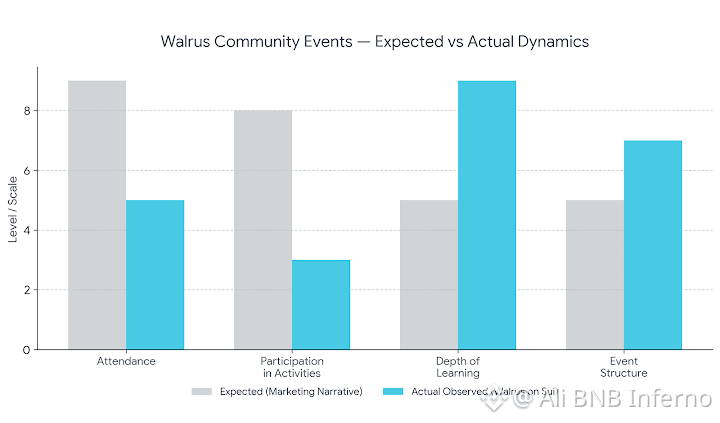
I noticed a small statistic that stuck with me. Less than 30% of attendees actively participated in a live coding exercise, but those who did engaged for longer periods and produced meaningful results. The pattern suggested that Walrus designs community events with quality interactions in mind rather than headline metrics. It felt like a conscious choice to prioritize retention of understanding over rapid scaling of numbers.
Another design choice stood out in practice. The event structure left open moments for participants to explore independently. Walrus did not micromanage or push people into preplanned sequences. This optionality encouraged curiosity while still maintaining a gentle framework. The balance between guidance and autonomy felt intentional and disciplined, reflecting the broader philosophy behind Walrus itself.
Sitting in the event, I realized who benefits first. Developers willing to engage patiently gain the most insight and support. $WAL does not try to flatten the learning curve for mass appeal. Instead, it nurtures those prepared to invest time. That choice subtly filters the audience and shapes future contributors by favoring depth of knowledge over immediate expansion.
By the end of the session, I was left reflecting on the long-term implications. Walrus community events grow slowly but deliberately, creating strong foundational knowledge rather than chasing viral metrics. I kept wondering whether this approach will cultivate a resilient developer base over time or whether the slow pace might limit network effects in the short term.