
The thing that made me look came during ordinary use rather than any edge case or stress test. While working through the CreatorPad task with @Plasma I expected the usual emphasis on speed because that is how the project is often framed. What I noticed instead was restraint. The system did not try to impress me. It did not surface trust claims or performance metrics upfront. The experience felt intentionally plain which made the contrast between narrative and practice impossible to ignore.
In practice #Plasma behaves as if speed is a side effect not the goal. Transactions feel fast from a retail point of view but the interface never celebrates that speed. There is no attempt to dramatize confirmation or settlement. One concrete behavior stayed with me. The confirmation feedback loop felt steady rather than aggressively optimized. It did not chase the fastest visible response. It prioritized consistency. That choice signals something deeper than performance tuning. It suggests a system designed to behave the same way under repeated scrutiny rather than to win attention in a single moment.
Another detail that stood out was how defaults are handled. The default path already includes constraints that many networks push into advanced settings. There was no obvious fast lane for retail users and no separate promise that institutions would be served later through different rails. The same underlying structure handled everything quietly. That flips the usual expectation. In this setup retail users benefit from simplicity while institutions benefit from architecture that already matches their requirements without needing special treatment.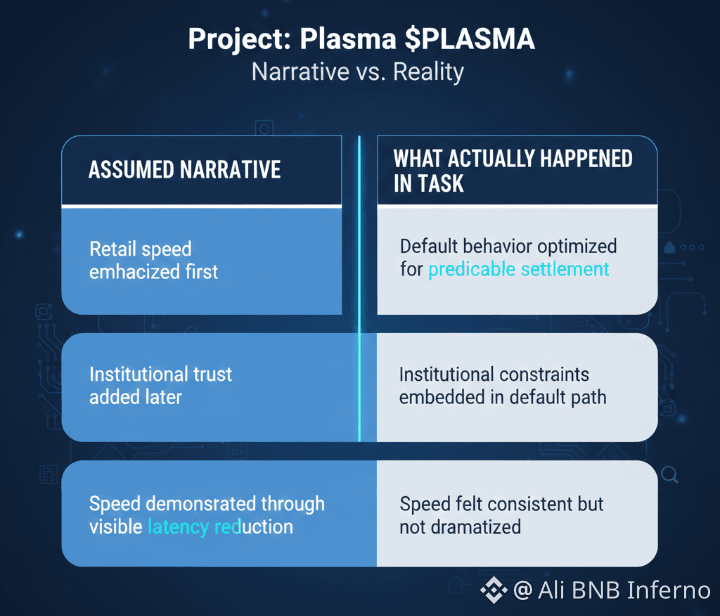
This makes the marketing language feel slightly inverted. The story is about bridging retail speed with institutional trust but in practice institutional trust seems to be the foundation while retail speed is the surface effect. Institutions appear to benefit first because the system is already shaped around their expectations. Retail users simply experience the result without being asked to understand it. That is a subtle but meaningful difference in how value is delivered.
As a builder this made me slow down. $XPL feels less interested in excitement and more interested in durability. It asks for trust through boredom rather than spectacle. I am left wondering whether this quiet alignment will ever be visible enough to matter in public narratives or whether Plasma is intentionally comfortable remaining unnoticed while it proves itself over time.

