
In every major wave of blockchain innovation there comes a moment when the industry stops chasing novelty and begins refining purpose. Plasma belongs to that moment. Rather than trying to be everything for everyone, this Layer 1 network is built around a single powerful idea: stablecoins deserve their own home. A place designed for speed, reliability, and everyday use. A chain where moving digital dollars feels less like interacting with experimental technology and more like sending money through a modern financial rail.
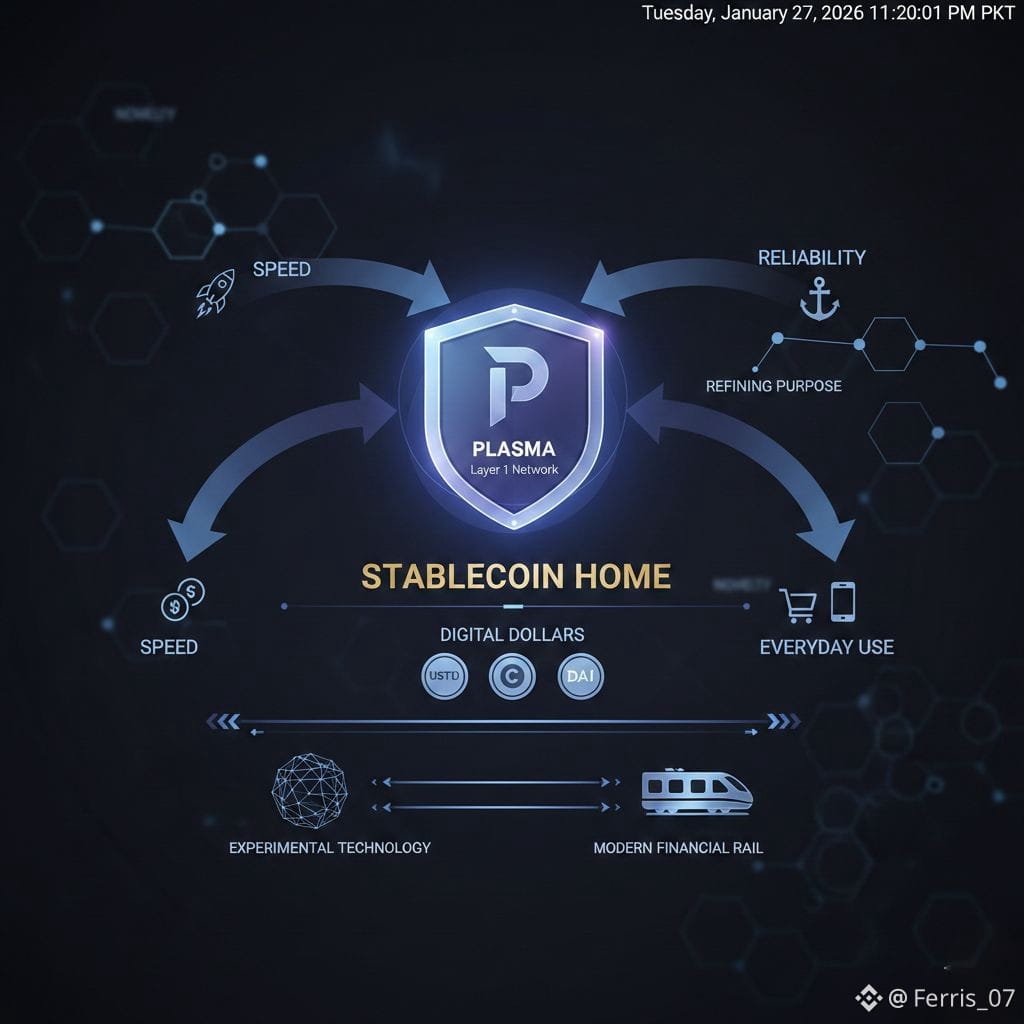
At its heart Plasma is engineered for settlement. Transactions finalize in under a second, a detail that sounds technical until you imagine a merchant waiting for confirmation at a checkout counter or a family sending funds across borders in real time. This speed is powered by PlasmaBFT, a custom consensus mechanism inspired by advanced Byzantine fault tolerant systems that allow validators to coordinate rapidly without sacrificing security. The result is a network tuned for high frequency payments rather than speculative congestion.
Execution on Plasma runs through a Rust based Ethereum client that preserves full EVM compatibility. For developers this means familiarity. Smart contracts written for Ethereum can migrate with minimal friction. Existing tools for testing, deployment, and wallet integration work as expected. Yet under the surface the chain is optimized for a different workload. Stablecoins are not an afterthought here. They are the core.
One of Plasma’s most striking features is its approach to gas. Instead of forcing users to hold a volatile native token just to send funds, the network supports paying fees directly in stablecoins. In certain cases basic transfers such as USDT can even be sponsored at the protocol level, making them effectively gasless for the end user. This small change has enormous implications. It lowers the barrier for newcomers, simplifies user experience for merchants, and removes friction in regions where stablecoins already function as everyday money.
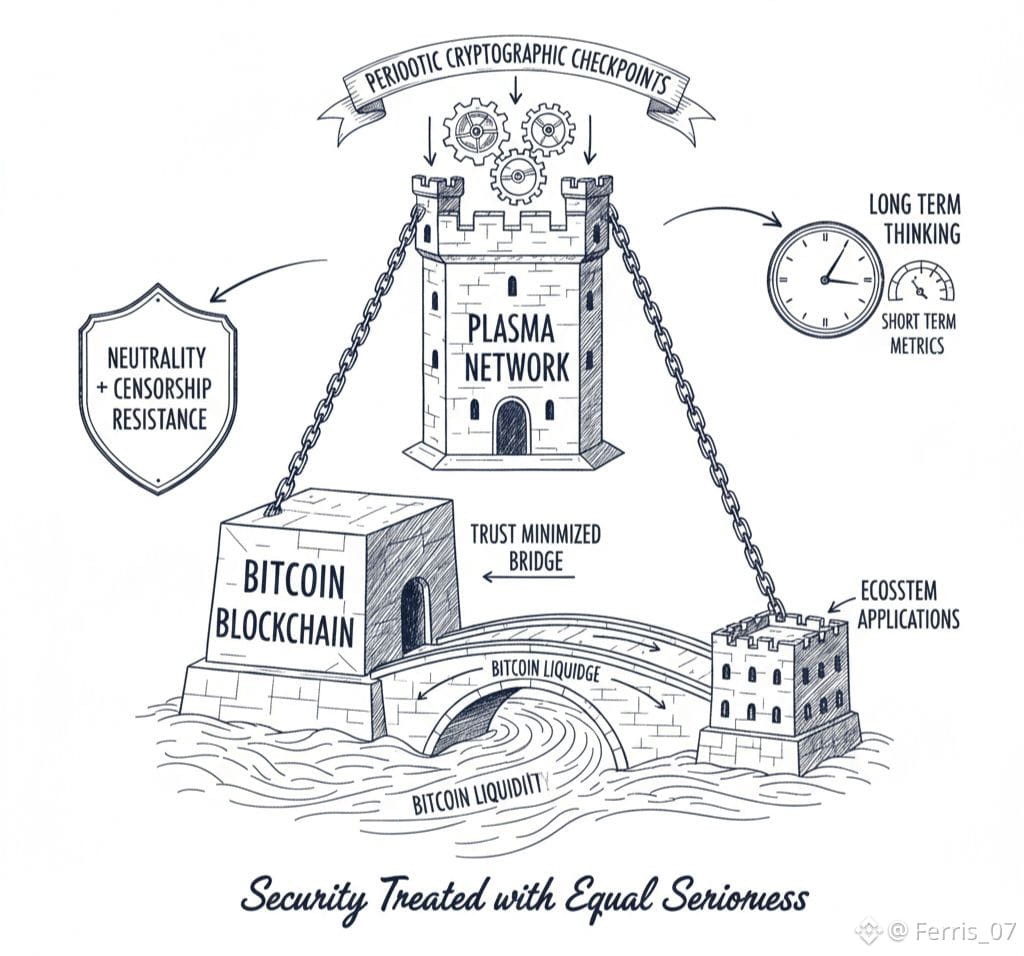
Security is treated with equal seriousness. Plasma anchors its state to Bitcoin through periodic cryptographic checkpoints. By tying its history to the most battle tested blockchain in existence, the network aims to inherit an additional layer of neutrality and censorship resistance. A trust minimized bridge brings Bitcoin liquidity into the ecosystem, allowing users to move value between chains while maintaining strong security guarantees. It is a quiet architectural decision that signals long term thinking rather than short term performance metrics.
Liquidity and adoption have followed quickly. Billions in stablecoins have already flowed into the network, alongside a growing list of partners across wallets, infrastructure providers, and decentralized finance applications. This depth matters. Payment networks only succeed when liquidity is abundant and routing value feels effortless. Plasma is positioning itself as a settlement layer that institutions can rely on and individuals can use without needing to understand the machinery beneath.
The use cases extend far beyond simple transfers. Cross border remittances become faster and cheaper when intermediaries disappear. Merchants gain access to instant settlement without card networks or chargebacks. Companies can pay global teams in stable value at any hour of the day. DeFi protocols can build on top of a chain where the dominant asset is not volatile but steady, enabling new forms of lending, liquidity management, and treasury operations. Even traditional financial players exploring tokenized dollars and onchain settlement rails find in Plasma a network designed for their specific requirements.
Behind the scenes a native token supports staking and governance, aligning validators and participants around the long term health of the chain. Economic incentives are structured to encourage reliability and honest participation, while community driven governance gives the ecosystem room to evolve as adoption grows.
Of course no ambitious infrastructure project is without challenges. New consensus systems must prove themselves over time. Regulatory landscapes for stablecoins continue to shift across jurisdictions. Competition from other high throughput networks remains fierce. Yet Plasma’s differentiation is clear. It is not racing to host every possible application. It is carefully shaping itself into the backbone for digital dollars.
There is something quietly compelling about that focus. In an industry often defined by hype cycles and speculative excess, Plasma speaks in the language of infrastructure. Of plumbing rather than fireworks. Of reliability rather than slogans. Its design choices reflect an understanding that the next chapter of blockchain adoption will not be driven solely by traders but by everyday economic activity. Salaries. Purchases. International transfers. Treasury flows. All the mundane movements of money that collectively define the global economy.
As stablecoins continue to spread across emerging markets and institutional balance sheets alike, the need for specialized settlement networks becomes increasingly obvious. Plasma is stepping into that space with a blend of technical rigor and human centered design. Sub second finality so people are not left waiting. Gas abstraction so newcomers are not confused. Bitcoin anchoring so long term security is not compromised for convenience.
In the end Plasma feels less like a speculative experiment and more like a quiet bet on the future of money. A future where digital dollars travel at internet speed, where merchants accept stablecoins as easily as cards, and where financial infrastructure fades into the background, doing its job without demanding attention.
If that vision takes hold, Plasma may well become one of the invisible engines powering global value transfer. Not loud. Not flashy. Just dependable, fast, and built for the world as it actually is.

