
In crypto, “compliance” usually means one of two extremes: totally closed bank chains or totally open DeFi where anyone can do anything. Plasma is trying to build something more useful in the middle, a stablecoin optimized Layer 1 where compliance is modular, not hard coded.
Think of Plasma as a payments and settlement highway for digital dollars. On top of that highway you have very different vehicles: a European neobank issuing compliant USD stablecards, a global exchange pushing stablecoin flows between venues, and a tier 1 bank settling institutional FX and on chain money market products. All three care about KYC and AML, but none of them want the exact same rulebook.
This is where plug in compliance on Plasma comes in.
At the base layer, Plasma provides fast finality, low stablecoin fees, and strict security around the $XPL gas token. Above that, applications can attach modular compliance modules, smart contracts and policy engines that define who is allowed to hold which asset, how transfers are screened, and what kind of monitoring is required. Instead of every project reinventing KYC from scratch, Plasma lets them reuse audited building blocks.
Under the hood, those modules might combine allow lists, revocation lists, travel rule logic, risk scores from off chain providers, and even zero knowledge proofs that a wallet has passed certain checks without exposing raw identity data. For developers, these are composable primitives. For compliance teams, they are levers they already understand, just expressed in code.
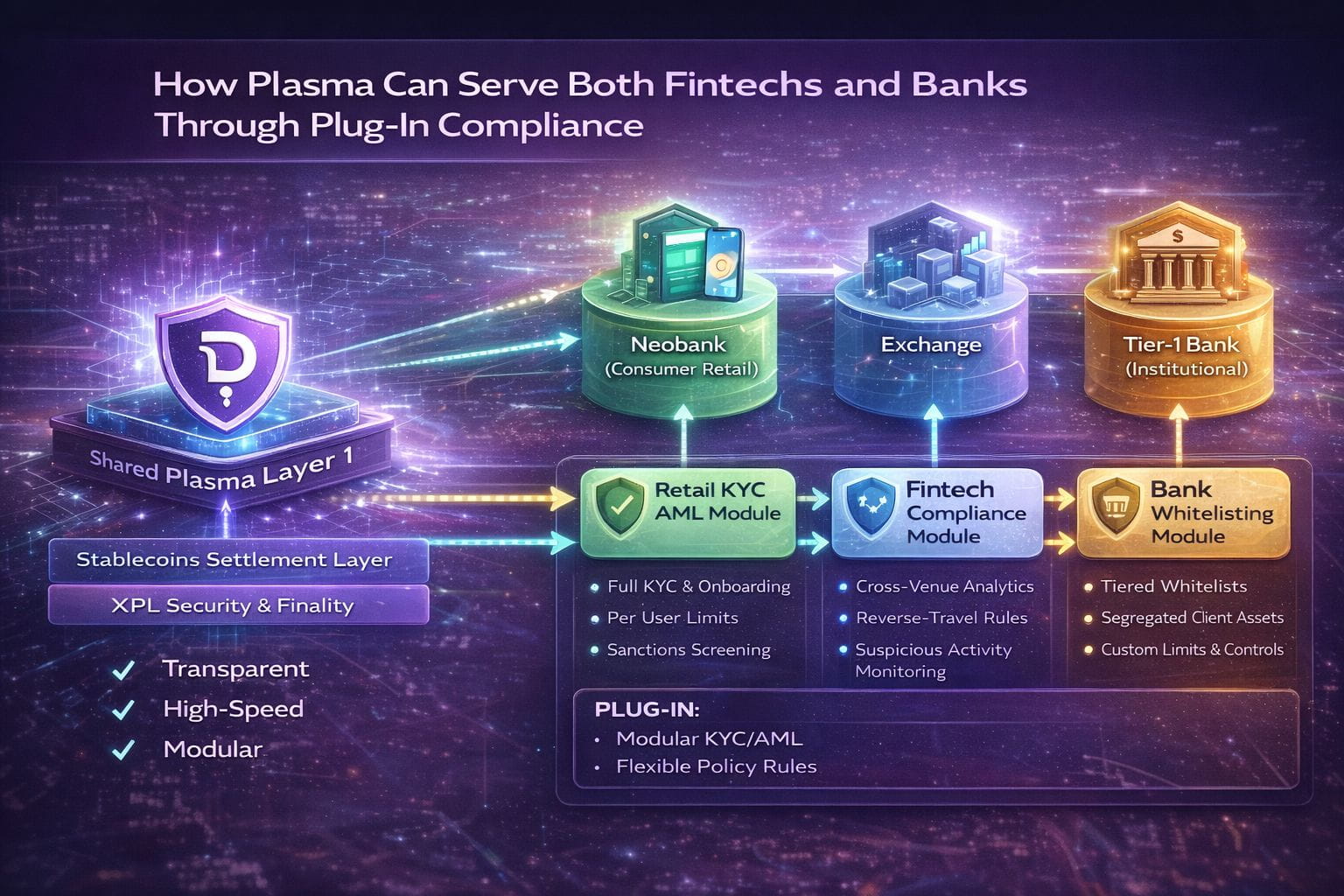
A neobank might choose a consumer grade module: full KYC at onboarding, per account limits, travel rule integrations, sanctions screening, and automated reporting to its national regulator. An exchange may deploy a different module focused on high volume flows, cross venue analytics, and stricter monitoring of suspicious patterns. A tier 1 bank can plug in its own whitelists, jurisdiction specific restrictions, segregation of client assets, and internal risk models. All of this lives on the same Plasma infrastructure, but each institution sees a compliance profile that matches its license and risk appetite.
From the user’s perspective, this feels surprisingly simple. Your wallet proves that it belongs to a particular compliance domain, for example “retail EU customer of Bank X” or “qualified counterparty of Prime Broker Y.” Once that proof is in place, your transfers clear automatically across apps that recognize that domain. You tap send, the on chain logic checks policy in milliseconds, and the payment lands. No one waits days for manual reviews.
Because these rules are encoded on Plasma, they gain two big advantages. First, they are transparent to regulators. Supervisors can audit the actual policy contracts and see how assets are allowed to move, instead of reverse engineering flows from CSV exports. Second, they are interoperable. A wallet or business that satisfies one institution’s policy can, subject to law, be cleared for others without repeating the entire KYC process. Compliance becomes portable.
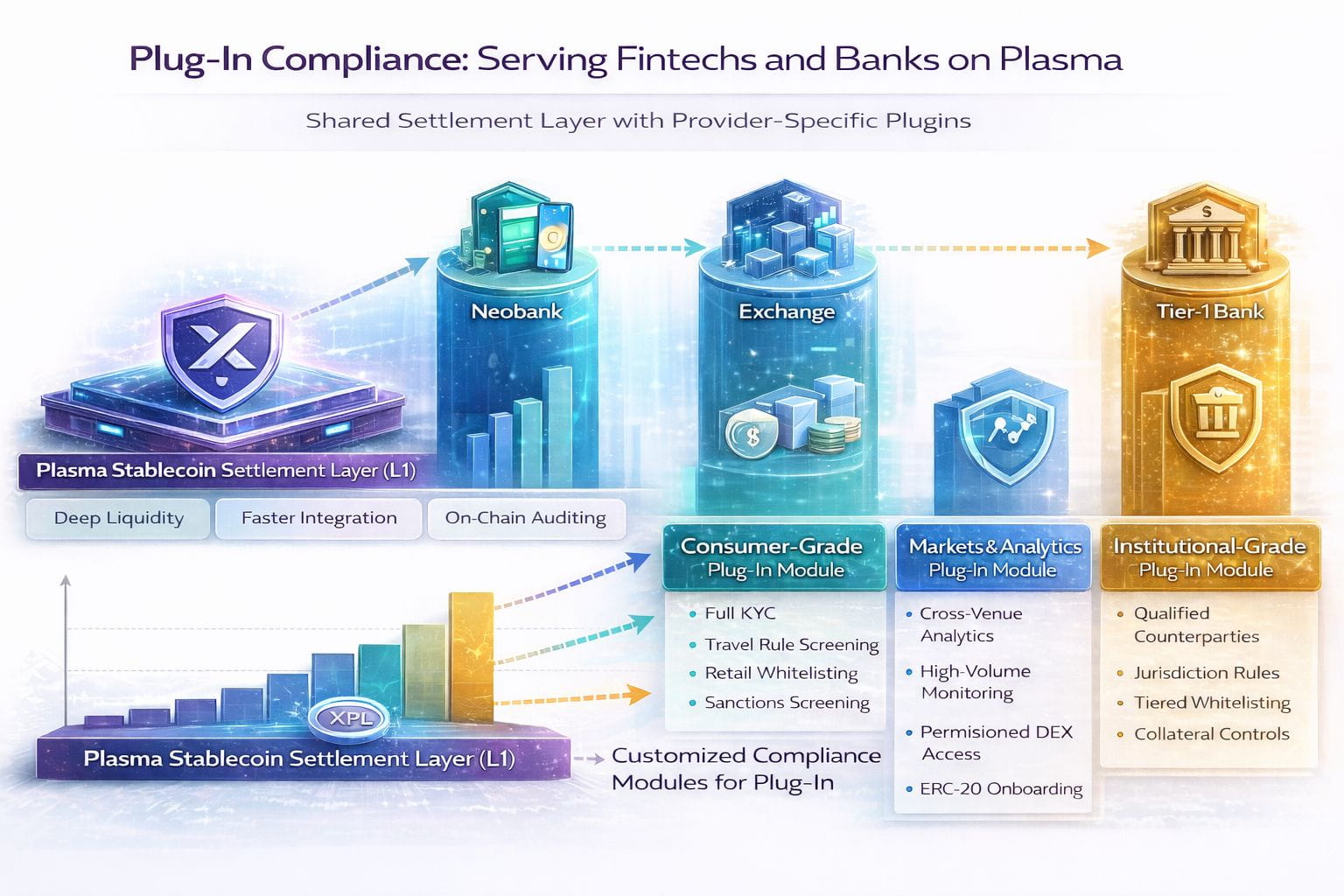
None of this turns Plasma into a walled garden. The base chain stays public and neutral, with XPL securing consensus and stablecoins providing the main medium of exchange. What changes is that sensitive applications can live directly on a public Layer 1 instead of hiding behind private bank chains. Compliance stops being a reason to fork the infrastructure, it becomes a reason to share it.
The longer term vision is powerful: thousands of regulated entities, fintech, broker dealers, neobanks, payment processors, even central banks, all plugging into the same Plasma settlement layer, each with their own compliance modules, all speaking the same technical language. Liquidity is deeper, integration is cheaper, and regulators get a cleaner view of systemic risk because key rules are visible on chain.
In that world, XPL is not just another gas token. It is the coordination asset for a network where payments, compliance, and capital markets finally run on the same programmable rails, and where plugging into Plasma means inheriting an entire compliance toolbox, not starting from zero.

