
@Dusk My introduction to Dusk wasn’t marked by urgency or grand vision. It felt more like discovering a building that had long been in use serving a clear purpose for those who needed it rather than something loudly promoted to attract attention. Launched in 2018, Dusk emerged during a period when blockchain projects were still striving to justify themselves through speed, spectacle, or ideological extremes. What made it notable wasn’t a bold promise of disruption, but a willingness to work within the realities that already existed.
By the time Dusk began forming, the broader ecosystem had divided itself into opposing philosophies. One camp championed total transparency, treating openness as an unquestionable virtue even when it conflicted with real-world needs. The other favored closed, permissioned systems that delivered compliance and efficiency at the cost of decentralization and trustlessness. The debate often felt oversimplified, as though privacy and accountability or regulation and innovation were mutually exclusive. Dusk didn’t loudly position itself as an alternative; it simply acted as though a middle ground was unavoidable.
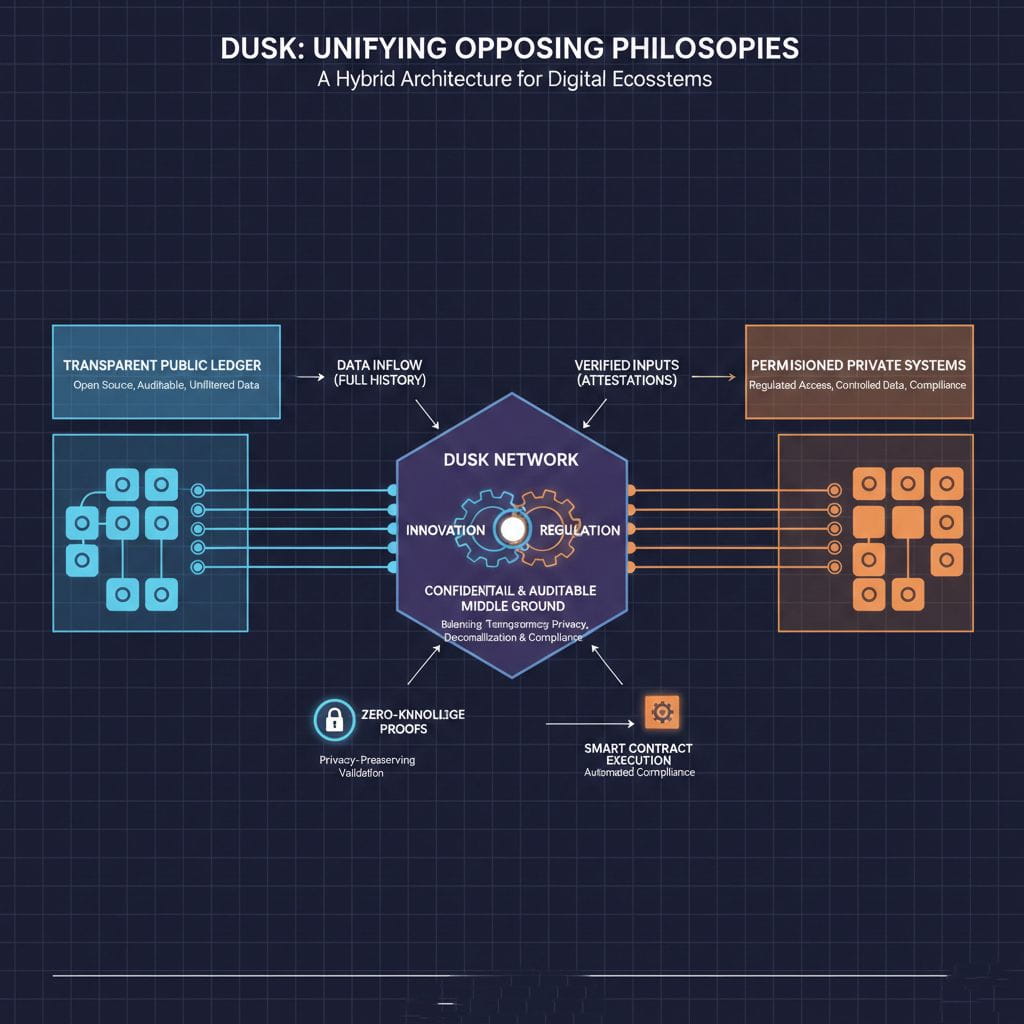
The project seemed to recognize something many others overlooked: financial infrastructure operates within social, legal, and institutional frameworks. These systems don’t reset just because new technology appears. Regulated entities can’t function if every transaction is fully exposed, yet they also can’t adopt opaque systems that offer no way to justify or audit activity when necessary. This isn’t an abstract dilemma it’s a practical constraint. Dusk’s foundation appeared to be built with that constraint in mind.
At the time, most privacy-focused solutions felt imbalanced. Some applied secrecy indiscriminately, making accountability nearly impossible. Others treated privacy as a secondary feature, added late and integrated poorly. Dusk’s design choices seemed more deliberate. Instead of pushing toward extremes, it aimed for equilibrium, even if that meant slower progress or fewer bold claims.
One of Dusk’s more defining decisions was its acceptance of limitations others tried to avoid. It didn’t attempt to outperform competitors in speed, flexibility, or experimentation. Its focus narrowed to building financial infrastructure that could realistically coexist with regulation. That choice may have reduced speculative excitement, but it also made the project more credible to institutions that typically observe from the sidelines.
This philosophy carried through to its overall design. Rather than overwhelming users with endless features, Dusk emphasized predictability and consistency. Simplicity here wasn’t a lack of depth it was intentional restraint. It reflected an understanding of which elements were necessary and which merely added complexity. In an industry where complexity is often celebrated as innovation, this approach felt quietly unconventional.
As a result, Dusk’s growth has been gradual rather than explosive. It hasn’t dominated headlines or chased every emerging narrative. Its pace mirrors its objectives: regulated institutions move carefully, and compliant financial products take time to develop. This kind of progress may not generate excitement in the short term, but it tends to endure longer than momentum driven by speculation.
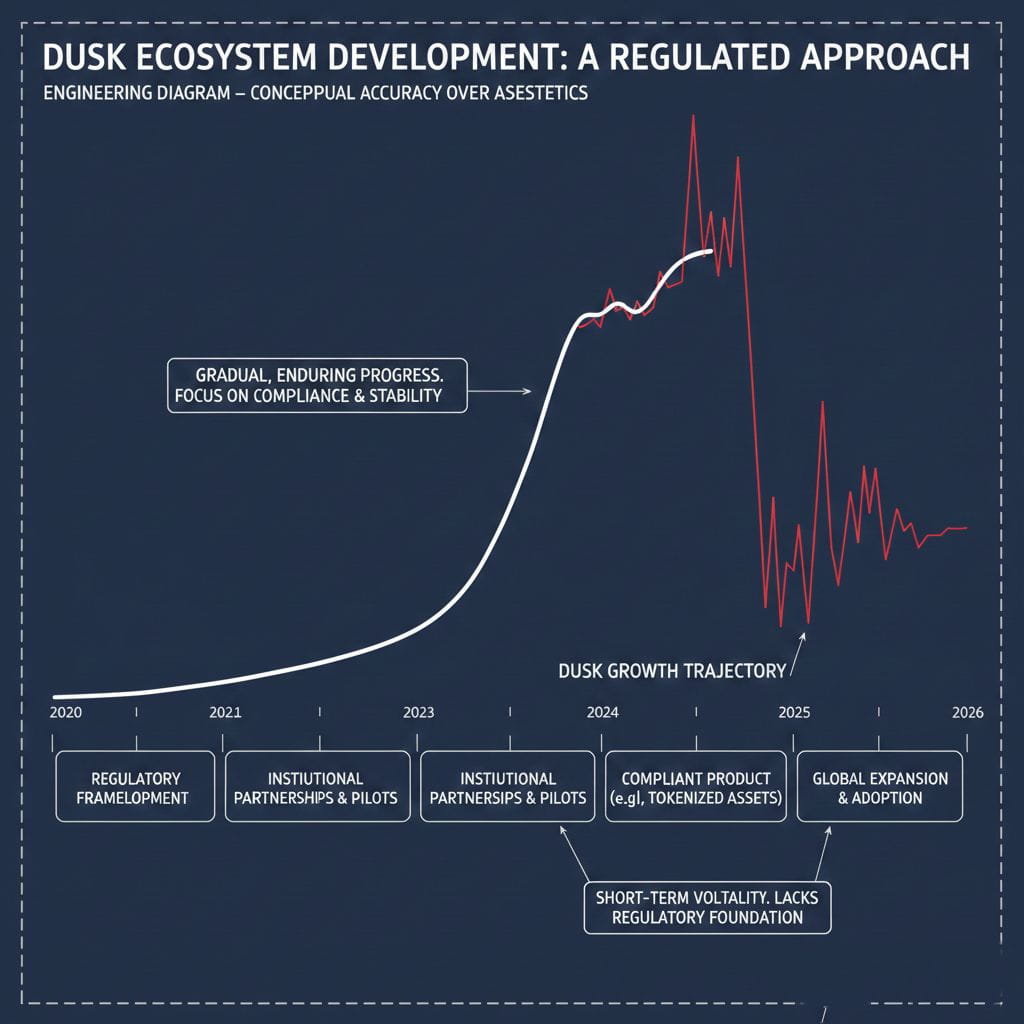
That doesn’t mean the path forward is without challenges. Supporting regulated finance requires ongoing adaptation to shifting legal frameworks across different jurisdictions. There’s an inherent tension between remaining flexible and preserving core principles. Additionally, relevance in an attention-driven market is difficult to maintain without visibility. Dusk’s understated approach may shield it from distractions, but it also risks being overlooked by those who influence perception.
There’s also the deeper issue of trust. Even the most thoughtfully designed systems depend on human confidence. Privacy mechanisms and auditability alone don’t guarantee adoption. Institutional trust is slow to build and fragile once established. Dusk’s long-term trajectory may depend as much on relationships and credibility as on its technical foundation.
Still, there’s something compelling about a project that doesn’t constantly seek validation. Dusk doesn’t present itself as the definitive future of finance. Instead, it seems to accept that financial evolution is gradual, constrained, and uneven. That grounded outlook gives it relevance, even without visibility.
After watching several cycles of hype and decline, I’ve grown wary of projects that promise simplicity in a complex world. Dusk doesn’t offer easy answers; it offers alignment with the idea that finance requires both privacy and responsibility, and that innovation doesn’t demand rejection of every existing structure. Sometimes progress comes from fitting into reality rather than trying to escape it.
What matters most to me isn’t where Dusk ultimately ends up, but how it continues to operate. If it maintains its disciplined, quiet approach, it may never dominate public conversation. But it could continue to serve where reliability matters most supporting systems that need to function consistently, without spectacle. In an industry fixated on future narratives, that focus on the present feels uncommon.
Perhaps that’s the clearest takeaway. Dusk doesn’t feel like it’s striving toward a dramatic arrival. It feels like it’s already positioned somewhere deliberate observing carefully, adapting slowly, and prioritizing relevance over recognition. Whether that strategy is rewarded remains uncertain. But having seen enthusiasm surge and fade many times, I find myself more intrigued than exhilarated and over time, that curiosity often proves more meaningful.
