
If you talk to small and mid-sized business owners today, most of them will tell you the same thing: getting credit is still stuck in the 20th century. Endless paperwork, weeks of waiting, and a process that often punishes younger, fast-growing companies simply because they do not fit traditional banking templates.
Now imagine that same SME walking into a world where:
Their invoices, cash flows, and collateral live on-chain.
Multiple lenders can compete to finance them.
Sensitive financials stay private, visible only to the parties that actually need to see them.
That is the kind of market Dusk is built to unlock.
Why SMEs need a different kind of blockchain
Most Layer 1s are great for open DeFi experiments, but terrible for real business lending. Everything is transparent: positions, counterparties, even pricing strategies. That is fine for yield farms; it is a non starter for a logistics company in Rotterdam or a manufacturer in Milan that does not want its competitors and suppliers reading its balance sheet on a block explorer.
Dusk flips that script.
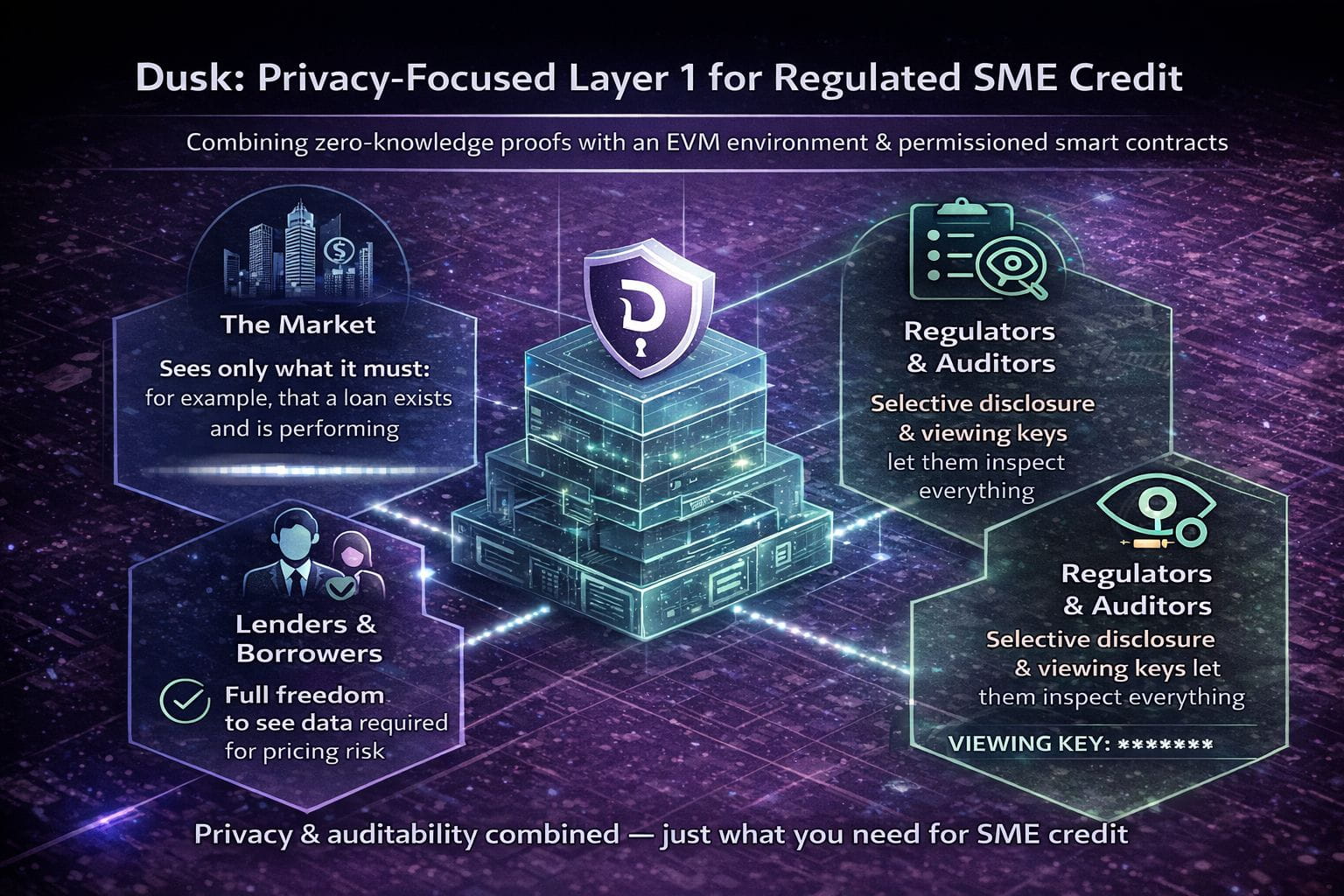
Dusk is a privacy focused Layer 1 for regulated finance, combining zero-knowledge proofs with an EVM like environment and permissioned smart contracts. It is designed so that:
The market sees only what it must (for example, that a loan exists and is performing).
Lenders and borrowers see the full required data for pricing risk.
Regulators and auditors can still inspect everything via selective disclosure and viewing keys.
That combination of privacy and auditability is exactly what you need for SME credit.
Private credit rails, not anonymous DeFi
“On-chain credit” usually conjures images of over-collateralized crypto loans. SMEs live in another universe: revenue cycles, trade finance, inventory, purchase orders, and receivables. These are messy, dynamic, and deeply tied to the real economy.
On Dusk, you can model that complexity without making it public.
A simple example:
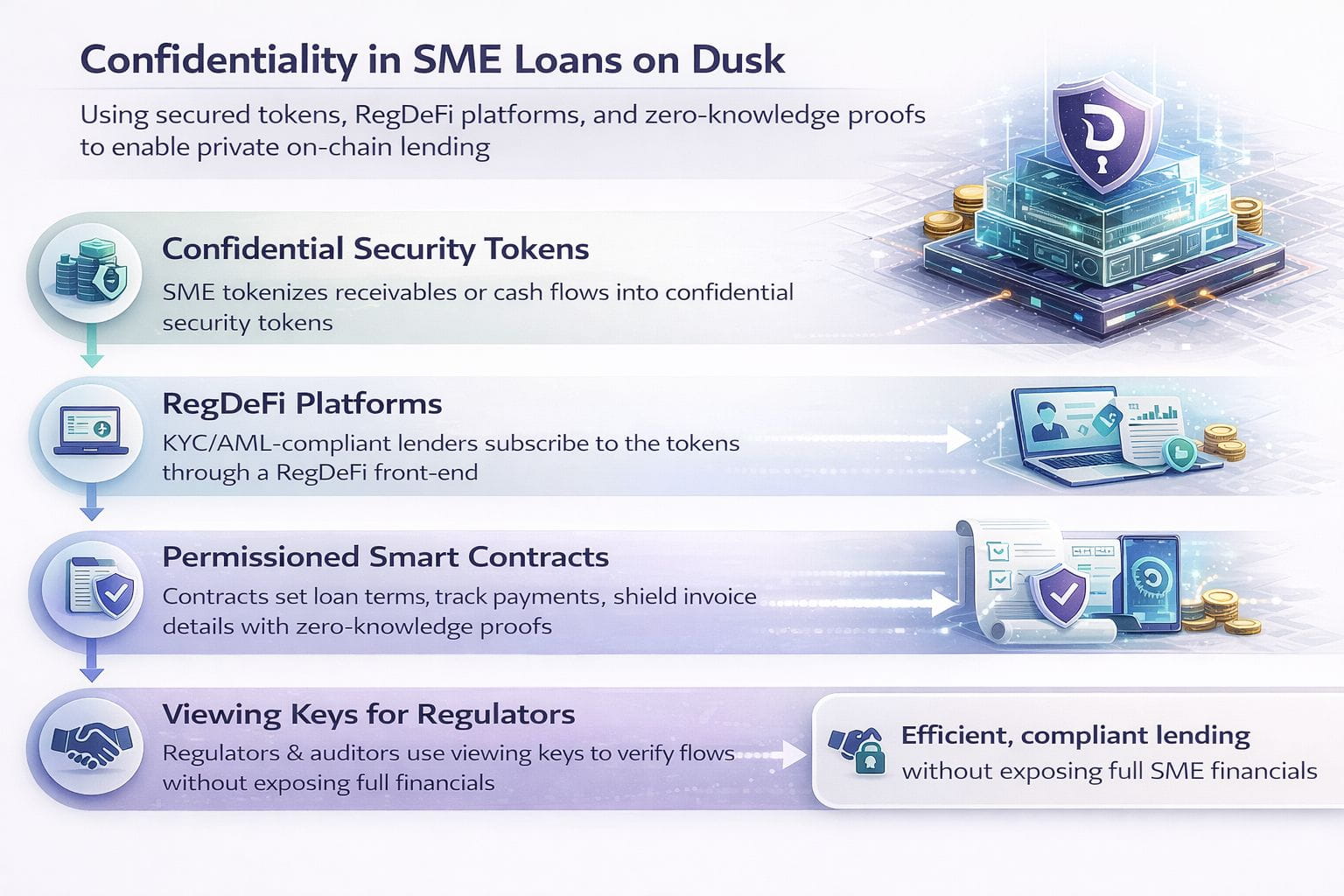
An SME tokenizes its receivables or future cash flows into confidential security tokens issued via a permissioned smart contract.
Lenders subscribe to these tokens through a RegDeFi front end where KYC/AML has already been done at the wallet level.
The loan terms, covenants, and payment schedules are enforced by the contract, but individual invoice details or margins are shielded using zero-knowledge proofs.
Regulators or auditors, if needed, can use viewing keys to verify flows without exposing the SME’s entire financial life to the world.
The result is a lending environment that feels as rigorous as traditional banking, but with the efficiency and programmability of crypto rails.
What lenders actually see
The magic of $DUSK is not that it hides everything; it is that it reveals the right things.
A lender in a Dusk-based SME credit marketplace might see:
Aggregated cash flow metrics
Proofs that collateral exists and meets predefined criteria
Performance history of previous on-chain obligations
Risk scores or attestations issued by regulated third parties
All of this can be verified cryptographically, yet the granular underlying data remains private. Competitors cannot spy on margins. Suppliers cannot see exact pricing. Traders cannot front-run the market based on a company’s borrowing patterns.
At the same time, the SME gets something they rarely see in traditional credit: competition. Multiple regulated lenders can plug into the same infrastructure, price the same borrower, and bid for the deal, all without asking the business to resubmit the same documents ten different times.
Why Dusk is built for this, not just compatible with it
You can, in theory, hack together private-ish SME lending on other chains using custom ZK circuits and off-chain data rooms. But Dusk is architected so that this kind of use case is not an exception, it is the default.
Key ingredients:
Native privacy: Zero-knowledge proofs live at the protocol level, not as an afterthought.
Regulatory ready design: Permissioned contracts and identity layers let platforms enforce who can deploy, who can invest, and under what rules.
Compliant DeFi (RegDeFi): Dusk’s core thesis is that real financial products need both compliance and composability. SME credit fits squarely in that category.
In other words, Dusk is not trying to bolt regulation onto a casino. It is building rails for the kind of money that already has regulators sitting at the table.
A new playbook for SME finance
If this vision plays out, “getting a loan” for an SME could look very different:
Instead of sending PDFs to a relationship manager, the business plugs its invoicing, PoS, or ERP data into a Dusk-native credit platform.
Identity and KYC are handled once at the wallet level, then reused across multiple lenders and products.
Funding offers arrive programmatically, with terms encoded in smart contracts and enforced on-chain.
Performance history becomes portable reputation, letting strong borrowers access better rates over time, even across platforms.
The public never sees the SME’s full books. Competitors stay in the dark. But the market, regulators, and lenders all operate on a shared, verifiable source of truth.
That is the promise of private SME financing on Dusk: moving real-world credit on-chain without forcing businesses to choose between privacy, compliance, and access to capital.
@Dusk #dusk $DUSK
