
Cryptocurrency market patterns alternate on waves of innovation. Immutable ledgers happened in 2009-2014, programmable money with smart contracts in 2015-2019, and scaling in 2020-2024. However, in 2026, things will change radically: thinking blockchains. Vanar Chain represents this development more thoroughly than any other competing platform-and to traders, who sees the emerging infrastructure games, knowing why it is of utmost significance.
The Woeful Prospects of Retrofitted AI Blockchains.
The Layer 1 networks mostly consider AI as a byproduct. Ether, Solana and even Avalance are more of high-throughput transaction registries with AI services overlayed with costly oracle networks and middleware off-chain. This puts three debilitating constraints on the side of enterprise users that can be felt instantly:
Opacity Gap: non-cryptographic opacities of off-chain AI decisions. In case an AI agent proposes a position in DeFi that costs 10M, regulators require it to provide evidence of its thinking. Conventional blockchains are not capable of doing it- establishing a baseline trust barrier.
Latency Tax: Each AI smart contract interaction would entail oracle calls at the price of $5-50 each with 30-120 seconds response time. This friction cannot stand any enterprise payment systems that process millions of transactions in a single day.
Compliance Void: Tibial AML regulations (EU AML, US OFAC) state that the decision trail is audited. Off-chain AI produces none. Businesses that have 2T+ of annual expenses will not access infrastructure without compliance-quality arguments.
Native Intelligence Stack by Vanar.
Vanar removes these limitations by architecture design in three layered fusion design:
Layer 1: Vanar Chain Foundation
Execution environment EVM compatible, block times of 3 seconds, transaction costs of 0.0005, has a 30m gas cap per block, which allows complex workloads with AI implementation at scale. Use of Go Ethereum (GETH) implementation gives familiarity to the developer no learning curve.
Layer 2: Neutron - Semantic Data Compression.
Conventional blockchains have a payload capacity of about 65KB/transactions. In the real world, enterprise documents (contracts, compliance certificates, insurance policies, etc.) are 200-500KB on average. Hacks such as IPFS result in the creation of custody risk- files that are not pinned disappear.
Neutron has 500:1 compression with a four stage AI pipeline:
Neural reconfigurations: Patterns of documents are identified through machine learning.
Quantum aware encoding: Algorithms to compress unique data.
Chain native indexing: Optimization of smart contract queries.
Deterministic recovery: Entire documents recoverable on-chain.
Outcome: a 500KB property deed is reduced to 1KB "Neutron Seed" permanently stored, instantly queryable, full audit.
layer 3: Kayon On-Chain Reasoning Engine
Kayon has smart contracts know how to reason and comprehend Neutron Seeds. Rather than numiniferous logic, contracts can:
IF (invoice matches PO) AND (delivery confirmed) AND
(insurance covers transit) AND (seller KYC verified across 47 jurisdictions)
THEN execute_payment
()
All arguments documented forever. Decision paths are audited by regulators. Companies that make cross-border payments will receive cryptographic evidence of conformity.
Trillion Dollar Market Collision
The architecture of Vanar is aimed at serving three enormous markets at the same time:
PayFi Transformation (Opportunity 2.3T)
The thesis is confirmed by the Worldpay partnership. Now state of chargeback processing 60+ days, 7+ middlemen, 2-3% charge. Vanar reduces this to 3 seconds with no intermediaries.
Permanent records of transactions (Neutron Seeds).
Kayon reasoning Automated compliance verification (Kayon reasoning)
Unexpected settlement (3 seconds finality)
Worldpay volume migration 0.1% = $2.3B annual throughput $1M+ monthly VANRY protocol revenue.
RWA Tokenization (Addressable 5T+)
Deeds to property, carbon credits, invoices, regulatory filings each of them becomes Neutron Seeds with compliance logic embedded in them. Current RWA market: $500M TVL. Vanar is designed to target enterprise level in need of tokenizing auditing.
Enterprise AI Infrastructure (450B in 2035)
Gartner: By end-2026, 40 percent of enterprise apps will have task-specific AI agents. Agents require executable environments. This is what vanar offers exactly getting placed earlier on the ais of AI adoption in the enterprise.
Token Economics: Intrinsic and Extrinsic Consideration in Unison
The supply model of VANRY strengthens the security of the network:
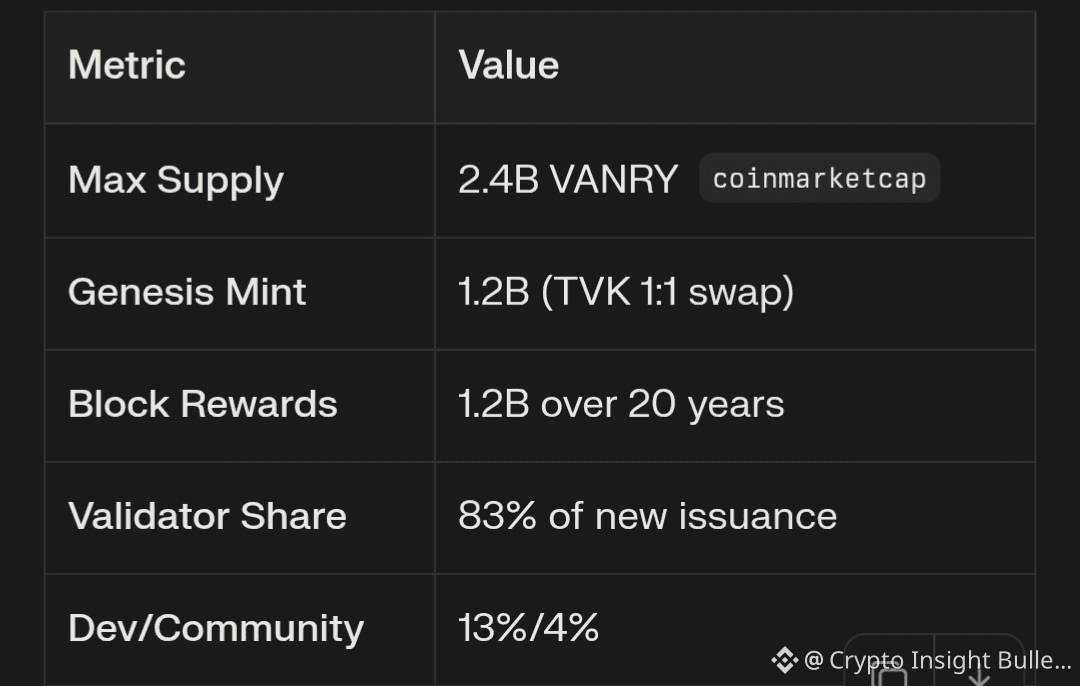
No team allocation. First in validating 7-14% APY; scale depending on adoption. Gas fee collection compounding staking returns.
Current Market Positioning
January 21, 2026 Metrics:
Price: $0.008907 (+1.52% 24h)
Market Cap: $19.81M (#738 rank)
24h Volume: $6.08M (30.72% vol/mkt cap)
FDV: $21.37M
Circulating: 2.22B / 2.4B total
Valuation Background Microscopic vs. Ethereum ($1.2T), Solana ($165B), even specific L1s like Aptos (5B+). Premature pricing of infrastructure.
Technological Signs (as of late analysis):
4H Chart: Bullish (50-day MA rising)
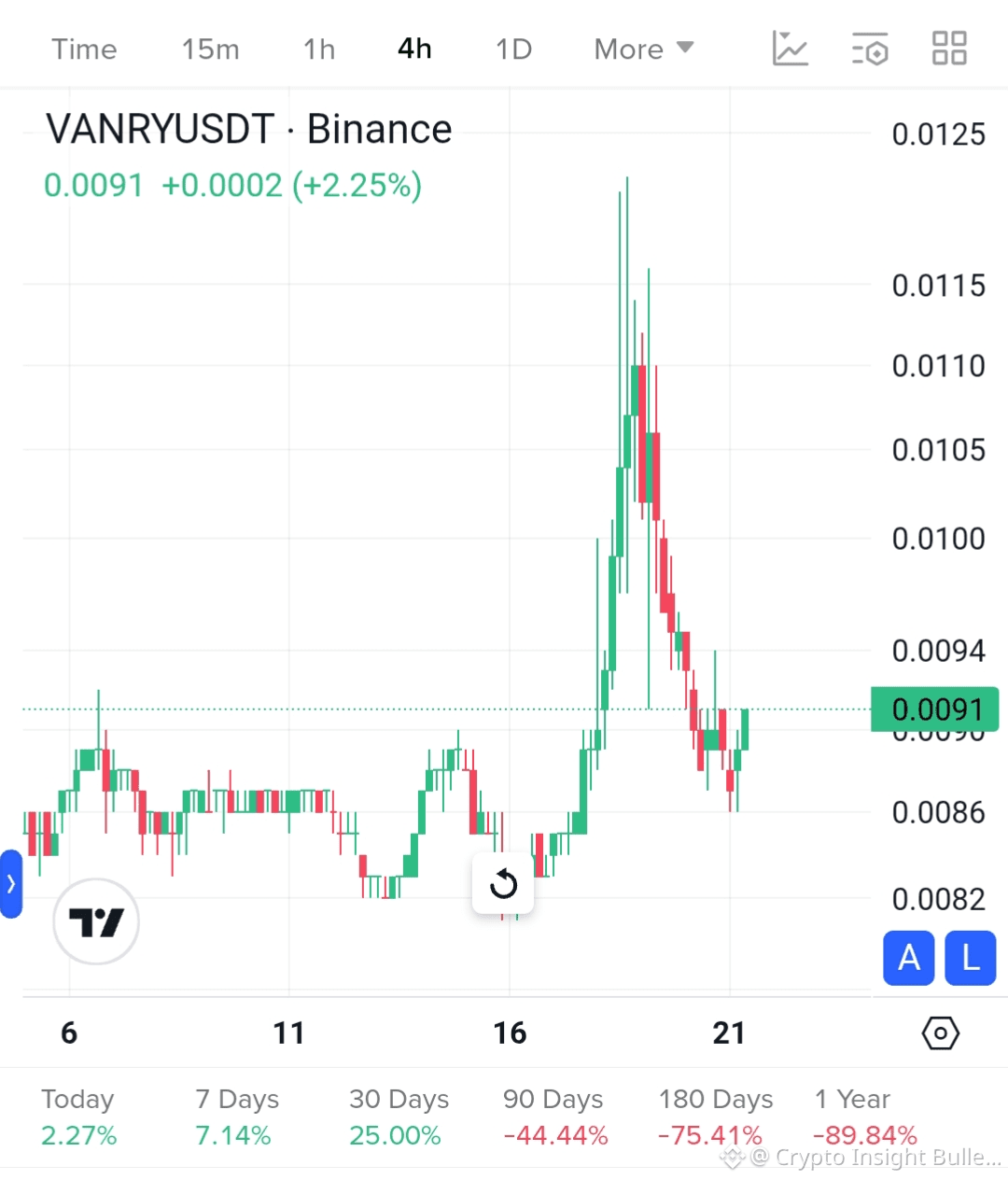
Daily Chart: Bearish (200-day MA declining since dec 2025)
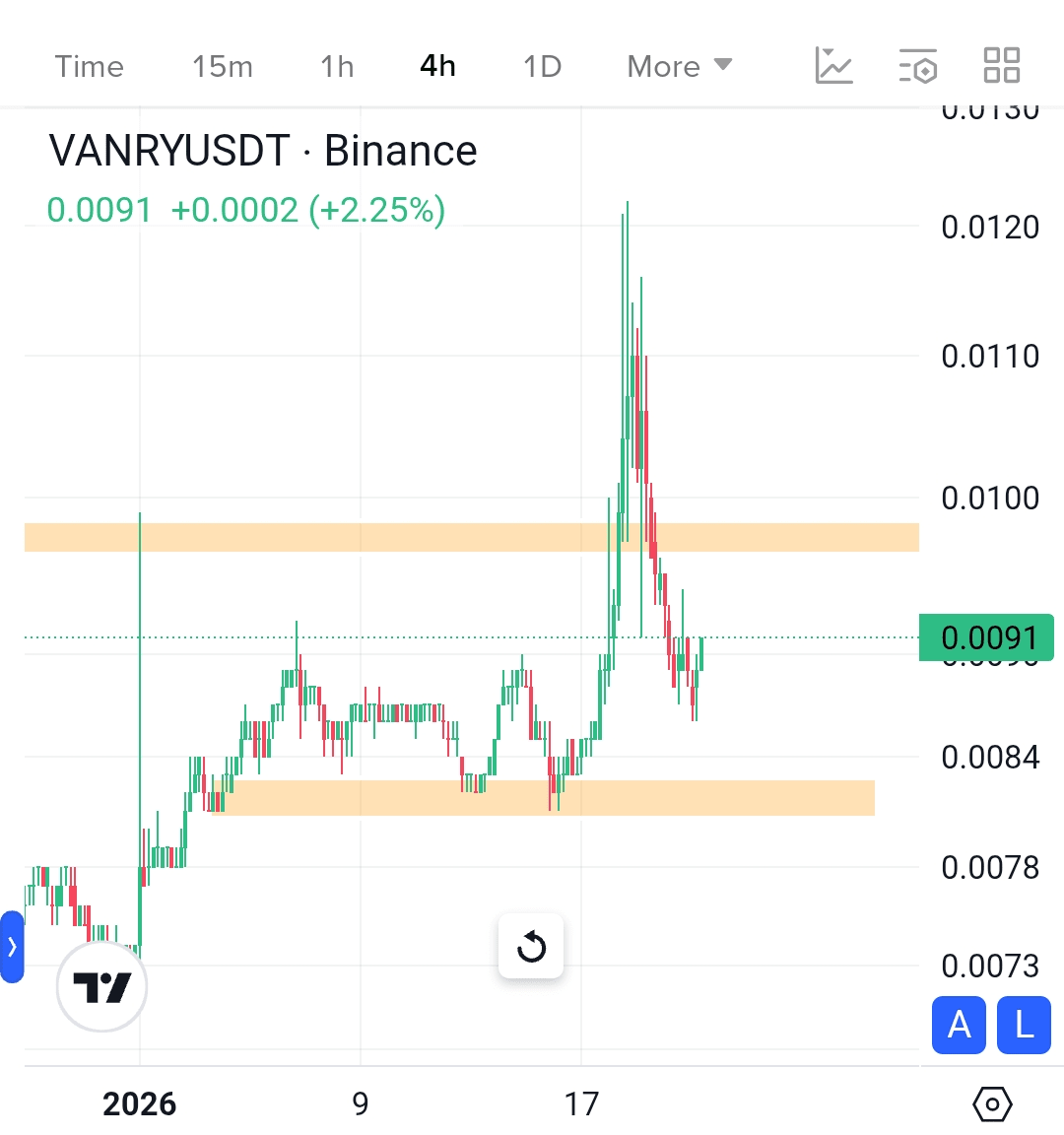
Important Levels Support $0.0082, Resistance $0.00975.
Investment Thesis & Risk Framework
Bull Case ($0.05-0.10 by 2028):
Kayon Alpha 2026 business is successful.
Worldpay pilots are turned to production (0.1% volume).
Neutron Seeds attain RWA momentum.
Staking economics is complicated by the presence of validators.
Base Case ($0.02-0.04): Ninety-five percent completion in 2/4 use cases.
Bear Case ( 0.003-0.005): technical delays, stalling of partnerships, regulatory headwinds.
Monitoring Execution Catalysts:
Feb 2026: Arcana Network CEO webinar w/ Vanar
Q1 2026: Kayon enterprise pilots revealed.
April 2026: Neutron popular debut (Vanar Vision summit)
Strategic Positioning
Vanar does not market itself based on speed of transactions (saturated). It competes by the density of intelligence per transaction - the only metric that may count in trillion-dollar workflows within enterprises. Curr. market values, the probabilities of 1% Worldpay adoption, are 0.001% and the market cap stands at $19.81M. Smart money disagrees.
To the traders: Support zone at dollar-cost average 0.008290.0085. Stake 50% position for 7-14% APY. Surveillance validator development + business declaration.
To investors: 18-36 months horizon is in line with enterprise pilot seasons. Position size indicates the risk of execution (10- 20 portfolio maximum).
Vanar Chain is not a more cost-effective or quicker one. It's smarter. And intelligence compounds.
