

When I spend time with Plasma, I don’t approach it as a new blockchain to evaluate on abstract technical merit. I approach it the same way I would approach a payment rail or a settlement network: by asking what assumptions it makes about the people who will actually use it. That framing changes everything. It shifts the focus away from what is theoretically possible and toward what is reliably usable. Plasma feels designed by people who have spent time watching how stablecoins are used in the real world, not how they are discussed online.
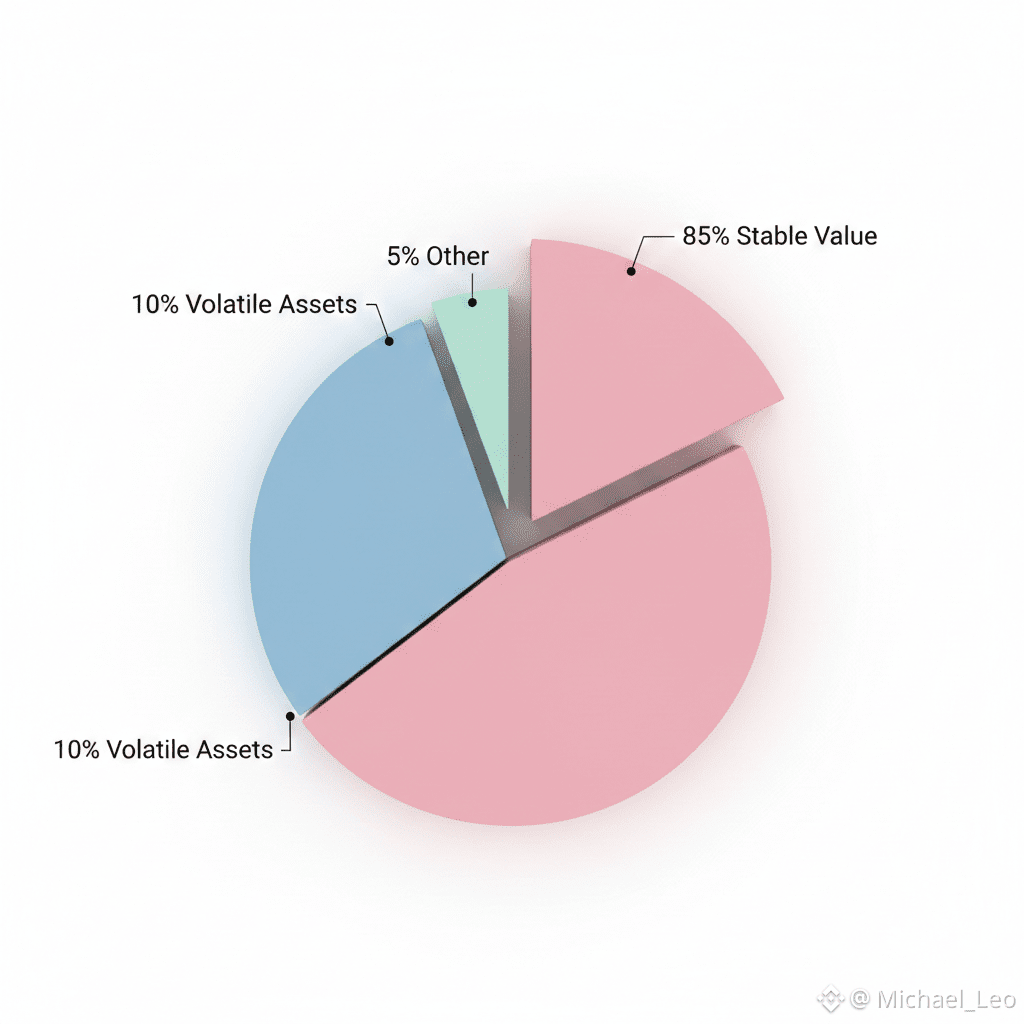
What I notice first is that Plasma is opinionated in a quiet way. It is not trying to be all things at once. It starts from a narrow but important observation: most on-chain economic activity that actually matters to everyday users revolves around stable value, not volatile assets. When someone sends USDT to a supplier, a family member, or a business partner, they are not participating in an experiment. They are completing a task. The system either supports that task smoothly or it becomes a source of stress. Plasma’s architecture reads like a response to that reality rather than a reaction to ideological debates about decentralization or expressiveness.
The emphasis on sub-second finality through PlasmaBFT makes sense when you think about how people experience payments. In most financial interactions, waiting is interpreted as uncertainty. Even a short delay creates doubt about whether something worked, whether it needs to be retried, or whether funds are temporarily lost. Deterministic finality removes that psychological friction. It aligns system behavior with human expectations. When a transaction completes, it is complete in a way that does not require follow-up checks or mental bookkeeping. That might sound mundane, but in payment systems, mundane is a feature, not a flaw.
Full EVM compatibility via Reth fits into the same pragmatic mindset. I don’t see it as a statement about developer preference or ecosystem reach. I see it as a way to reduce friction for teams who already know how to build payment logic, settlement contracts, and compliance-aware workflows. Infrastructure adoption is often less about excitement and more about familiarity. By staying compatible with existing execution environments, Plasma lowers the cost of entry without asking builders or institutions to internalize new mental models. That choice favors continuity over novelty, which is usually the right trade-off for systems that are meant to be depended on.
The stablecoin-centric features reveal even more about how the designers think about users. Gasless USDT transfers and stablecoin-first gas are not cosmetic improvements. They directly address one of the most common points of confusion for non-technical users: the idea that you need a separate, volatile asset just to move a dollar-pegged token. In traditional finance, the cost of a transaction is either implicit or abstracted away from the moment of action. Plasma mirrors that expectation. The user interacts with one unit of value and does not need to understand the internal accounting that makes the transaction possible. Complexity still exists, but it is deliberately hidden where it belongs.
This approach extends to how Plasma handles security and neutrality. The Bitcoin-anchored security model is not something most users will ever think about, and that is intentional. What matters to them is the outcome: a system that is difficult to censor, difficult to rewrite, and not easily captured by a single operator. Anchoring to Bitcoin is a way of outsourcing a portion of that trust to a system with well-understood properties, while keeping the execution environment responsive and practical. It is a layered decision that accepts architectural complexity in exchange for stronger guarantees at the settlement level.
I find this balance interesting because it acknowledges a hard truth about infrastructure design. Strong guarantees often come at the cost of speed or simplicity, while user-friendly systems sometimes weaken their security assumptions to feel smoother. Plasma appears to be trying to avoid that false choice by separating concerns. Fast execution and simple user experience live at the top, while neutrality and resistance are handled underneath, quietly and persistently. That separation allows the system to behave like a modern payment network without abandoning the properties that make on-chain settlement valuable in the first place.
When I think about real usage, I imagine Plasma being tested not by showcase applications but by repetitive, unglamorous flows. Payroll disbursements, merchant settlements, remittance corridors, and internal treasury movements are all environments where small inefficiencies compound quickly. These are not edge cases; they are the baseline. If Plasma can handle those flows without requiring constant attention from users or operators, that tells me more than any feature list ever could. Infrastructure proves itself by surviving boredom, not by generating excitement.
The role of the token only makes sense to me when viewed through this operational lens. Its purpose is to keep the system running, to pay for resources, and to align incentives between those who maintain the network and those who rely on it. In a well-designed settlement system, the token fades into the background for end users. They may never consciously interact with it, and that is a sign of success rather than a weakness. The more invisible the mechanism, the more mature the infrastructure usually is.
What Plasma ultimately signals to me is a shift in how consumer-facing blockchain systems are being thought about. Instead of asking users to meet the technology halfway, it meets users where they already are. It accepts that most people do not want to learn new concepts just to move money. They want reliability, predictability, and speed, with minimal cognitive overhead. Plasma’s design choices suggest that its builders understand this deeply and are willing to sacrifice flashiness to achieve it.
If this approach continues to guide development, it points toward a future where blockchains increasingly resemble utilities rather than platforms. They become things people rely on without naming, systems that quietly do their job and stay out of the way. As someone who values infrastructure that earns trust through consistency rather than persuasion, I find Plasma’s direction encouraging. It feels less like a statement and more like a commitment to making stablecoin settlement feel normal, which is exactly what real adoption tends to look like.

