
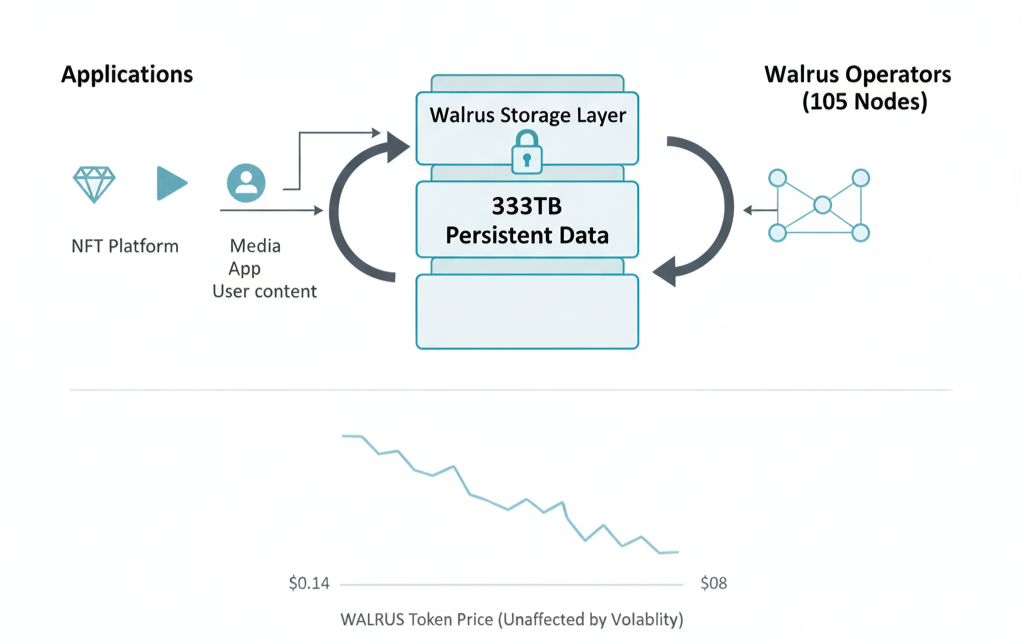
I've been watching the Walrus storage metrics expecting to see applications start pulling data as the token crashes and it's just not happening. WAL sits at $0.0811 today after testing $0.0798 overnight—that's flirting with breaking below $0.08. RSI dropped to 35.35 from yesterday's 47.81 as the recovery attempt failed. Volume spiked to $1.70M with real selling conviction. Every signal says panic. But that 333TB+ of data stored on Walrus mainnet? Still there. Still being served. Still growing slowly. Applications aren't deleting files or migrating terabytes elsewhere because data doesn't work that way.
That persistence reveals something fundamental about infrastructure versus speculation that token charts completely miss.
Traders can exit positions in seconds. Sell tokens, move capital, chase different opportunities. Infrastructure doesn't have that luxury. Data stored on Walrus represents months or years of application development, user content, business operations. You can't just delete it and start over somewhere else when the storage token dips. The switching costs are measured in engineering time, user disruption, and business risk—not just dollar amounts.
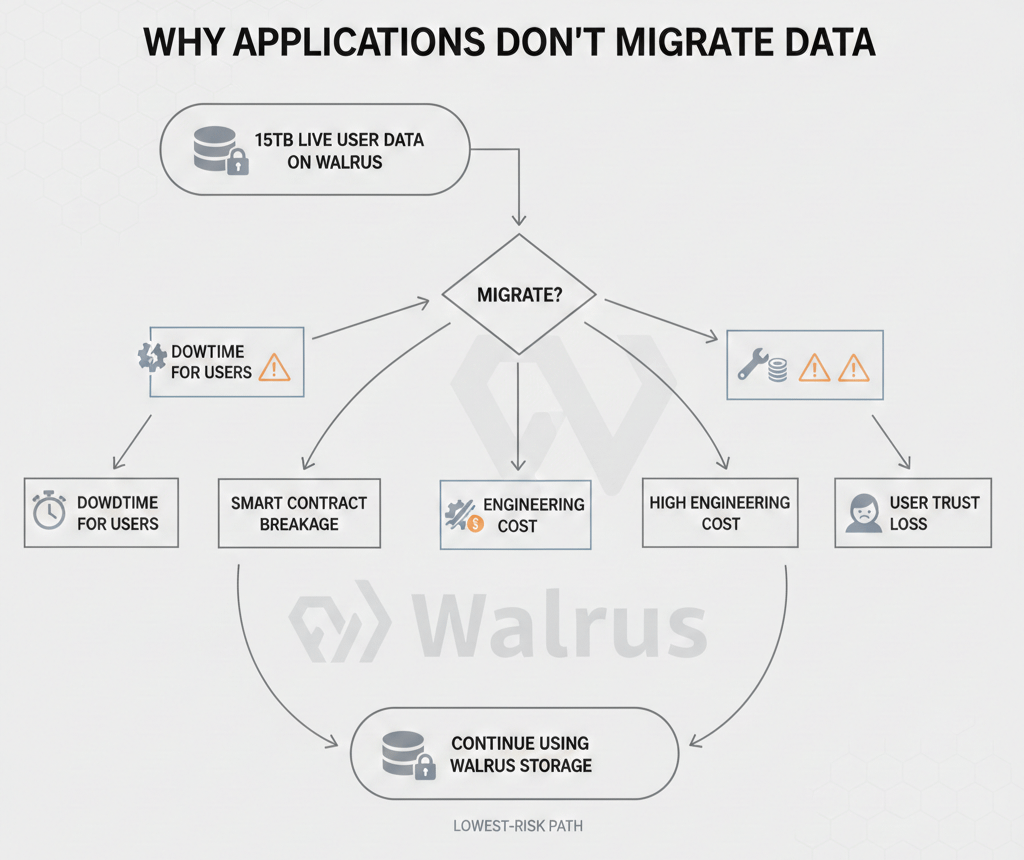
Here's what caught my attention talking to a developer. Their application has 15TB of user-generated content on Walrus accumulated over nine months. Photos, videos, documents—stuff users created and expect to remain available. When I asked if they considered migrating as WAL crashed, they looked at me like I was insane. "Where would we put 15TB? How would we move it without downtime? What do we tell users when their content temporarily disappears during migration?"
Those aren't rhetorical questions. They're real operational problems with no good answers. So they keep paying Walrus storage fees at current WAL prices because the alternative—migrating 15TB of live user data—is dramatically more expensive and risky than just continuing to operate.
The circulating supply of 1.58 billion WAL out of 5 billion max means token could fall further. More unlocks coming. More potential selling pressure. But the data already stored on Walrus isn't affected by future token price. It's there. It needs to stay available. Applications can't delete user content because the storage token crashed. They're locked in not by contracts but by operational reality.
Walrus processed over 12 terabytes during testnet when developers were validating that data could be stored and retrieved reliably. That testing created confidence to commit production data to mainnet. Once that production data exists—users depending on it, business logic referencing it, infrastructure built around it—removing it becomes nearly impossible without major disruption.
Here's a concrete example of what data persistence means. An NFT platform stores artwork for 50,000 NFTs on Walrus. That's hundreds of gigabytes of images, metadata, and access control data. The NFT smart contracts reference Walrus blob IDs directly. Token holders expect to view their artwork whenever they want. The platform can't just delete that data or migrate it elsewhere without breaking the NFT functionality for 50,000 holders.
Even if they wanted to migrate, where would they go? IPFS requires rebuilding all the blob ID references in smart contracts. S3 means centralizing what was decentralized. Arweave requires completely different integration patterns. Every alternative involves major engineering work, smart contract updates, user communication, and migration risk. Easier to just keep paying Walrus storage fees even if WAL is at $0.08.
My gut says people dramatically underestimate data inertia. Tokens can move instantly. Data can't. Once terabytes of production information exist on infrastructure, that infrastructure becomes very hard to replace. Not impossible—just costly enough that token price volatility isn't sufficient motivation to migrate unless prices fall catastrophically further or alternatives offer dramatically better value.
The RSI at 35.35 shows momentum deteriorating again after yesterday's brief recovery attempt failed. But applications managing terabytes of data don't make infrastructure decisions based on RSI. They evaluate whether their users can access data reliably. Whether performance meets requirements. Whether costs are sustainable. Walrus delivers on those operational metrics even at $0.0811.
Volume of $1.70M during the selloff shows significant trading activity. Real capital exiting. But storage usage on Walrus doesn't correlate with trading volume or token price. The 333TB of data represents commitments made over months when WAL was at various prices. Those commitments persist because data persistence is infrastructure reality.
This is where Walrus benefits from being infrastructure rather than pure speculation. Speculators already left. Sold at $0.14 or $0.12 or $0.10 or $0.09. The people still involved at $0.08 are applications serving real users who need data to stay available. Those applications can't just shut down storage because the token crashed. They're operationally locked in by their own success.
Walrus: applications serving real users can't delete data when tokens crash—that operational lock-in is infrastructure moat.
The 105 operators running Walrus nodes are serving storage requests for that 333TB regardless of what WAL trades at. They're maintaining uptime. Processing availability challenges. Ensuring data stays accessible. Because the applications depending on that data are paying storage fees even at $0.08. The operational layer keeps functioning independent of speculation because data commitments create demand independent of token price.
At $0.0811 testing psychological support around $0.08, some operators might be questioning whether continued operations make economic sense. But they're still serving the 333TB of committed data because applications can't easily move elsewhere. That creates a floor under usage that token charts don't show. Even if new storage growth stops, existing data creates baseline demand that persists.
Time will tell whether Walrus storage continues growing at $0.08 or whether new applications wait for token stability before committing data. But the 333TB already there isn't going anywhere quickly. Data persistence creates infrastructure stickiness that speculation can't match. That's why storage metrics matter more than token charts for evaluating whether Walrus survives long-term.

