

I remember when this stopped being something I only understood on paper. It was last year. Markets were uneasy, and I was moving assets across chains. Nothing big. Just a small position in tokenized bonds. Even that felt slower than it should have. Confirmations lagged. Fees shifted around without warning. And that familiar doubt showed up again, whether the transaction details were genuinely private or just lightly obscured. You know the moment. You keep your eyes on the pending screen a little too long, running through worst cases in your head. Will the network hold up. Is the privacy layer actually doing what it claims. Nothing broke, but it didn’t feel clean. A routine step felt heavier than it had any reason to be.
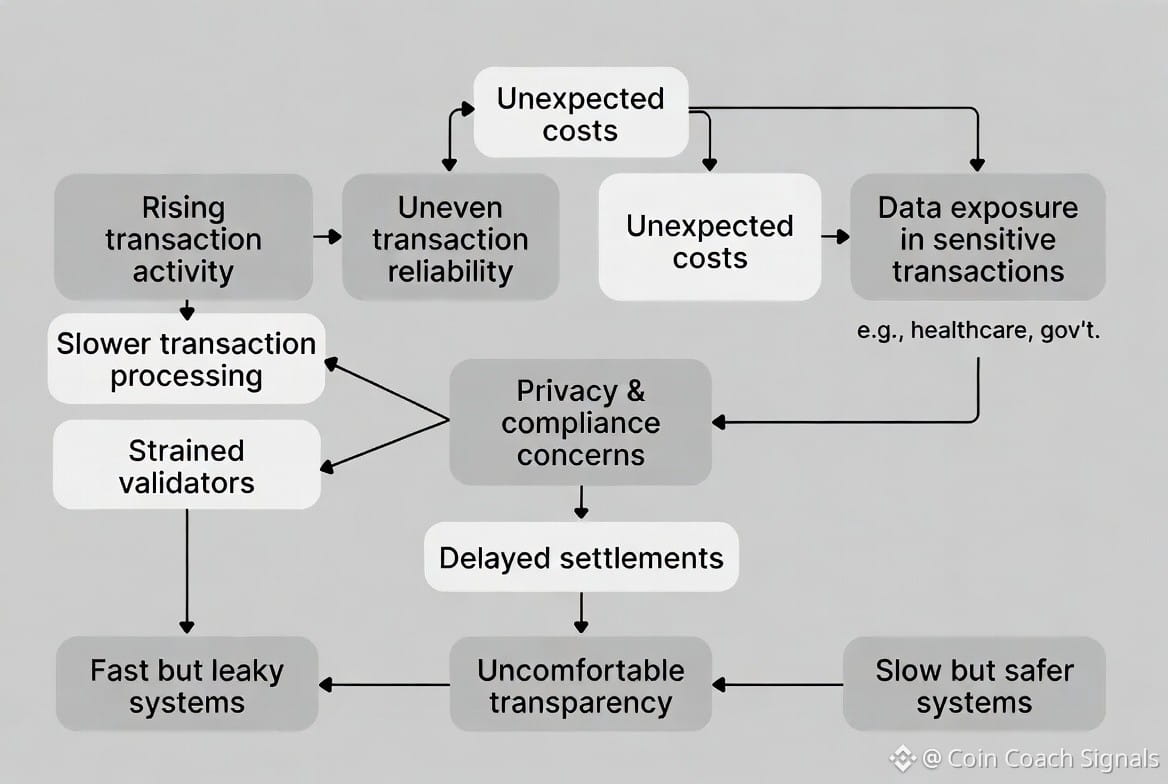
That kind of friction is common across crypto today. When activity rises, things slow down. Validators feel stretched. Reliability becomes uneven. Costs appear at the worst possible times. Add sensitive transactions into the mix and there’s always a background concern about data exposure. The experience starts to feel like working around limitations instead of moving straight through a process. Strip away the marketing and the issue is straightforward. Most chains bolt privacy and compliance on later. That choice leads to delayed settlements and transparency that institutions aren’t comfortable with. Users are left choosing between systems that move fast but leak information, or ones that feel safer but crawl. Over time, that uncertainty turns everyday actions into decisions you pause over.
It feels a lot like dealing with a traditional bank during peak hours. Long lines. Fees that never quite add up. And the quiet sense that your information is being logged somewhere you don’t really control. Nothing dramatic. Just friction that slowly adds up.
This is where Dusk Network starts to matter. Since mainnet went live in early 2025, the chain has been built around this exact problem. The focus is privacy-preserving financial use cases. Not broad DeFi. Not trend chasing. Compliant confidentiality comes first. Zero-knowledge proofs hide sensitive details like amounts and counterparties, while still allowing selective disclosure when audits or regulatory checks are required. Instead of default transparency, verification is controlled. Just as important is what the network avoids. Execution is intentionally constrained so settlement times stay predictable, even when the system is under pressure. In finance, predictability usually matters more than raw speed.
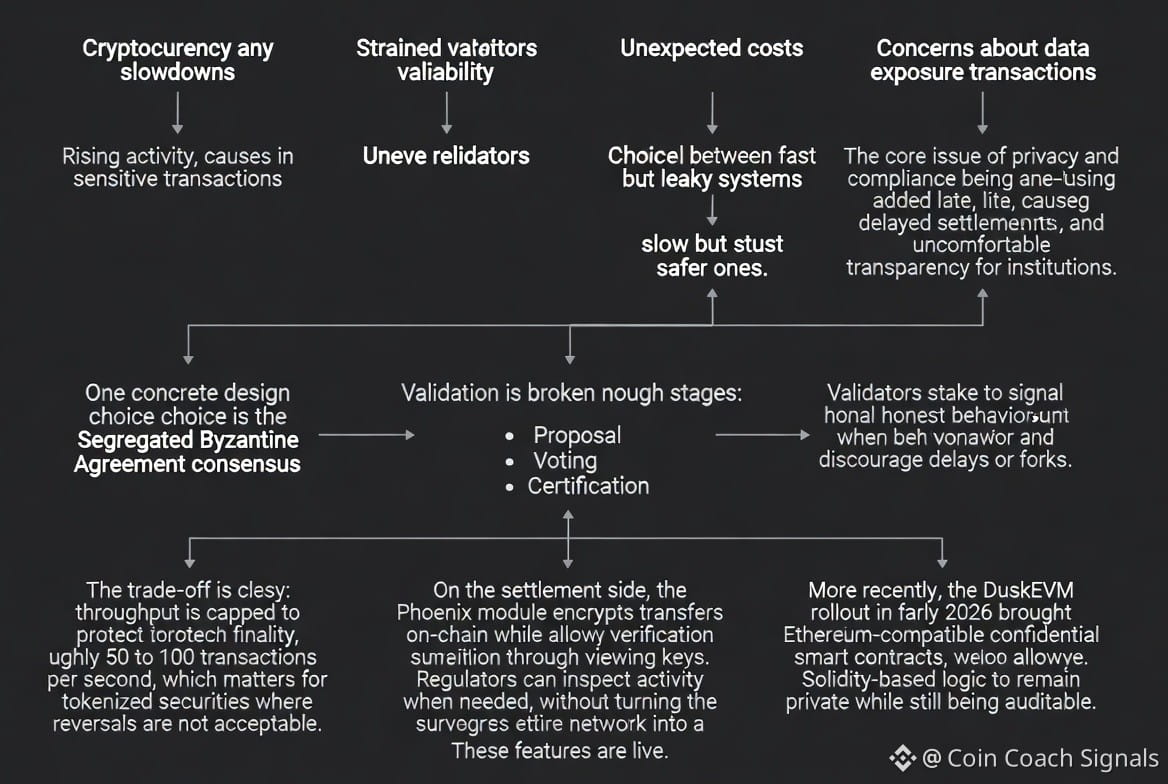
One concrete design choice is the Segregated Byzantine Agreement consensus. Validation is broken into stages. Proposal. Voting. Certification. Validators stake to signal honest behavior and discourage delays or forks. The trade-off is clear. Throughput is capped to protect finality, roughly 50 to 100 transactions per second. That matters for tokenized securities, where reversals are not acceptable. On the settlement side, the Phoenix module encrypts transfers on-chain while allowing verification through viewing keys. Regulators can inspect activity when needed, without turning the entire network into a surveillance system. These features are live. More recently, the DuskEVM rollout in early 2026 brought Ethereum-compatible confidential smart contracts, allowing Solidity-based logic to remain private while still being auditable.
On the token side, DUSK is straightforward. It pays transaction fees. It covers execution and settlement. It helps keep spam in check. Staking is central. Holders lock DUSK to act as provisioners and earn emissions for securing the network. Governance exists through staking as well. Token holders vote on upgrades and parameter changes, though participation has stayed moderate. Security is enforced through slashing. Malicious behavior, like double-signing, results in penalties. There’s no elaborate narrative here. The token exists to keep the system running.
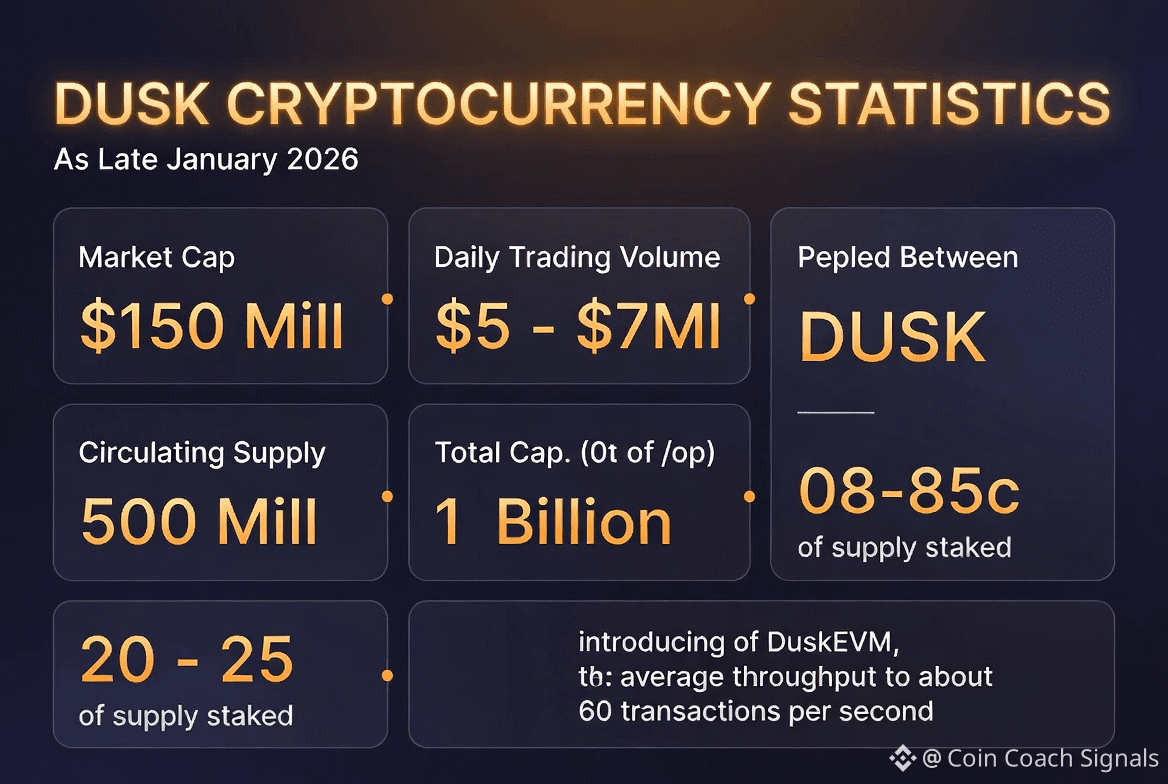
As of late January 2026, Dusk’s market cap sits around $150 million. Daily trading volume is roughly $5 to $7 million. Circulating supply is near 500 million DUSK, with emissions spread over a long schedule toward a 1 billion cap. Around 20 to 25 percent of supply is staked, supporting average throughput of about 60 transactions per second following the DuskEVM rollout.
This shows the gap between short-term trading narratives and long-term infrastructure value. Attention spikes around events like mainnet launches or integrations such as NPEX. Prices react. Then the noise fades. What actually matters is repeated use. Institutions choosing the chain for RWA tokenization because it fits European compliance frameworks. Infrastructure progress is quiet by nature. It rarely makes headlines. Products like the NPEX application, which tokenized more than €300 million in securities by mid-2026, or integrations with Chainlink CCIP for cross-chain settlement, show how the roadmap has moved beyond a basic mainnet into a more layered system with regulated data feeds.
Risks are still part of the picture. A failure case could appear during a liquidity mismatch. Large RWA redemptions. Bridges to traditional markets under strain. Off-chain verification slowing everything down. Competition is real too. Chains like Aztec or Secret offer similar privacy features with broader ecosystems, which can pull developers away. Regulation remains another unknown. Changes to European frameworks, including potential updates to DLT-TSS licensing, could either widen the opportunity or narrow it.
Looking at Dusk roughly a year into mainnet, this isn’t a story about fast wins. It’s about whether users come back for a second transaction. Not because it’s new. Because it works. When friction fades, routines form. That’s where long-term momentum really comes from.
@Dusk
