

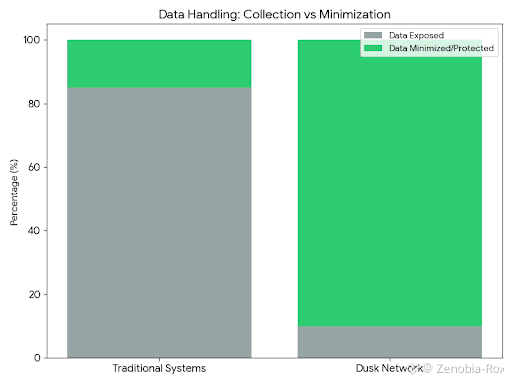
Banks and enterprises around the world are actively exploring blockchain technology, but adoption remains slow. The reason is not a lack of interest or innovation, but the reality that most blockchains were never designed for regulated, high-stakes financial environments. Institutions must operate under strict legal, regulatory, and operational constraints. They must protect sensitive customer data, comply with global regulations, support audits, and ensure financial stability. Dusk Network was created to meet these exact requirements, making $DUSK uniquely suitable for banks and enterprises.
Unlike many blockchain projects that prioritize openness at the cost of privacy, Dusk takes a more balanced approach. It recognizes that financial institutions cannot function in a system where all data is publicly visible. At the same time, it understands that regulators require transparency, accountability, and oversight. Dusk bridges this gap by embedding privacy, compliance, and auditability directly into its core protocol rather than treating them as optional features.
Financial institutions are bound by regulations such as KYC, AML, counter-terrorist financing rules, data protection laws, and reporting obligations. Traditional public blockchains struggle to support these requirements because their transparency exposes transaction details to everyone. This creates an immediate conflict with banking secrecy laws and corporate confidentiality policies. Dusk resolves this issue by enabling transactions to remain private while still being verifiable and compliant. This allows banks and enterprises to use blockchain technology without violating regulatory or legal standards.
Privacy on Dusk is not based on obscurity or off-chain workarounds. Instead, it is achieved through advanced cryptographic techniques that allow transaction validity to be proven without revealing underlying data. This means that balances, counterparties, transaction amounts, and contractual logic can remain confidential. For banks, this level of privacy is essential. Customer trust depends on the protection of personal and financial information, and enterprises must safeguard proprietary business data. Dusk ensures that confidentiality is preserved while still maintaining the integrity of the network.
One of the most critical concerns for regulators and institutions alike is auditability. Banks must be able to demonstrate compliance, trace transactions when required, and provide verifiable records to auditors and authorities. Dusk introduces a model where transactions are private by default but can be selectively disclosed. Authorized parties such as regulators, auditors, or internal compliance teams can gain access to relevant information without exposing the entire transaction history to the public. This approach supports regulatory oversight while preserving confidentiality.
Identity management is another fundamental requirement for banks and enterprises. Anonymous participation, which is common in many blockchain ecosystems, is not acceptable in regulated finance. At the same time, storing personal identity data on a public ledger creates serious privacy and security risks. Dusk enables privacy-preserving identity verification, allowing institutions to confirm that participants meet regulatory requirements without placing sensitive identity information on-chain. This supports compliant onboarding, access control, and secure participation in financial networks.
Settlement finality is essential in institutional finance. Banks cannot tolerate uncertainty about whether a transaction will be reversed or disputed. Dusk offers strong finality, ensuring that once a transaction is confirmed, it is irreversible. This is particularly important for high-value transactions, securities settlement, and interbank operations. Predictable and reliable settlement reduces counterparty risk and improves overall financial stability.
Smart contracts are a powerful tool for automation, but most blockchain platforms expose smart contract logic publicly. This transparency is unsuitable for enterprise use cases where business logic, pricing models, or contractual terms must remain confidential. Dusk supports confidential smart contracts, allowing complex agreements to execute securely without revealing sensitive details. This enables banks and enterprises to automate processes such as settlements, compliance checks, and financial agreements while maintaining confidentiality.
Tokenization of real-world assets is one of the most promising applications of blockchain for traditional finance. However, regulated asset tokenization requires strict controls around identity, access, and compliance. Dusk provides the infrastructure needed to issue, manage, and trade tokenized assets within a regulated framework. Only authorized participants can interact with these assets, and compliance rules can be enforced at the protocol level. This makes Dusk suitable for tokenizing equities, bonds, funds, and other regulated instruments.
Security is non-negotiable for banks and enterprises. Dusk is built with enterprise-grade cryptography and a strong security model designed to withstand sophisticated threats. Because privacy and compliance are integrated into the protocol rather than added externally, the system is less complex and more secure. This reduces the risk of vulnerabilities and increases confidence for institutions deploying mission-critical applications.
Another key advantage of Dusk is its ability to balance decentralization with institutional control. Private blockchains offer control but lack openness, interoperability, and innovation. Public blockchains offer openness but often lack compliance and governance structures suitable for regulated entities. Dusk operates as a public blockchain while still supporting regulated participation. Institutions can benefit from decentralization without losing control over data, governance, or regulatory obligations.
Operational efficiency is another major driver for enterprise adoption. Traditional financial systems rely on intermediaries, manual reconciliation, and slow settlement processes. Dusk enables automation through smart contracts, faster settlement, and reduced reliance on intermediaries. This lowers operational costs, reduces errors, and improves efficiency while remaining fully compliant with regulatory requirements.
For enterprises operating across multiple jurisdictions, regulatory consistency is a major challenge. Dusk’s design supports compliance with different regulatory frameworks while maintaining a unified infrastructure. This makes it easier for multinational institutions to deploy blockchain solutions without fragmenting systems or duplicating processes.
Dusk’s long-term vision is closely aligned with the needs of regulated finance. Rather than chasing short-term trends, the project focuses on building sustainable infrastructure for institutional adoption. This includes ongoing development around compliance, privacy, scalability, and governance. For banks and enterprises making long-term technology investments, this strategic alignment is critical.
Trust is a fundamental requirement in financial systems. Banks must trust the technology they use, regulators must trust that rules are being followed, and customers must trust that their data is protected. Dusk fosters trust by combining transparency where required with privacy where necessary. Its design acknowledges that trust in finance is built through accountability, security, and compliance rather than radical openness alone.
From a strategic perspective, Dusk allows banks and enterprises to explore blockchain innovation without abandoning established regulatory frameworks. It enables a gradual transition from legacy systems to modern, decentralized infrastructure. This reduces risk, supports experimentation, and allows institutions to modernize at their own pace.
In practical terms, Dusk can support a wide range of institutional use cases. These include regulated DeFi, tokenized securities, private payments, compliance-friendly lending platforms, and secure data sharing between financial institutions. Each of these use cases benefits from Dusk’s combination of privacy, auditability, and compliance.
Importantly, Dusk does not force institutions to choose between innovation and regulation. It demonstrates that blockchain technology can work within existing legal frameworks while still delivering efficiency, automation, and transparency. This makes it an attractive option for institutions that have previously viewed public blockchains as incompatible with their needs.
Ultimately, DUSK is suitable for banks and enterprises because it respects the realities of regulated finance. It recognizes that privacy, compliance, and security are not optional features but essential requirements. By designing a blockchain that aligns with institutional standards, Dusk enables banks and enterprises to harness the benefits of decentralized technology without compromising their responsibilities.
As financial institutions continue to explore digital transformation, the demand for compliant, privacy-preserving blockchain infrastructure will only grow. Dusk is positioned to meet this demand by offering a solution that feels familiar to institutions while still delivering the advantages of blockchain innovation. For banks and enterprises seeking a practical, forward-looking blockchain platform, DUSK represents a strong and credible choice.
