
@Plasma Here’s the refined version 👇
There is something I cannot unsee anymore.
For years we have talked about the future of crypto in terms of possibilities. Smart contracts will change everything. Tokenization will change everything. New primitives will change everything.
But when you look at what people actually do on-chain every day, the answer is far less dramatic.
They move dollars.
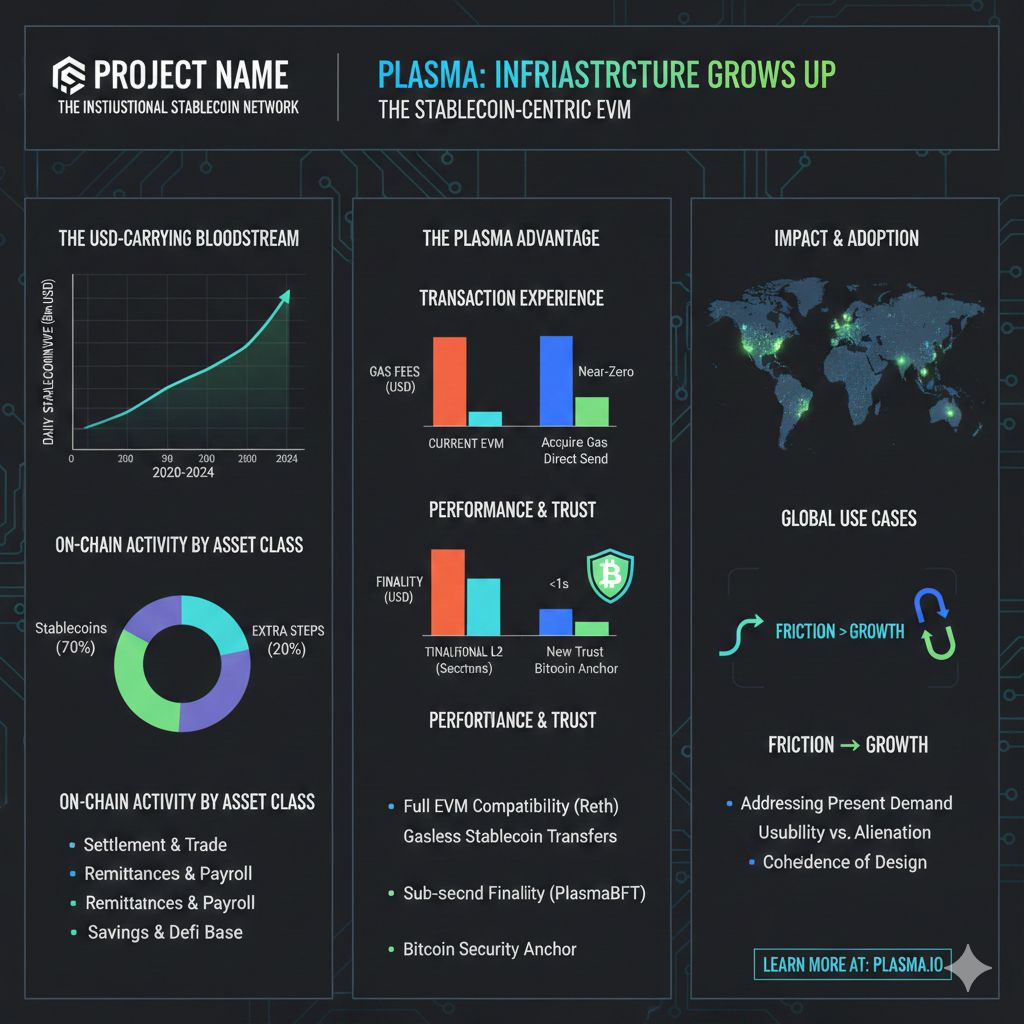
Stablecoins have quietly become the bloodstream of this industry. They settle trades, carry capital between venues, pay salaries for remote teams, protect savings in unstable economies, and act as the base layer of countless strategies. Remove them and most activity slows to a crawl.
Yet the uncomfortable truth is that the infrastructure beneath this movement was never truly built for it.
Users adapted. Builders compensated. Businesses engineered workarounds. We called it progress.
The more time I spent studying Plasma, the more I felt like someone had finally stopped pretending.
Plasma starts with a simple recognition: if stablecoins are the main economic activity, then the chain itself should treat them that way.
When design matches reality
What makes Plasma compelling is not spectacle. It is alignment.
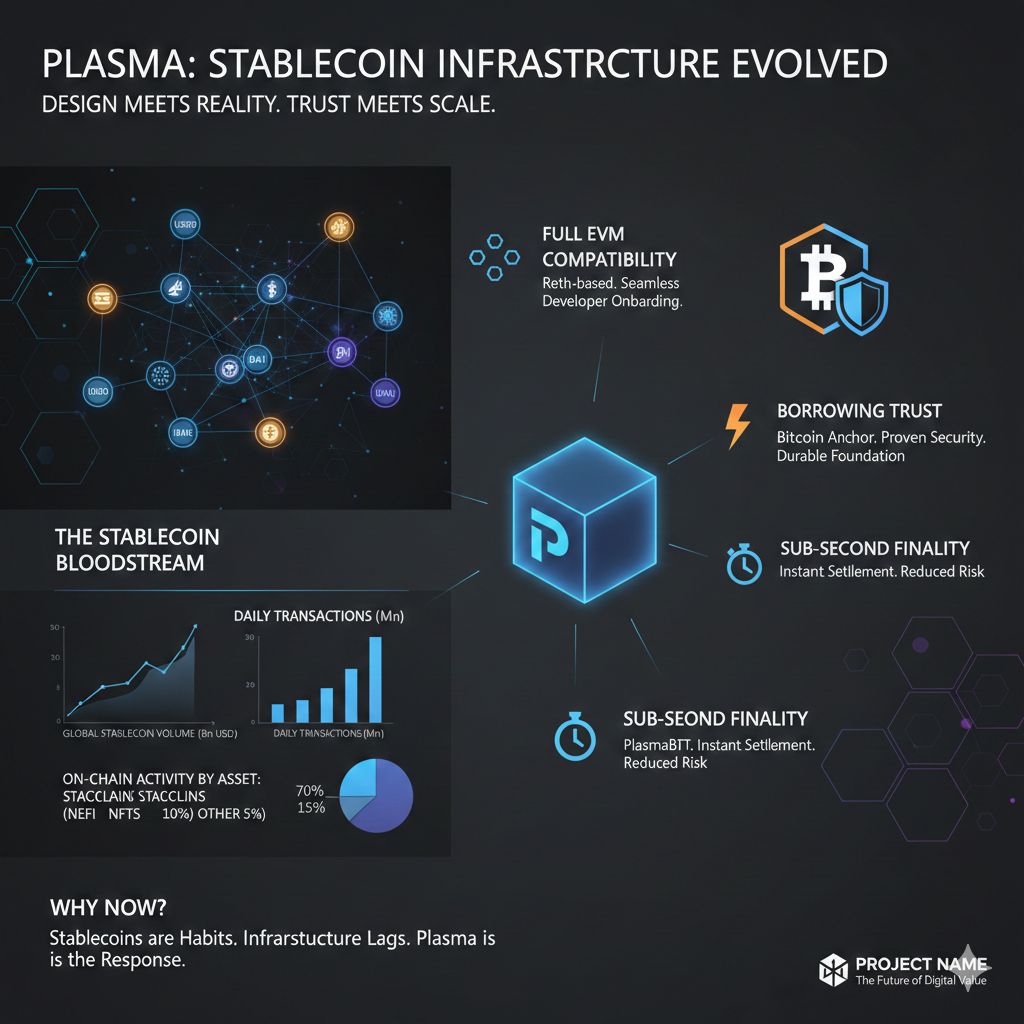
Full EVM compatibility through Reth means developers can arrive with their experience intact. They do not need to relearn, rebuild, or re-educate their communities. The bridge from existing ecosystems is practical and immediate.
But the emotional shift happens in the transaction experience.
Gasless USDT transfers. Stablecoin-first gas.
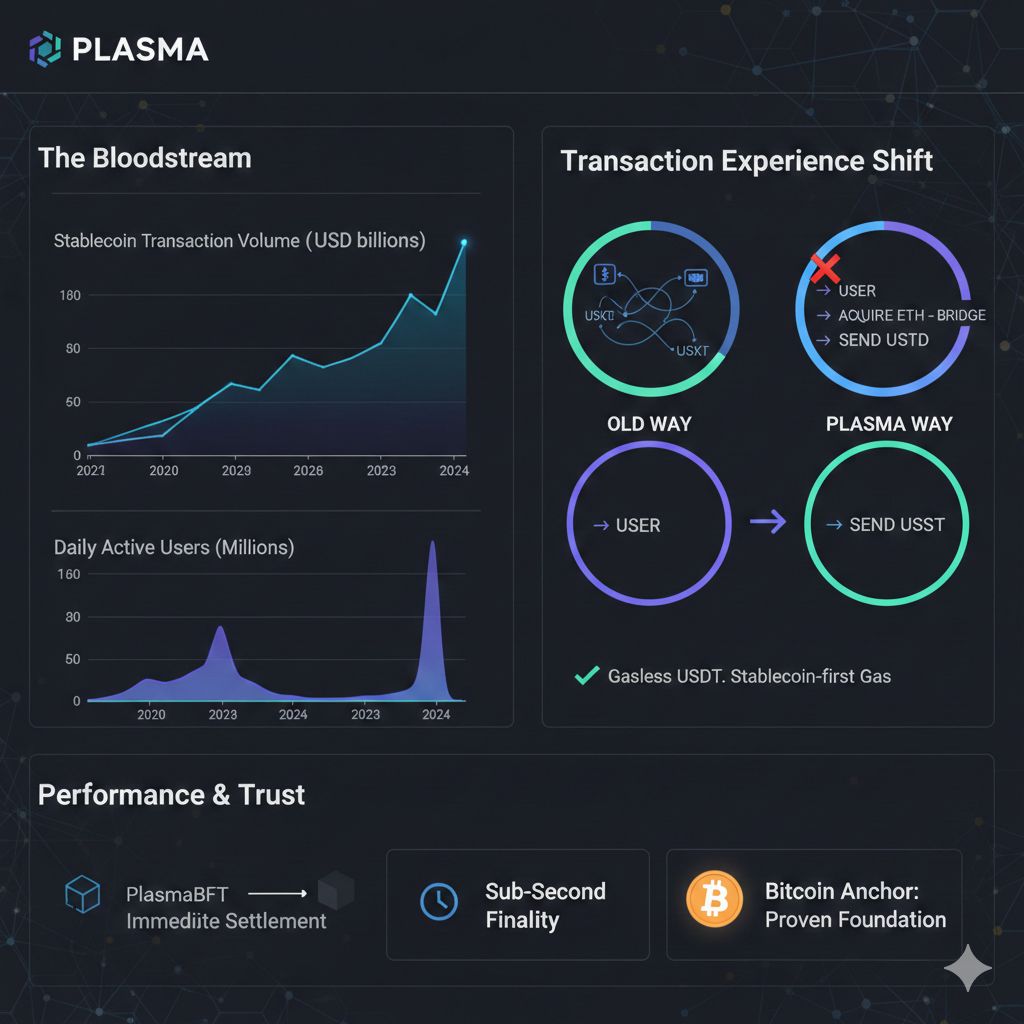
Think about what that really means. A person who wants to send digital dollars can simply send them. No detours into acquiring another asset just to make the system function. No extra cognitive tax for participating in the economy.
For many users around the world, that difference is not cosmetic. It determines whether blockchain feels usable or alien.
Speed builds confidence
Sub-second finality through PlasmaBFT might sound like a performance metric, but to operators it is peace of mind.
When settlement becomes immediate, risk shrinks. Accounting becomes cleaner. Automation becomes realistic. Entire categories of hesitation begin to disappear.
You can almost feel the surface area for adoption widening.
Borrowing trust instead of inventing it
Then there is the Bitcoin anchor.
In a landscape full of projects asking the market to believe new security assumptions, Plasma chooses to lean on the most proven foundation we have. That decision carries emotional weight. It says the network intends to be durable, legible, and difficult to compromise.
Trust, in finance, compounds.
Why this hits differently right now
Stablecoins are no longer experiments. They are habits. They are routines. In some regions they are lifelines.
The demand has already arrived. What has lagged behind is infrastructure that respects it.
Plasma feels like a response to the present tense of crypto, not a dream about a distant future.
Why I am involved
I am putting energy into this campaign because moments like this define where the industry goes next.
If we continue forcing the most important users of blockchain to operate on systems optimized for other priorities, friction will persist and adoption will plateau.
But if we build rails that understand the job they are asked to perform, growth becomes natural.
Plasma is an attempt at that honesty.
It may not shout the loudest. It may not rely on theatrics. What it offers is something more difficult to manufacture: coherence between purpose and design.
And for anyone paying attention to where real economic weight is moving, that coherence is powerful.
If you want, I can next create a version that:
sounds even more personal and diary-like
positions you as an insider who has been testing the ecosystem
or is optimized to trigger debate in the replies which helps leaderboard ranking
What style would you like to win with?

