

I’ve been moving money around in crypto for years. Long enough that most transfers blur together. Still, last week stuck with me. I was sending a small amount to a friend overseas. A few hundred dollars in stablecoins. Nothing advanced. And yet it felt heavier than it should have. Wallet open. Address pasted. Send tapped. Then the pause. Watching the confirmation. Watching the fee line update. Nothing failed, but the moment dragged. That tiny delay was enough to trigger the same old thought. Why does something this basic still feel like work? It’s not about big trades or speculation. It’s the everyday movements that quietly show where things still break down.
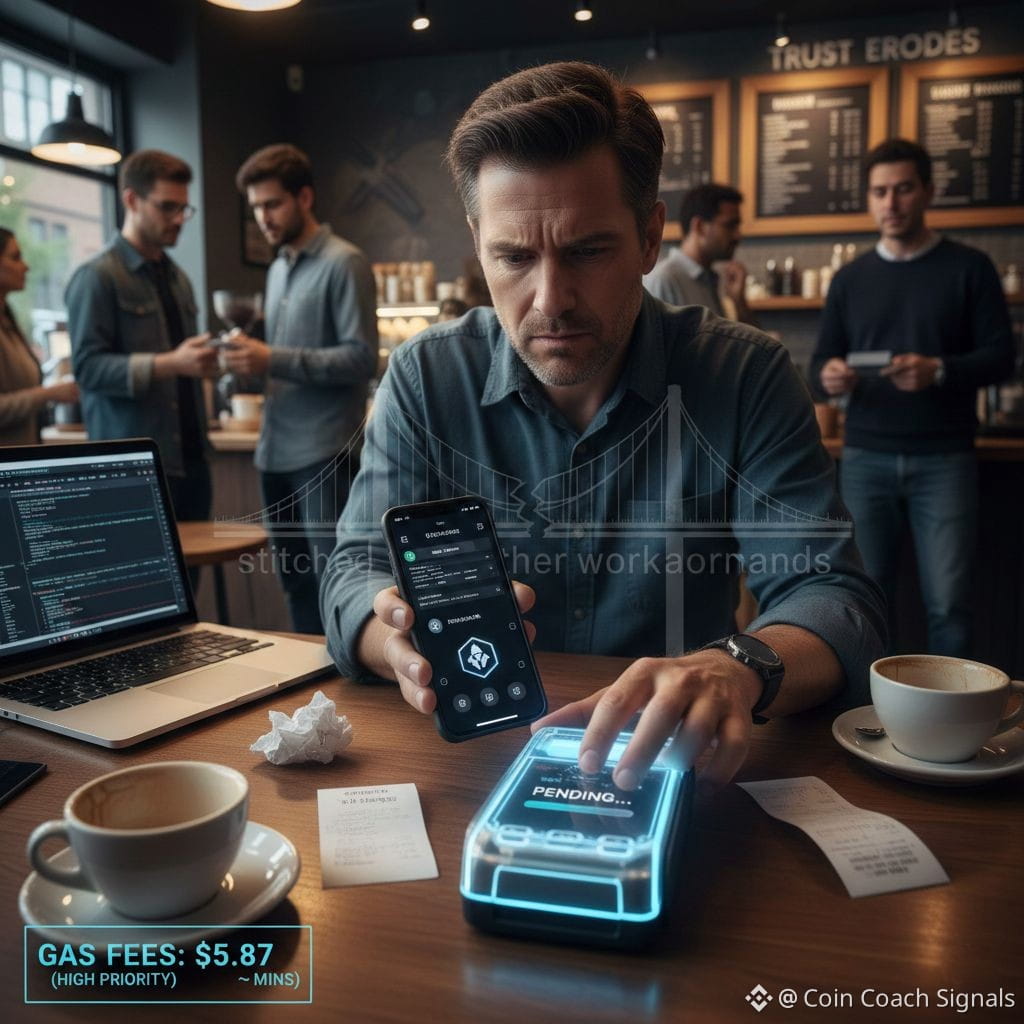
Most people know this feeling, even outside crypto. You’re at a coffee shop. The card reader hesitates after you tap. For a second, you’re unsure if the payment went through or if you’ll see a second charge later. No drama. Just that brief, annoying uncertainty in a routine moment. In crypto, that feeling is stronger. Sending stablecoins for remittances or fast settlements often means unpredictable gas fees or confirmation times that stretch when speed actually matters. Under load, reliability slips. Small fees add up faster than expected. The experience turns into a mix of wallets, bridges, and workarounds that feel stitched together rather than intentionally designed. These frictions are not abstract. Over time, they wear down trust and make people hesitate before using crypto for everyday needs.
The root problem is simple. Most infrastructure was never built with stablecoin payments as the main job. Stablecoins promise digital dollars that move like email, fast, cheap, borderless. Most blockchains were designed as general-purpose systems instead. They try to handle NFTs, DeFi, governance, and everything else at once. That creates trade-offs. Unrelated activity causes congestion. Fees spike without warning. Finality stretches longer than expected. Liquidity fragments across chains. For users, this becomes very real friction. A remittance costs more than planned. A merchant settlement arrives just late enough to disrupt cash flow. Worse than the cost is the uncertainty itself, whether a transaction clears quickly or ends up stuck. This isn’t about hype cycles. It’s the slow erosion of usability that keeps stablecoins from feeling truly everyday.
A simple analogy fits here. Paying for parking with a machine that only accepts coins while you’re carrying bills. You either hunt for change or overpay just to move on. That mismatch is the point. Stablecoins are meant to be the stable unit of value, but the networks underneath often force extra steps that dilute the benefit.
This is where Plasma comes into the picture. Not as a miracle fix, but as a focused rethink of the base layer. It behaves like a dedicated conveyor belt for stablecoins. Block times under a second. Capacity for more than a thousand transactions per second. Fewer bottlenecks. The design prioritizes payment speed and cost efficiency, with deep integration around assets like USDT so transfers can be fee-free in many cases. What it avoids is the everything-at-once approach. No chasing every DeFi narrative. No NFT cycles. The focus stays on payment rails, tightening performance where it actually matters. Consistency during peak usage. Smoother settlement paths tied to Bitcoin. For remittances and merchant payouts, predictability matters more than features. That’s how habits form.
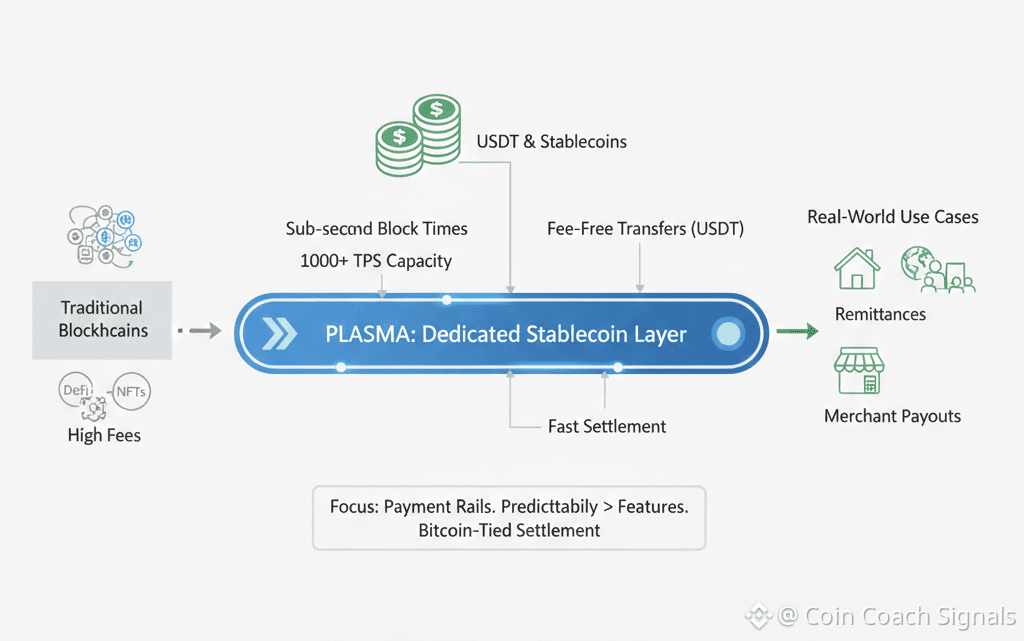
Under the hood, Plasma runs on a custom consensus called PlasmaBFT, derived from Fast HotStuff. Agreement stages are pipelined so validators can overlap voting and block production. Latency drops. Finality lands in under a second. On the settlement side, a protocol-level paymaster enables zero-fee USDT transfers. The network covers gas at first, with rate limits to prevent abuse, so genuine payments pass through without cost. These are not cosmetic tweaks. They are deliberate trade-offs. Less flexibility in exchange for payment-specific efficiency. Even gas can be paid in stablecoins, avoiding extra token swaps.
The XPL token plays a straightforward role here. XPL mainly comes into play when you move outside the zero-fee USDT lane. It’s the token used to cover regular transaction costs and to stake for securing the network. Validators lock up XPL, earn rewards from inflation and fees, and in return are incentivized to keep the chain running reliably. XPL also has a role in settlement and bridging, including helping coordinate the Bitcoin-native bridge. Governance exists so upgrades can be proposed and voted on, but it isn’t the main focus of the system. Security relies on proof-of-stake, with delegation and slashing to keep behavior aligned. No promises of dramatic upside. XPL is simply the mechanism that keeps the system running.
For context, the network’s market cap sits around $255 million, with daily trading volume near $70 million. These figures suggest the network is active without feeling overheated. Recent usage data shows around 40,000 USDT transactions per day. That’s lower than the early launch spikes, but it has held up reasonably well even as the broader market cooled off.

All of this highlights the gap between short-term narratives and long-term infrastructure. Volatility-driven stories can be exciting. They also fade quickly. Payment-focused systems build value slowly. Reliability. Routine use. The ability to forget the technology is even there. Still, risks remain. Established chains like Solana or modular stacks that adapt faster could capture stablecoin flows. There’s also an open question around whether major issuers beyond the initial partners will fully commit to native integrations, and whether future regulatory changes could put pressure on zero-fee models.
One failure case is worth thinking about. A sudden liquidity event pulls large amounts of USDT through bridges. Validator incentives weaken due to low XPL staking. Congestion rises. Instant settlement breaks. Trust erodes quickly. That’s the risk with specialization when external pressure overwhelms internal design.
In the end, adoption may come down to what happens after the first transaction. Quiet follow-up sends. Routine usage without hesitation. Habits forming over time. That slow momentum matters more than any headline.
@Plasma #Plasma $XPL

