

Digital agreements are everywhere in finance, but most of them still lean on shaky trust. OTC trades, tokenized assets, private loans, institutional settlements they all face the same challenge: how do you make commitments that everyone can rely on, without spilling sensitive details? Legal contracts give you enforcement, but they’re slow, hard to automate, and don’t play well across borders. Smart contracts automate the process, but in doing so, they put everything out in the open. There’s a built-in contradiction here. Finance needs privacy to work, but decentralized systems demand transparency. Dusk’s framework doesn’t pretend to erase this tension; it works with it.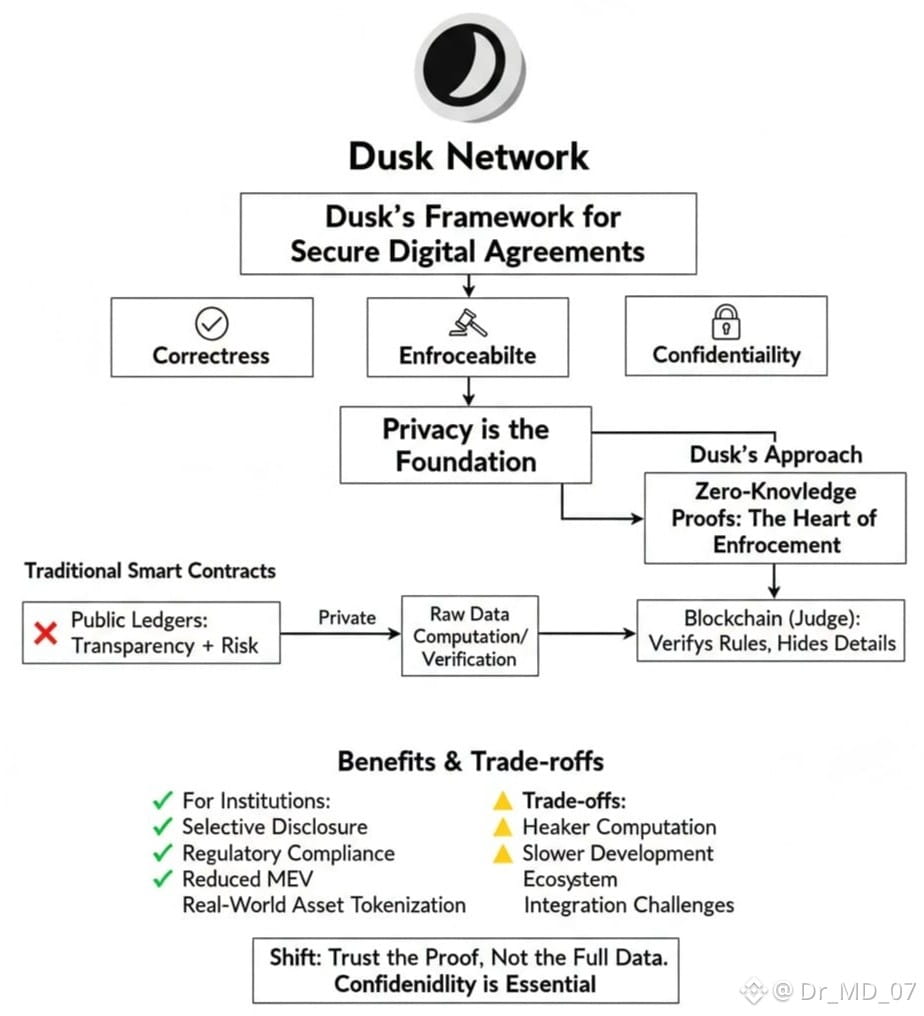
Strip a digital agreement down to the basics and you find three things that matter: correctness, enforceability, and confidentiality. Most blockchains get the first two right and let the third one slide. Public ledgers can prove something happened, but they’re terrible at keeping secrets. Dusk turns that on its head. Privacy isn’t a bonus feature it’s the foundation. The framework is built so that you can check whether rules were followed, but you never get to peek at the raw data behind the scenes.
On the technical side, Dusk doesn’t treat zero-knowledge proofs as just a privacy add-on. They’re the heart of the enforcement mechanism. That’s important. Instead of running everything out in the open and then scrambling to hide parts of it, Dusk makes sure only the cryptographic proof ever hits the blockchain. The proof says, “Yes, all the rules were met balances, permissions, constraints without naming names, showing amounts, or exposing how the logic works.” I like to think of it as a sealed agreement: the blockchain acts like a judge, confirming everyone played by the rules, but never seeing the private details.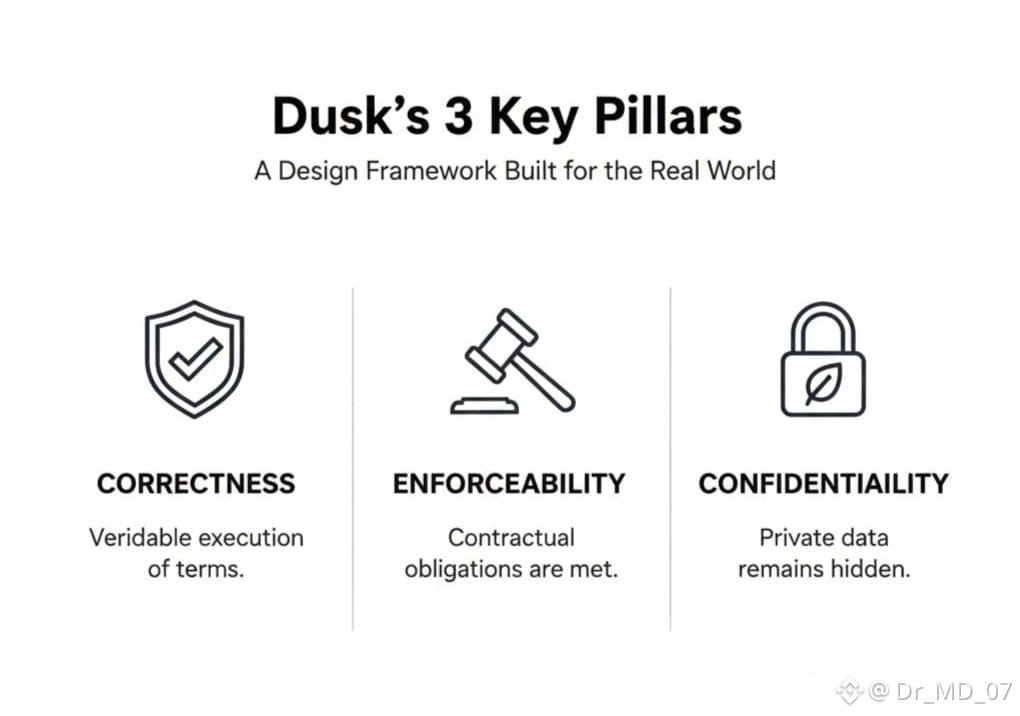
Design-wise, this approach shrinks the amount of information you put on-chain. Every extra byte out there creates friction with regulators and opens up new attack surfaces. Dusk avoids this by only putting out what’s strictly needed for verification. That matters right now, because institutions are watching crypto, but they won’t join if it means broadcasting their strategies. Asset managers, market makers, big enterprises they’re not against blockchains, but they won’t reveal their positions in real time. Dusk’s framework is built for them.
The timing fits the broader crypto landscape. As tokenization reaches into real-world assets, privacy isn’t optional anymore; it’s required. Regulated markets need selective disclosure the power to prove compliance to the right people, without making everything public. Dusk delivers that by separating “can you verify this?” from “can you see everything?” The same goes for the rise of more complex on-chain finance. As bilateral and multilateral agreements become the norm, running everything out in the open just isn’t workable. Dusk lets these deals live on-chain without turning them into public intelligence.
But no system is perfect. Zero-knowledge proofs mean heavier computation, which slows things down and makes development a little trickier. Developers have to think differently privacy-first contracts aren’t written like standard Solidity ones. There’s an ecosystem trade-off, too: private agreements don’t mesh as easily with everything else, which can slow down network effects. Still, these aren’t bugs. They’re the price you pay for privacy. Like security, privacy never comes free.
Different users feel the impact in different ways. Builders get tools to create apps that look and feel like real financial infrastructure, not just DeFi experiments. Investors get a stake in the idea that privacy is a must for institutions, not just a nice-to-have. Traders see less information leaking out, which should mean less MEV and fewer wild swings markets get a little saner.
For me, what’s striking is how Dusk flips the idea of trust. Instead of saying, “Trust the code, even though it shows you everything,” it says, “Trust the proof it reveals nothing except that the rules were followed.” That’s a quiet but profound shift. It brings blockchains closer to how serious, real-world agreements actually work, where confidentiality isn’t optional it’s essential.
