
A few years ago, Ah Zu worked at a company where the office had a NAS that looked quite professional, with RAID set up clearly. The boss emphasized in the group every day, 'We have three backups, no worries.' Until one day, the air conditioning in the server room failed, the chassis alarmed for high temperatures, and the RAID array lost two drives in succession, the whole cabinet blinking with red lights. The IT guy got up in the middle of the night to rescue it, spending two days and one night to recover the data bit by bit from the remote backup. The boss said, 'Thanks to you all,' but that week no one actually slept well because everyone knew that this time it was just luck; next time might not be the same.
Since that day, I have completely lost my sense of security regarding the phrase: 'Make a few more copies, and you'll be safe.' This is true for small volumes, but once data reaches tens or hundreds of TB and nodes are churning wildly, 'making more copies' either becomes outrageously expensive or doesn't help at all when incidents stack up. Many so-called decentralized storage solutions fundamentally follow this path, just swapping hard drives for nodes and server rooms for networks; it looks very Web3 but fundamentally relies on 'stacking replicas for peace of mind.'
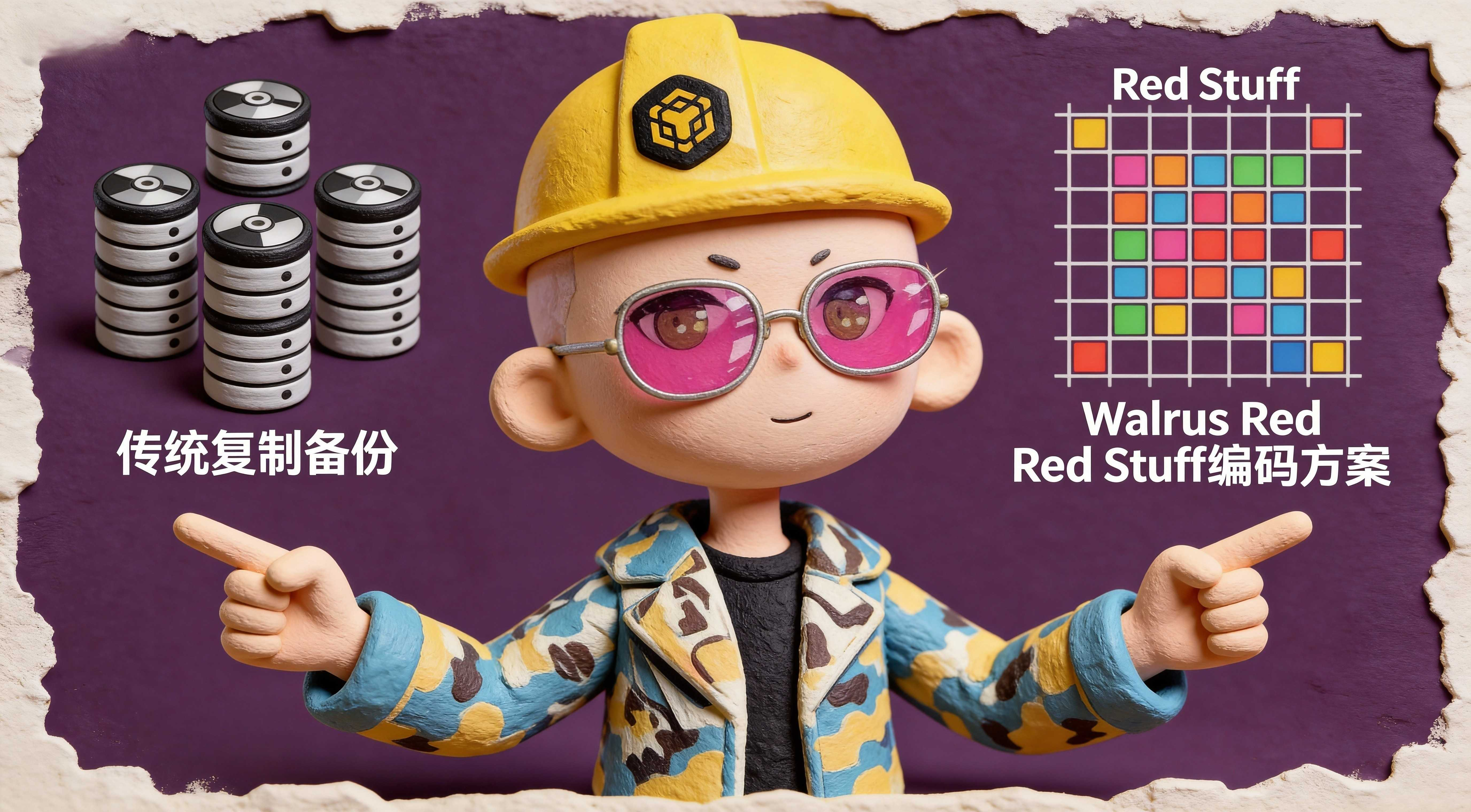
For developers at the infrastructure level and investors, the question is actually quite simple: Is it possible, under acceptable redundancy costs, to make reliability a matter 'written in mathematics' rather than just spoken by the project team? The answer Walrus provides is the combination of Red Stuff and PoA.
First, let's talk about the well-known old problem: replication vs erasure coding. The advantage of full replication is its simplicity and ease of recovery; if one copy fails, just copy another from somewhere else. The downside is equally straightforward: copying a 1TB file 5 times means 5TB, and copying it 10 times means 10TB, leading to linear increases in cost and management complexity. Thus, the industry began to adopt erasure coding, slicing files and adding parity blocks, allowing for recovery as long as a sufficient number of pieces are available; the theory is quite elegant.
The problem is that one-dimensional erasure coding has two fatal pain points in decentralized environments: one is node churn, making it difficult to guarantee that those specific pieces are online during recovery; the other is recovery bandwidth, where many implementations ultimately end up with 'losing a little, having to re-fetch a lot.' For TB-level blobs, O(|blob|) level recovery feels not much different from full replication.

What Red Stuff does is pull this matter into two dimensions. You can imagine your blob as a 'pixel map' cut into a grid, where each row and column has undergone erasure coding. In this way, if a small piece is lost, you only need to fill in a small section along that row or column, with the amount of data recovered being approximately O(|blob|/n); it's 'recover as much as lost,' not 're-lift the entire file.' In the background, the protocol can continuously self-heal using this two-dimensional structure: with nodes coming and going endlessly, the system quietly re-encodes and fills in gaps without needing a massive network migration or relying on some central scheduler.
More importantly, Red Stuff is not a standalone encoding library but rather the foundation of the responsibility and punishment mechanisms that come after Walrus. If you want to seriously say on-chain, 'I really stored this,' mere encoding is far from enough; there needs to be a clear starting point of responsibility. This is where PoA comes into play.
PoA, short for Point of Availability, can be roughly understood as 'the point of availability hammer.' The client first uses Red Stuff to encode the blob into a bunch of slivers, calculates a commitment, and then registers this data's ID, size, lease, and other metadata on Sui. Each storage node receives its respective sliver, and after verifying its accuracy, signs and returns the statement 'I have stored this piece of data.' Once the client collects enough signatures, they can piece together a certificate of availability to send back to the chain. From the moment this certificate is written into the chain, this blob is no longer just 'a user uploaded a bunch of bytes,' but becomes a formal responsibility object of the entire network.

With PoA, developers have a clear boundary when writing applications: Before PoA, it was an 'effort-based' upload process; after PoA, you can confidently assume, 'This thing must be readable, otherwise someone will have to pay for it.' However, merely writing the point of responsibility on the chain is not enough; you also have to continuously verify that those nodes are not 'running off after signing.'
The difficulty lies in the fact that Walrus assumes an asynchronous network, meaning it doesn’t expect everyone to have a synchronized clock and doesn’t pre-set an upper limit on message delays. In such an environment, if the challenge mechanism is poorly designed, malicious actors can always exploit the time gaps: guessing challenges in advance, temporarily pulling data, or relying on delays to 'pull a fast one.' Walrus's approach combines the structure of Red Stuff with asynchronous randomness to design a completely asynchronous challenge process, allowing for 'spot checks' to be mathematically plausible.
You could make a not-so-rigorous analogy: this is a particularly cunning exam supervisor who will never tell you in advance which day attendance will be taken, who will be called, or which section will need to be recited; instead, they use a random method recognized by the whole class to suddenly call your name and a specific content. If you haven't studied, relying on last-minute efforts won’t work. In Walrus, the one called out is a specific node's particular sliver, which must present data and proof to demonstrate that it has indeed stored that content from start to finish. If caught lying or slacking off, there will be corresponding economic penalties, and the signatures on the PoA will turn into evidence for accountability.
Red Stuff, PoA, and asynchronous challenges bind together to form the type of engineering solution that Walrus aims for: 'low redundancy + high reliability.' The former addresses 'how to support large-scale fault tolerance with 4.x times the cost,' the middle layer addresses 'from when this becomes the network's responsibility,' and the latter continuously questions in real asynchronous environments, 'Are you really fulfilling this responsibility?'
Whether the real world will accept this can be seen in the numbers. The esports club Team Liquid has already migrated its content library, which exceeds 250TB, to Walrus, with match recordings, behind-the-scenes footage, and historical materials all becoming on-chain assets that can be scheduled within the Sui ecosystem. If you don’t trust the underlying data layer’s reliability, it’s hard to migrate at scale; this is one of the highest votes of confidence in the protocol's reliability.
For underlying developers, Walrus provides a relatively clean abstraction: the chain only manages the blob's ID, lease, payment, and permissions, while the actual TB-level content is handled by Red Stuff combined with PoA and challenges to ensure reliability. You don’t have to figure out how to maintain high redundancy and recoverability across a bunch of nodes yourself. For infrastructure investors, this story is not 'just another storage coin,' but a path that incorporates reliability, costs, and the costs of malicious behavior into mathematics and protocols.
The answer that Walrus provides is not 'trust me,' but a complete set of engineering designs that advance these issues to the rigor of academic papers.
This is why I would say: it rewrites the nightmare of 'if the hard drive fails, it's all over' into a very low probability event that you can calculate with a calculator.
#Walrus $WAL @Walrus 🦭/acc


