
That’s a fascinating (and slightly mind-bending) update to our understanding of the solar system! You’re likely referring to the recent high-precision data from missions like NASA’s **InSight lander** and the **Mars Reconnaissance Orbiter**, which have allowed scientists to measure Martian physics with unprecedented accuracy.
While Einstein’s theories of relativity are universal, the practical application on Mars is a masterclass in why "space time" isn't just a sci-fi trope.
---
## The Einstein Connection: Why Time Drifts
Einstein’s **General Relativity** tells us that gravity warps the fabric of space-time. The stronger the gravity, the slower time passes (gravitational time dilation).
* **Mass Matters:** Mars has only about **38% of Earth’s gravity**.
* **The Result:** Because Mars is less massive than Earth, time actually moves slightly **faster** on Mars than it does here.
* **Velocity Matters:** Einstein’s **Special Relativity** also plays a role. Because Mars and Earth move at different orbital speeds, their relative clocks drift even further apart.
---
## Why This Matters for Future Missions
For a robot or a human on the surface, the difference is minuscule—roughly a few milliseconds per day. However, for modern technology, those milliseconds are an eternity.
### 1. GPS and Navigation
Just as Earth-based GPS satellites have to account for relativity to stay accurate, Martian positioning systems will fail if they don't compensate for the Red Planet’s specific "time signature." A tiny error in time leads to a massive error in landing coordinates.
### 2. Deep Space Communication
Data packets sent between Earth and Mars rely on synchronized timestamps. As we move toward a "Martian Internet," the lag and the drift must be baked into the software to prevent data corruption.
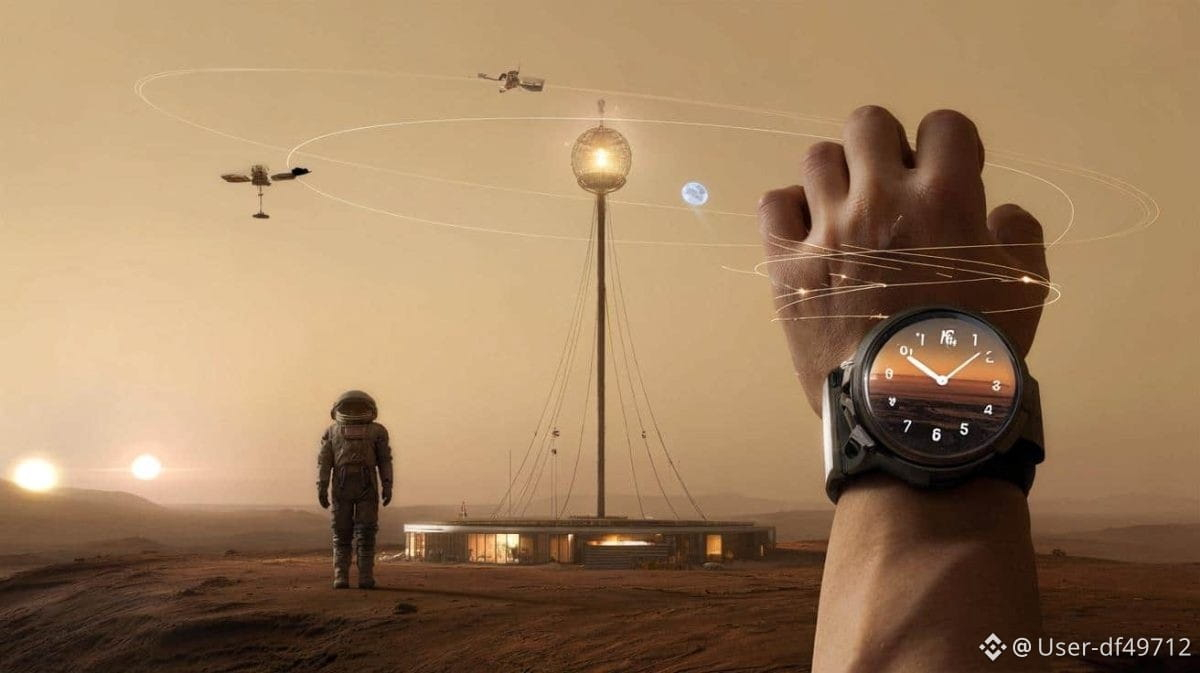
### 3. The "Mars Clock" Challenge
Future colonists won't just be dealing with a different length of day (a **Sol** is 24 hours and 39 minutes); they will be living in a slightly faster temporal reality.
---
## Fun Fact: Mars is Speeding Up
Recent data from the RISE instrument on InSight actually showed that Mars' rotation is **accelerating** slightly every year. This shortens the Martian day by a fraction of a millisecond, adding another layer of complexity for mission planners trying to keep the clocks synced.
> **The Big Picture:** Einstein predicted that time is not a constant, but a local experience. Mars is simply the first place where we are forced to treat that "local experience" as a critical engineering requirement.
Would you like me to dive deeper into how we currently synchronize clocks between Earth and the Mars rovers?#AISocialNetworkMoltbook $BNB
