

Early blockchains made one big, quiet assumption: to verify something, you have to show everything. If you want people to trust the system, everyone gets to see every last detail. That idea gave the first blockchains their sense of trust and honestly, it worked fine when things were simple. But as money, complexity, and cutthroat behavior piled in, that old assumption started to feel more like a shackle than a strength.@Dusk flips this on its head. It treats knowledge and proof as two separate things. Knowledge means the guts of a transaction: balances, strategies, partners, timing, all the moving pieces. Proof is different it’s just a guarantee that the rules were followed and outcomes are valid. Most blockchains mash these together, broadcasting all the details so anyone can verify. Dusk goes out of its way to keep them apart.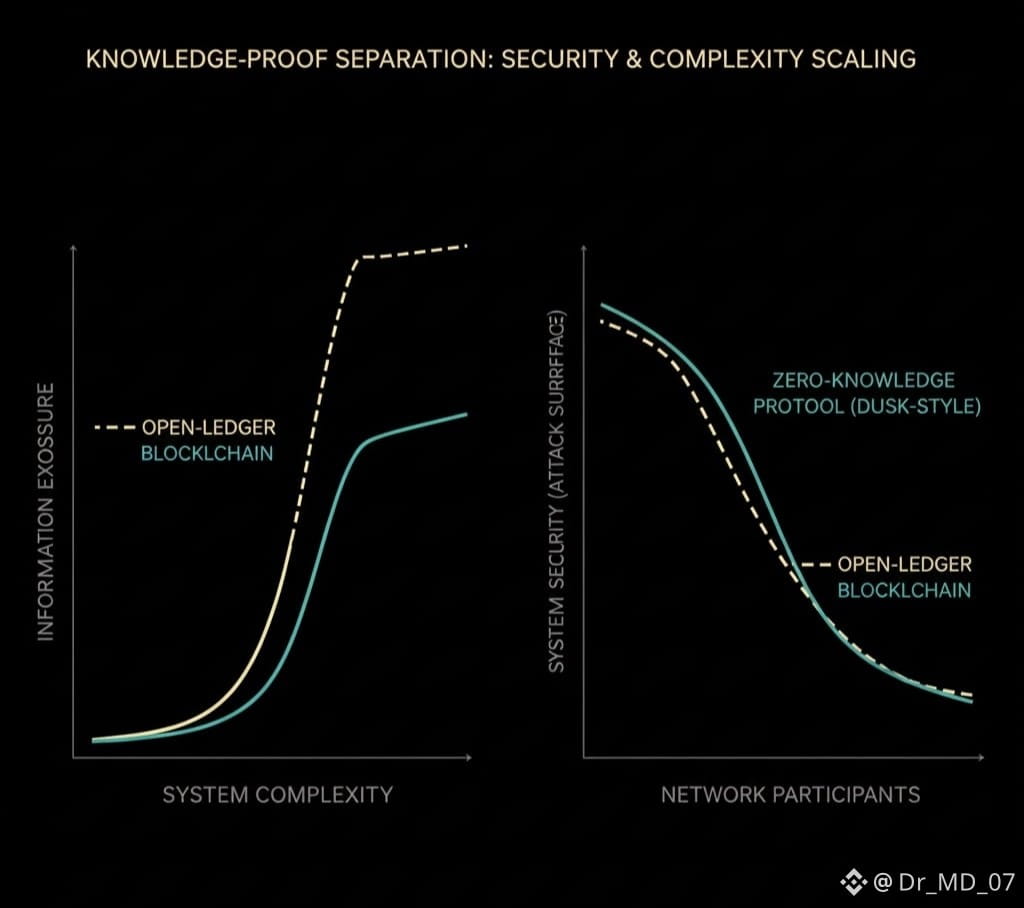
In classic open-ledger systems, the whole process is built on observation. You can trust a transaction because you see its whole history. Sure, this works when spilling the beans is cheap and no one’s smart or motivated enough to abuse it. But throw in real competition, and suddenly all that visibility turns into a weapon. Observers get an edge they can profit without taking risks, just by watching. Information becomes ammo.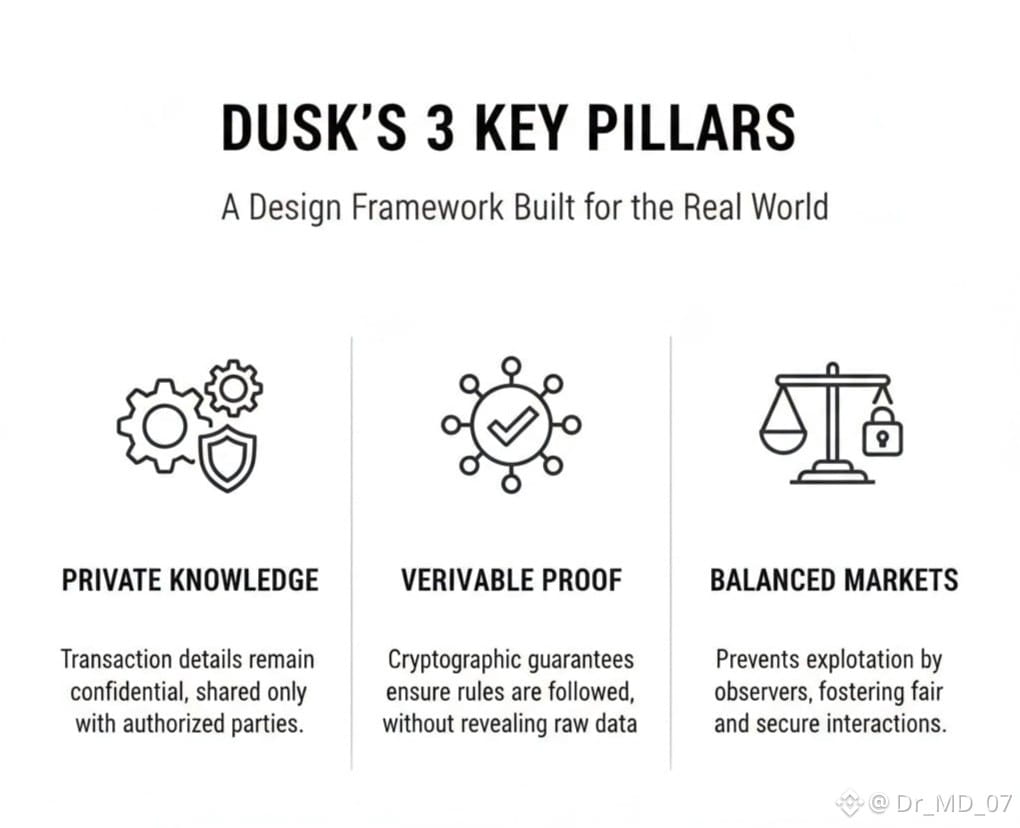
From where I sit, mixing up verification with visibility is just a shortcut. Seeing everything isn’t the same as proving things are correct it’s just easier when the stakes are low. But as the stakes rise, the cost of exposing everything starts to bite.
Dusk’s design lets people keep their knowledge private. They create cryptographic proofs showing they played by the rules, and the network checks those proofs no need to see the underlying data. This isn’t about hiding or being sneaky. It’s about precision. Only reveal what the system needs, nothing more.
You really see the value of this when you look at how complex logic works under the spotlight. If all the internal state is public, it’s child’s play for others to guess what you’re up to. They can front-run your trades, and running anything clever becomes dangerous because everyone can see your playbook. By splitting proof from knowledge, Dusk makes it so no one has to piece together your intentions from raw data.
What grabs me most about this is how it echoes how trust works in the real world. Courts, auditors, regulators they don’t need every detail of every action. They need evidence that the rules were followed. Trust comes from reliable guarantees, not total transparency. Dusk bakes that thinking right into its protocol.
This matters more now than ever. As crypto infrastructure matures, blockchains have to handle compliance, smart contracts, complex partnerships, long-term deals. All that stuff gets fragile if you expose every detail. The more complicated the system, the more dangerous it is to be completely transparent.
To me, this explains why so many advanced DeFi ideas never make it past the drawing board. They just can’t survive with everything out in the open there’s too much risk. With Dusk, splitting knowledge and proof makes it safer to build complicated things, because you shrink the attack surface.
There’s a price, of course. Proofs take more computing power. Developers need to think harder about rules, and the tools aren’t as slick as the old, see-everything systems. But the payoff is real. Less information leaks out, so fewer people can exploit the system, and markets get healthier especially where there’s big money and long-term strategies.
The main hurdle is getting people to use it. Builders and users have to rethink habits formed in the era of total transparency. And sometimes, markets stick with what’s easy instead of what’s robust. But in my view, this will shift over time. As money and strategies get more sophisticated, people will want proof without full disclosure. It’s inevitable.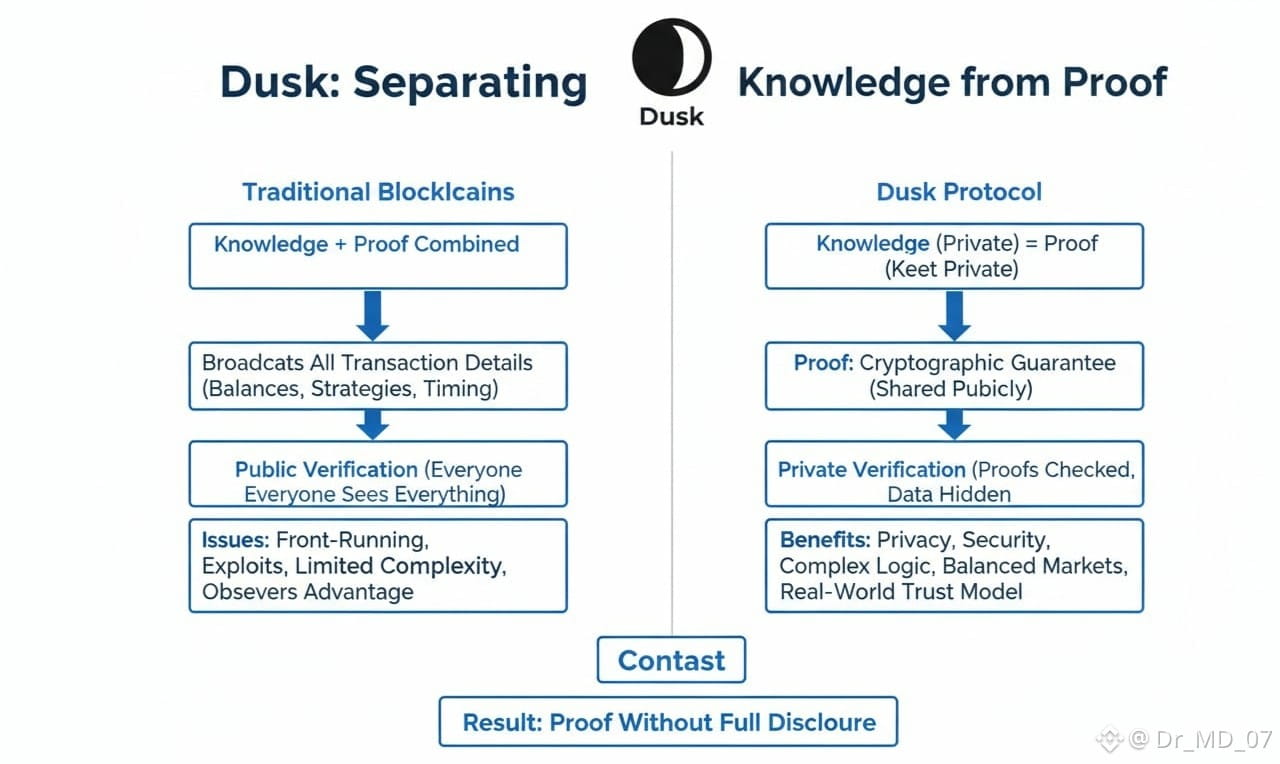
In the end, separating knowledge from proof isn’t just about privacy it’s a core security tool. Blockchains that force everyone to see everything will always tip the scales toward observers, not participants. Dusk’s approach brings things back into balance. You can prove things are right, without turning information into a weapon.
