
At the beginning of 2026, conditions are forming for price growth against the backdrop of the launch of spot exchange-traded funds, the issuance of a new stablecoin, and the expansion of tokenization capabilities on its own blockchain.
In this regard, the dynamics of XRP will depend on the maintenance of regulatory transparency in the USA and whether investor interest in XRP-based products will remain despite increasing competition.
How ETFs on XRP have changed demand
In a recent report, the management company 21Shares estimated the probability of XRP reaching $2.69 by 2026 at 30%, calling this scenario bullish. The forecast is based on several key achievements of XRP and Ripple in 2025.
In August 2025, a years-long dispute with the U.S. Securities and Exchange Commission (SEC) over the status of the cryptocurrency concluded. After this, XRP became available again for American financial firms, banks, and payment operators. The resolution of the conflict with the SEC became a reason for launching spot ETFs based on XRP in the U.S.
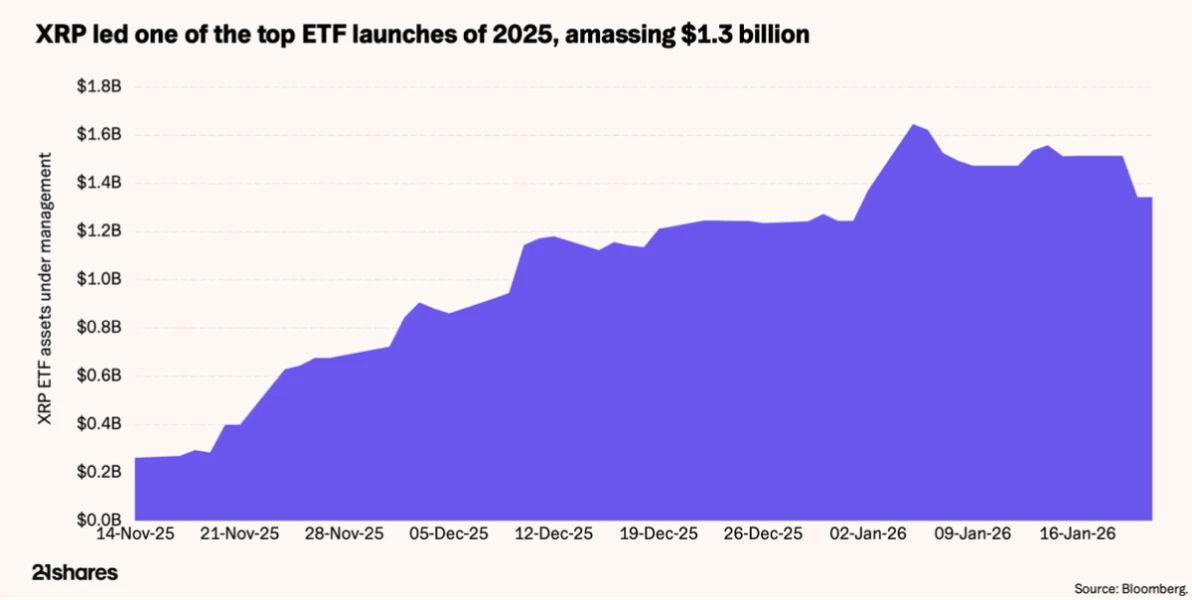
According to 21Shares analyst Matt Mena, the launch of the ETF radically changed the demand landscape for this asset. Just one month after the launch, the funds attracted over $1.3 billion in assets under management.
«Not everyone understands that the ETF on XRP set a world record. The instrument has become the leader in the duration of continuous inflows of funds, regardless of the asset class, outpacing stocks, commodities, bonds, and even Bitcoin, for more than 50 days in a row. This is truly an impressive result,» said Mena in a conversation with BeInCrypto.
In addition to ETFs, XRP has also gained several new products that have become drivers of growth.
XRPL expands the possibilities of tokenized finance
By 2030, analysts at 21Shares expect that the global financial system will transition to hybrid rails, combining tokenized bank deposits, regulated stablecoins backed by fiat currencies, and compatible settlement levels.
Against the backdrop of growing interest in the tokenization of finance, Mena calls the XRP Ledger (XRPL) a neutral settlement layer that connects liquidity, speed, and compliance with regulatory requirements.
Recently, activity in the network has increasingly focused on the possibilities of programmable infrastructure. This allows institutional players to issue and service complex RWA assets, such as bonds and stocks.
At the same time, the effectiveness of the XRP stablecoin — RLUSD as a liquidity tool — strengthens the opinion of 21Shares analysts about the further growth of XRP, provided user interest remains strong and continues to grow.
The report highlights an impressive acceleration — the market capitalization of RLUSD has grown by approximately 1,800%: from $72 million to $1.38 billion in less than a year. Such growth gives the stablecoin potential for use as collateral in large institutional cases and expanded financial instruments.
But even against the backdrop of recent growth, the asset continues to face serious competition from other large networks. It remains to withstand demand from investors — only this way can the bullish scenario be realized.
Risks of decline and the influence of competition on the market
The decrease in interest in XRP-ETFs, insufficient inflow of real assets into XRPL, and the slow spread of RLUSD — these factors may lead to different scenarios for XRP's price dynamics.
In addition to the optimistic scenario, 21Shares is also considering alternative options depending on the market situation and the pace of adoption. The base scenario with a 50% probability suggests regulation supportive of a stable flow of investments into ETFs and a smooth increase in utility. Under such conditions, XRP could be worth around $2.45.
Analysts estimate the bearish scenario at -16%: with a decrease in demand and capital outflow to competing assets, the price could approach $1.60.
In addition to the risk of reduced demand for XRP, competitive pressure is also increasing. Over the past year, networks such as Canton, Solana, and others have noticeably grown.
Canton, launched less than two years ago, has already processed assets worth trillions of dollars in tokenized form.
However, Mena did not express serious concern about the increasing competition. He acknowledged the scale and dynamics of other networks but pointed out the XRP community as the main distinction.
«The XRP Army is one of the largest and most prominent communities in the crypto industry. Besides Bitcoin and Dogecoin, it's hard to find another token that is as well-known, even to those who are distant from cryptocurrencies,» he noted.
For XRP, 2026 will be a test — whether it can turn this momentum into sustainable value.
