
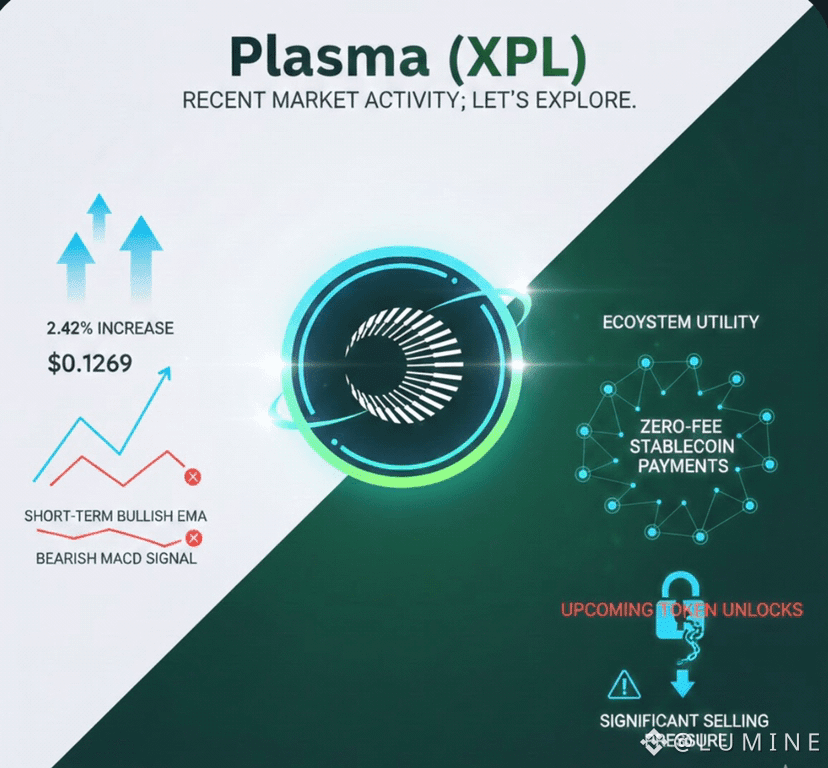
In a market often driven by noise, narratives, and short lived hype cycles, Plasma (XPL) has been quietly positioning itself as something different: an infrastructure-first project designed to solve real payment friction rather than chase speculative attention. At the time of writing, Plasma (XPL) is trading at $0.1269, marking a 2.42% increase over the last 24 hours. That price movement may seem modest on the surface, but beneath it lies a layered story of technical signals, ecosystem ambition, and looming token dynamics that deserve closer inspection.
This is not a hype piece. It’s a grounded, professional, and organic exploration of where Plasma stands today and where it could be heading next.
Let’s explore.
Understanding the Current Market Context
Before diving into indicators or ecosystem narratives, it’s important to zoom out and understand why Plasma is attracting renewed attention. The crypto market is entering a phase where utility is being re-priced. Investors are increasingly asking harder questions:
Does this protocol actually solve something?
Is there real usage potential beyond speculation?
How sustainable is its token economy?
Plasma operates at the intersection of these questions. It is not trying to be everything at once. Instead, it has chosen a specific lane: zero-fee stablecoin payments, optimized for scale, speed, and real-world usability.
The recent 2.42% price increase suggests renewed market engagement, but price alone never tells the full story. To understand what’s happening and what may happen next we need to break the analysis into three critical dimensions: price dynamics, ecosystem utility, and unlock pressure.
Price Dynamics: Momentum With Mixed Signals
Short-Term EMA: A Bullish Undertone
From a technical perspective, Plasma currently shows a short-term bullish EMA (Exponential Moving Average) trend. This is often interpreted as a sign that recent buying pressure is outweighing selling pressure, at least in the near term.
EMA trends are particularly useful because they respond more quickly to price changes than simple moving averages. In Plasma’s case, the EMA alignment suggests:
Buyers are stepping in on dips
Short-term sentiment has shifted from neutral to cautiously optimistic
Market participants are willing to pay slightly higher prices over time
This doesn’t guarantee continuation, but it does indicate that XPL is not being aggressively sold down at current levels. For traders and momentum watchers, this is often the first signal that an asset may be entering a short-term accumulation phase.
MACD: A Bearish Counterweight
However, the picture is not one-sided. Alongside the bullish EMA trend, Plasma is also flashing a recent bearish MACD (Moving Average Convergence Divergence) signal.
This divergence between EMA and MACD tells a more nuanced story.
A bearish MACD signal often suggests:
Momentum is slowing
The rate of upward movement is weakening
A short-term pullback or consolidation may occur
Rather than signaling an outright reversal, this type of setup frequently leads to sideways price action. In other words, the market may be taking a breath—digesting recent gains while waiting for a catalyst.
What This Means for Market Participants
When bullish EMA trends coexist with bearish MACD signals, the market is usually at a decision point. Plasma is not in a clear breakout phase, nor is it in a breakdown. It is hovering in a zone where:
Long-term participants are watching fundamentals
Short-term traders are cautious
Volatility may compress before expansion
For investors, this kind of technical tension often precedes directional clarity. The question becomes: will the next catalyst come from ecosystem growth—or from token supply dynamics?
Ecosystem Utility: The Quiet Strength of Plasma
Zero-Fee Stablecoin Payments: A Rare Focus
Plasma’s core value proposition is refreshingly specific: zero-fee stablecoin payments. In an industry where transaction costs, network congestion, and unpredictable fees still plague everyday use cases, Plasma aims to remove friction entirely.
This is not a minor detail.
Stablecoins are increasingly being used for:
Cross-border payments
Payroll and remittances
Merchant settlements
Treasury management
Yet fees—whether on Layer 1 or Layer 2 networks—remain a barrier to mass adoption. Plasma’s zero-fee architecture positions it as an infrastructure layer optimized not for speculation, but for flow.
Why This Matters More Than Ever
As regulation tightens and traditional finance edges closer to blockchain rails, networks that prioritize predictability and efficiency gain an edge. Plasma’s focus on stablecoins means it aligns naturally with:
Businesses seeking cost certainty
Developers building payment-heavy applications
Users who value speed over yield farming
Instead of competing with DeFi protocols chasing high APRs, Plasma quietly supports the plumbing that makes everyday crypto use possible.
Ecosystem Expansion: Beyond a Single Use Case
While payments are the foundation, Plasma’s ecosystem is designed to expand outward. A payments layer is only as powerful as the applications built on top of it. As the ecosystem grows, Plasma aims to support:
Wallet integrations
Merchant tools
Settlement layers for fintech platforms
Cross-chain stablecoin flows
This approach reflects a long-term mindset. Rather than launching dozens of half-baked features, Plasma is building a base that others can reliably build upon.
Utility vs. Speculation
One of the most underrated aspects of Plasma is its refusal to oversell. In a market saturated with grand promises, Plasma’s value lies in execution. This doesn’t always translate into immediate price explosions—but it does build credibility.
Projects with real utility often lag in speculative cycles, only to outperform when the market shifts its focus from narratives to numbers.
Unlock Pressure: The Risk Beneath the Surface
Understanding Token Unlocks
No analysis of Plasma would be complete without addressing the elephant in the room: upcoming token unlocks.
Token unlocks introduce new supply into the market. Depending on size, timing, and holder behavior, they can significantly impact price dynamics. In Plasma’s case, these unlocks represent a non-trivial risk of increased selling pressure.
This doesn’t mean a crash is inevitable—but it does mean the market must absorb additional tokens.
Why Unlocks Create Volatility
Unlock pressure affects markets in two primary ways:
Psychological Impact
Traders often front-run unlocks, selling early in anticipation of increased supply.Actual Supply Increase
Early contributors, investors, or ecosystem participants may take profits, especially if liquidity is available.
Even if only a portion of unlocked tokens are sold, the expectation of selling can suppress upside momentum.
Balancing Fundamentals and Supply
Here’s where Plasma’s story becomes complex.
On one hand:
The ecosystem is growing
Utility is clear and defensible
Market interest is gradually returning
On the other:
Unlocks increase circulating supply
Short-term price appreciation may be capped
Volatility risk remains elevated
This creates a push-and-pull dynamic. Long-term believers may view unlock-related dips as opportunities, while short-term traders may remain cautious until supply stabilizes.
How Mature Markets Absorb Unlocks
Historically, the healthiest projects are not those that avoid unlocks—but those that survive them. If Plasma’s network usage, partnerships, and real-world adoption grow alongside supply, unlock pressure becomes a temporary headwind rather than a fatal flaw.
The key variable is demand.
Market Psychology: Why Plasma Feels “Early”
One of the most interesting aspects of Plasma’s current position is how it feels under-owned. It is not dominating headlines. It is not trending on social feeds. Yet it continues to build.
This is often the phase where:
Long-term capital quietly accumulates
Builders outnumber speculators
Volatility compresses before expansion
Plasma sits in that uncomfortable middle zone where conviction matters more than hype. For professional observers, this is often where asymmetric opportunities emerge—not without risk, but with clarity.
What to Watch Going Forward
To understand where Plasma may go next, several indicators deserve close attention:
On-chain usage metrics related to stablecoin transfers
Ecosystem announcements tied to real integrations
Market reaction to upcoming token unlocks
Volume trends during consolidation phases
Price alone will lag these signals. Those who watch only charts may miss the broader narrative forming underneath.
Final Thoughts: A Project Defined by Restraint
Plasma (XPL) is not trying to win the loudest contest in crypto. Instead, it is positioning itself as a reliable, efficient, and scalable payments layer in an industry that desperately needs one.
At $0.1269, with a 2.42% daily increase, XPL reflects renewed interest—but also restraint. The bullish EMA trend suggests momentum is building, while the bearish MACD reminds us that markets move in cycles, not straight lines. The ecosystem’s focus on zero-fee stablecoin payments gives Plasma a real, defensible use case, even as upcoming token unlocks introduce short-term uncertainty.
This is a project that rewards patience, understanding, and a willingness to look beyond surface-level price action.

