
Bitcoin is facing increasing pressure from sellers at the end of January 2026. $2.24 billion outflow from stablecoins, the minimum Coinbase Premium, and a sharp drop in hash rate due to a powerful ice storm in the USA have weakened BTC.
A combination of factors inspired one of the most respected traders in the market, Peter Brandt, to make a forecast. He believes that $BTC could fall below $70,000 if the overall market sentiment does not change.
The outflow of stablecoins indicates capital withdrawal from the market
The digital asset market is experiencing a noticeable contraction in liquidity: over ten days, the market capitalization of the twelve largest stablecoins decreased by $2.24 billion, reflecting an 8% drop in Bitcoin. According to the Santiment platform, the decline does not fit standard profit-taking.
The data indicates serious problems for Bitcoin buyers. Instead of converting capital into stablecoins and waiting for new entry points, investors are withdrawing funds into fiat.
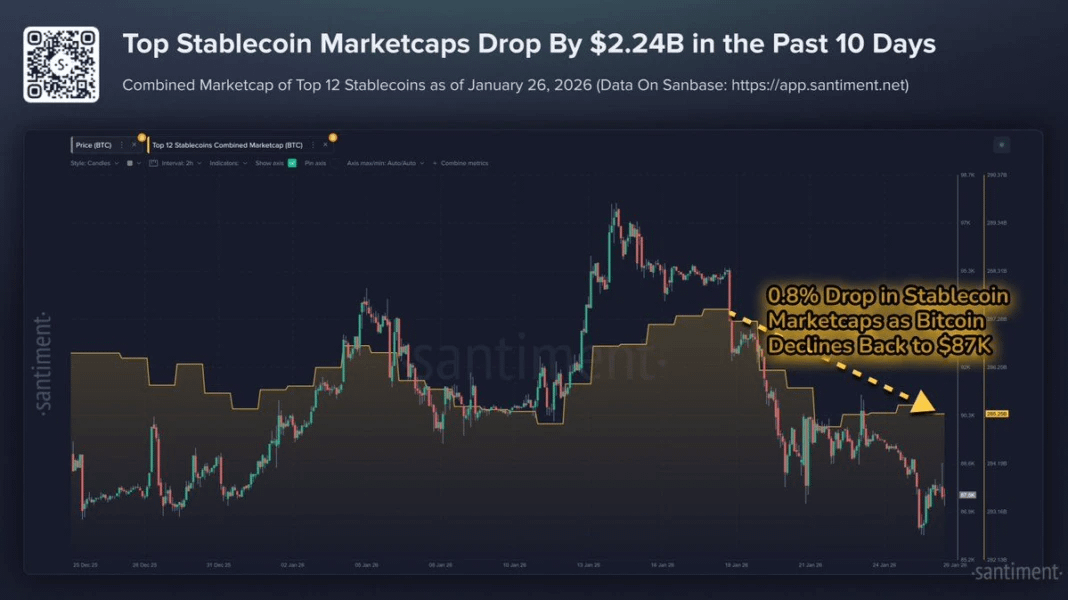
Stablecoins provide key liquidity for crypto asset transactions. If their volume declines, the market finds it harder to withstand seller pressure and support recovery.
In previous periods, market growth was closely linked to an increase in the capitalization of stablecoins — this signal indicated an influx of new funds. The current decline suggests a contraction in short-term buying power.
The Santiment team also pointed out that capital outflow can be explained by the transition of funds into gold and silver, which now look more attractive. As a result, altcoins may incur significant losses.
Coinbase Premium in negative territory
The drop in Bitcoin also intensifies the annual low of the Coinbase Premium index, indicating increased pressure from sellers in the US.
The Coinbase Premium Index reflects the difference between the price of Bitcoin on Coinbase Pro and the average global benchmark, allowing for an assessment of the sentiments of American institutional and retail investors.
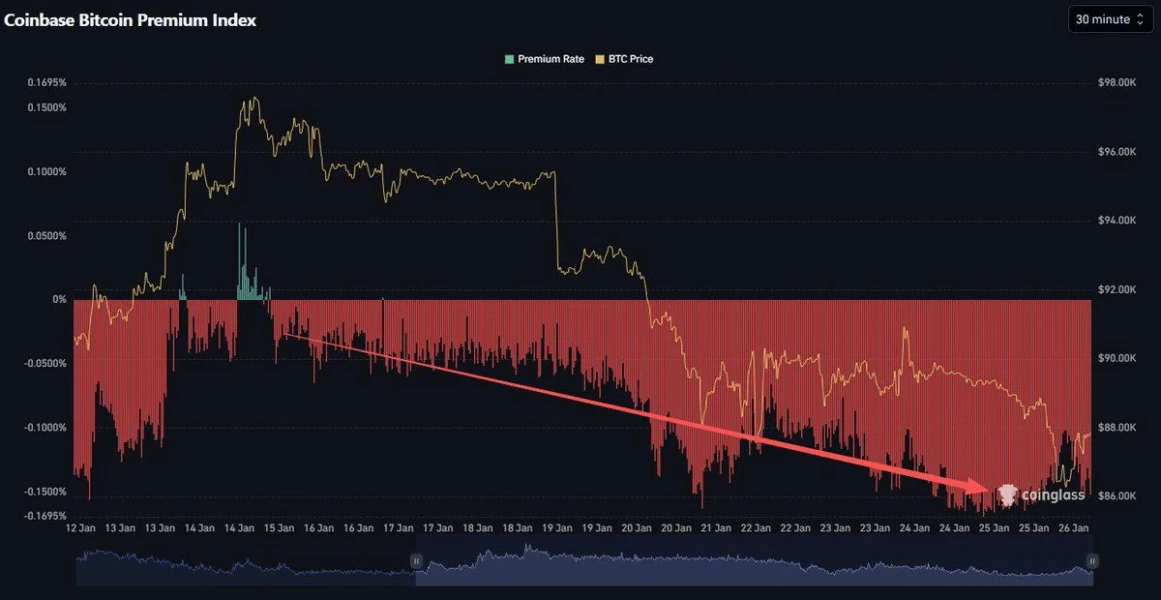
According to Coinglass, from January 12 to 26, 2026, the premium went negative: the metrics dropped below -0.05%, and after January 21, nearly reached -0.15%. According to CryptoQuant, the average value of the Bitcoin premium index on Coinbase over 7 days became the lowest since the beginning of the year.
The negative premium indicates that Bitcoin is trading at a discount on Coinbase, reflecting more active selling from participants in the US.
The snowstorm led to a mining crisis and a drop in hash rate
A powerful ice storm in the US has dealt another blow to Bitcoin — the hash rate fell from 1,133 ZH/s to 690 EH/s over two days. The US accounts for about a third of the world's Bitcoin mining capacity. The largest farms are located in Texas and are managed by companies such as MARA and Foundry Digital.
Analyst Darkfost from CryptoQuant notes that the hash rate of MARA has decreased fourfold over three days compared to the monthly average. Severe frosts have led to power grid failures, rising electricity costs, and forced restrictions. Under such conditions, miners had to shut down equipment to avoid losses.
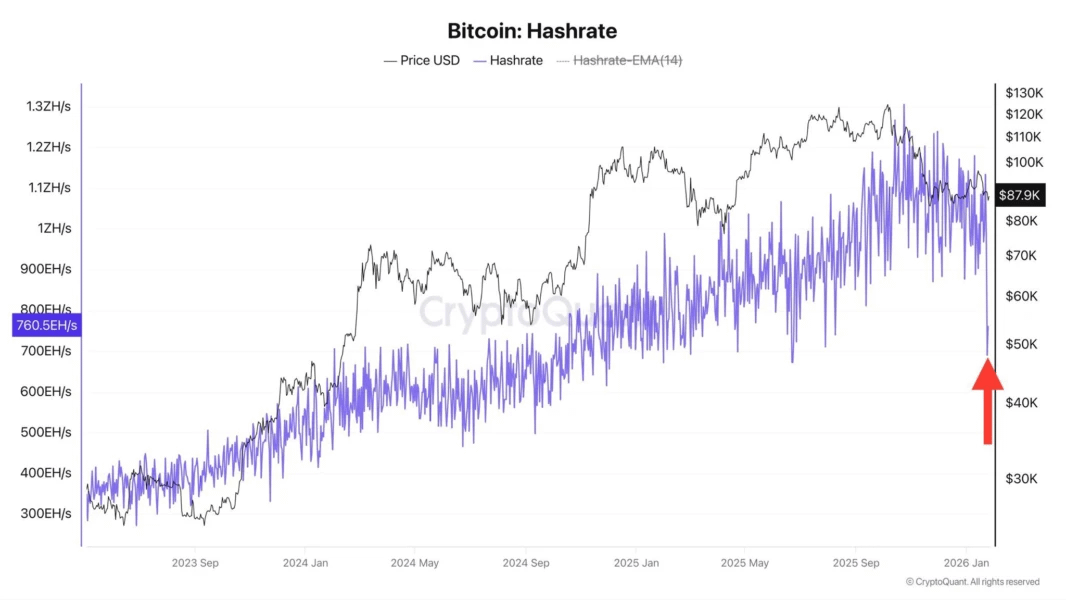
If mining companies face falling revenues, miners may start selling Bitcoins to cover current expenses — this will increase pressure on the market amid low liquidity.
"Such a period of tension may even force some holders to sell BTC if the storm drags on. Miners may need to cover fixed costs until the situation stabilizes," said analyst Darkfost.
Technical analysis indicates a continuation of the downtrend
Experienced trader Peter Brandt noted a bearish technical signal coinciding with the overall downward trend. According to him, Bitcoin has broken down from a bearish channel on the daily chart, piercing the boundary of the rising channel formed since late December 2025.
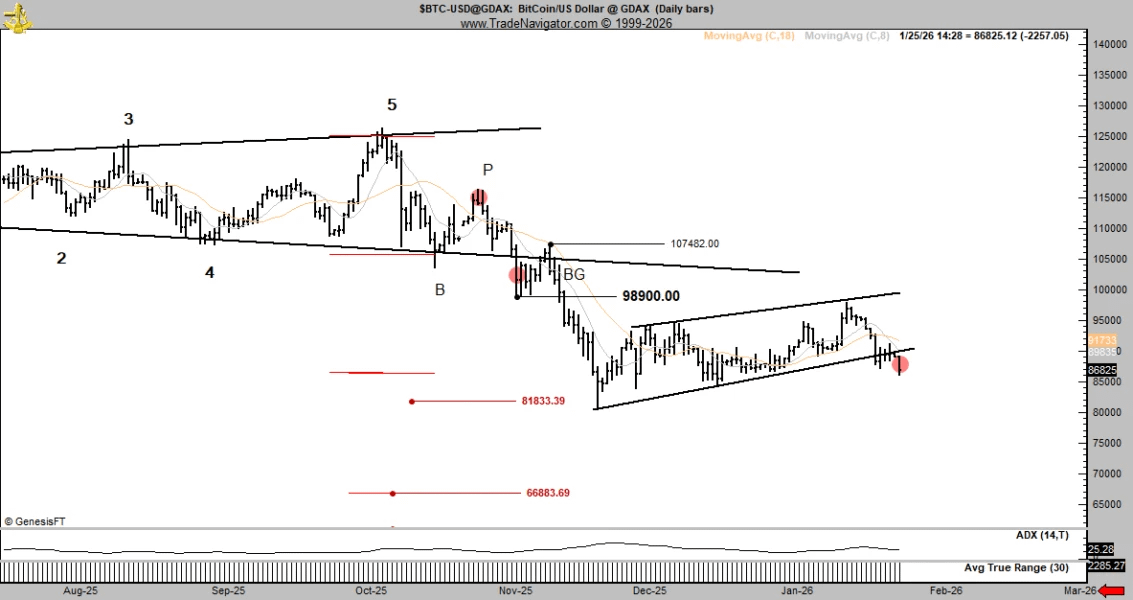
Brandt estimates that Bitcoin needs to recover above $93,000 to cancel the negative scenario. Otherwise, the price could fall to $81,833 or even $66,883.
This technical forecast reinforces the bearish sentiment reflected in on-chain metrics and the overall structure of the market. Against the backdrop of declining liquidity, active selling from the US, and pressure on miners, Bitcoin lacks support to return to important resistance levels. A combination of technical and fundamental factors hampers the market's ability to quickly develop a recovery.
