

A few months back, I tried to place a private trade on a DeFi platform. Nothing fancy. I just didn’t want my intentions splashed across a public mempool. Even with “privacy” turned on, enough information leaked that bots figured out what was happening and jumped ahead of me. It only cost a few basis points, but that’s not the point. When you trade long enough, you realize privacy isn’t about hiding numbers for fun. It’s about not getting punished for acting. That experience stuck with me because it showed how fragile most privacy setups still are, especially when real money and regulated assets are involved.
The root of the problem is simple. Most blockchains are transparent by default, and privacy gets layered on afterward. That works on paper, but in practice it creates cracks everywhere. MEV bots still see patterns. Fees spike when privacy circuits get heavy. Developers end up juggling half-baked tools to reveal some data but not all of it. For institutions, that’s a nonstarter. If you’re tokenizing securities or moving regulated capital, you need transactions to stay quiet without breaking compliance. When privacy adds friction instead of removing risk, adoption stalls. Not because people dislike decentralization, but because the infrastructure doesn’t behave predictably under pressure.
I usually think of it like holding a sensitive meeting in a room with glass walls. No one hears the words, but they can still read body language, timing, intent. That’s enough for competitors to act. Real privacy means solid walls, with a door you can open for auditors when required. Most chains never quite get there.
@Dusk is clearly built around trying to solve that exact mismatch. It’s not aiming to be a playground for everything on-chain. It’s a layer-1 designed specifically for private, compliant financial activity. Transactions are confidential by default, but the system allows selective disclosure when audits or regulators need visibility. That focus shows up in what it doesn’t do. No meme traffic. No gaming load. No chasing raw TPS numbers for marketing. The goal is steady, predictable execution for assets that actually need privacy. Since mainnet went live, the addition of DuskEVM has made this more practical by letting teams reuse Ethereum tooling without giving up confidentiality, which lowers friction for builders who don’t want to learn an entirely new stack.
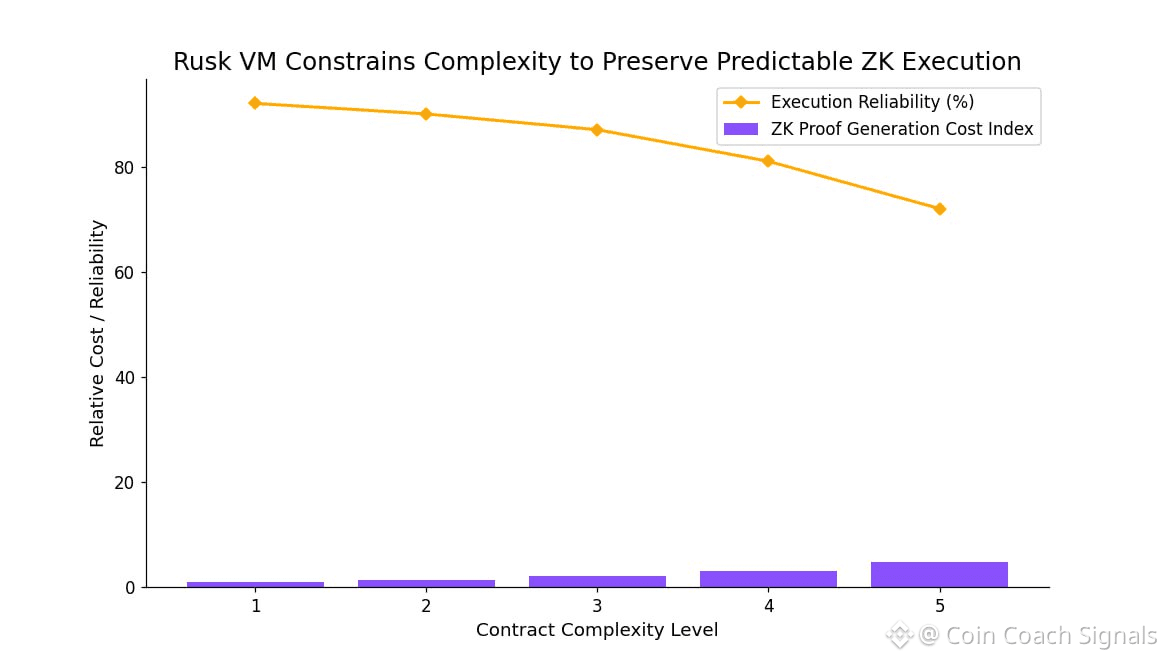
One technical piece that matters here is the Rusk VM. Instead of executing contracts publicly, it generates zero-knowledge proofs that confirm execution without revealing inputs. That’s powerful, but it’s intentionally constrained. Complex logic is limited so proof generation doesn’t spiral out of control. It’s a trade-off, but a deliberate one. Financial systems care more about reliability than unlimited expressiveness. On the consensus side, Dusk uses a proof-of-stake design built around succinct attestations. Blocks finalize fast, usually within a couple of seconds, without long confirmation windows. That’s critical for private transactions, where delayed finality increases exposure risk. You can see this reflected in current activity, like the Sozu liquid staking protocol pulling in over twenty-six million in TVL, showing people are comfortable locking capital into the system rather than treating it as experimental.
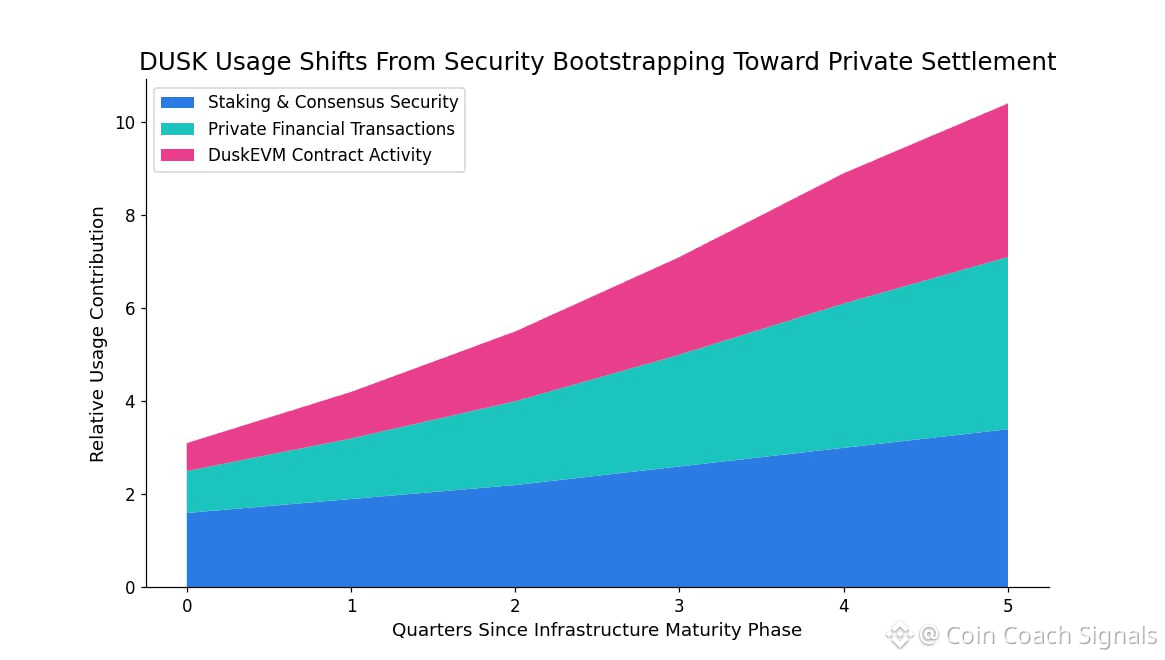
$DUSK the token doesn’t try to be clever. It pays for transactions. It gets staked to secure the network. A portion of fees gets burned to keep supply in check. Validators bond it to participate in consensus, and slashing exists to keep behavior honest. Governance is stake-weighted and directly tied to upgrades, including things like oracle integrations and protocol parameter changes. Emissions started higher to bootstrap security and participation and taper over time, which makes sense for a chain that expects usage to grow gradually rather than explode overnight.
From a market perspective, it’s not tiny, but it’s not overheated either. Roughly four hundred sixty million tokens circulating. Market cap sitting around the low hundreds of millions. Daily volume is healthy enough to move in and out without chaos, but not dominated by pure speculation.
Short-term price action tends to follow familiar patterns. A partnership drops. A regulatory-friendly narrative picks up. Volume spikes. Then it cools. I’ve traded those moves before. They’re real, but fleeting. The longer-term question is different. Does this infrastructure actually get used repeatedly? The NPEX integration and DuskTrade pipeline, with hundreds of millions in tokenized assets planned, matter more than price candles. Metrics like staking participation and yields from Sozu suggest people are starting to treat it as infrastructure rather than a trade, but that kind of confidence builds slowly.
There are real risks, though. Privacy chains are a crowded space. Fully anonymous systems like Monero appeal to a different crowd, while Ethereum rollups are pushing ZK tech from another angle. Dusk’s bet on compliance-friendly privacy narrows its audience. The bridge incident in mid-January was a reminder that even well-designed systems can stumble at the edges. A serious bug in proof verification during a high-value settlement would be hard to recover from reputationally. And regulatory rules aren’t static. If future requirements force broader disclosure, the balance #Dusk is trying to maintain could get harder.
In the end, infrastructure like this doesn’t prove itself with headlines. It proves itself quietly. The second transaction that goes through without stress. The third time someone settles value without worrying about exposure. Over time, those moments add up. Whether Dusk becomes a backbone for private, compliant finance or stays a niche tool depends on how consistently it delivers when no one is watching.
@Dusk
