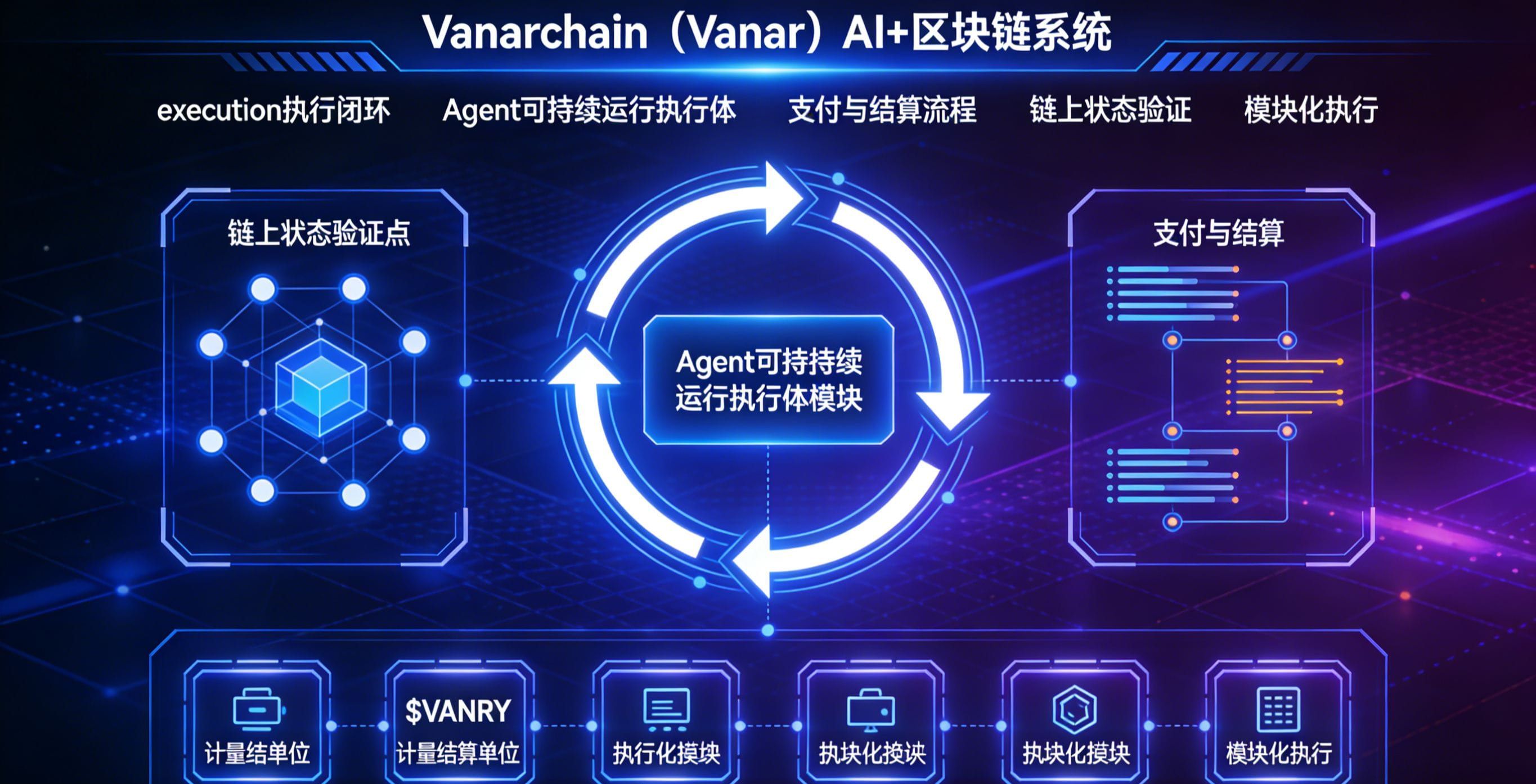
If viewed only from the narrative perspective of 'AI + blockchain',@Vanarchain (Vanar), it is easy to overlook a key term emphasized repeatedly in its white paper: execution.
Here, execution is not about whether the model reasoning is smart enough, but whether a system can truly complete a closed-loop action under real-world constraints.
This is also the starting point of Vanar's understanding of AI-first infrastructure:
It's not about 'what AI can think of', but 'whether AI can complete, settle, and be recognized'.
An Agent is not an automation script, but a sustainably operating entity.
In the industry context, AI Agents are often simplified to 'more complex automation programs'.
However, in Vanar's white paper, the positioning of the Agent is clearly closer to a long-term existing execution entity.
A key distinction lies in:
Agents do not just output results; they must also bear the costs of their actions and complete settlements.
Without this layer, the activity space of the Agent can only remain in demos, simulation environments, or internal systems. Once entering the real world, computing power, data, and service calls will incur immediate costs, and these costs must be settled without relying on human intervention.
Why doesn't Vanar start with the 'wallet experience'?
A significant judgment by Vanar is:
Agents will not participate in the system as 'human users'.
The design premise of traditional wallets is:
Confirmation → Signature → Human Judgment.
But the operation of the Agent is continuous, without interfaces, and real-time.
Therefore, Vanar did not attempt to modify the wallet to adapt to Agent, but instead provided callable payment and settlement capabilities directly at the protocol layer.
Payment is no longer a UI action, but a part of the execution process.
This means:
When Agents call computing power, access data, and execute content distribution, settlement occurs synchronously, rather than being accounted for afterwards.
Whether execution is completed is determined by settlement.
In Vanar's system design, payment is defined as a basic capability rather than an additional module.
The white paper clearly describes a merging process:
Execution → Verification → Accounting, essentially belongs to the same link.
In other words:
If settlement does not occur, execution is not considered complete.
This design allows the Agent's behavior to be verifiable and enables external systems to trust its results. It is not 'the Agent says it has completed,' but 'the on-chain state has already provided the answer.'
Real-world constraints must be acknowledged on-chain.
The biggest limitation faced by Agents in real-world environments often comes from the resource side:
Computing power is charged by the second, data interfaces are charged per call, and content authorization is settled based on usage.
Vanar's choice is to let these cost relationships be directly borne by the on-chain system, rather than relying on off-chain reconciliation or manual settlement.
Only in this way can the Agent continue to operate without human participation.
This is also why Vanar's payment system is not a 'functional component' but a part of the execution system.
Compliance is not a patch, but a part of the settlement logic.
On the issue of cross-regional operations, Vanar also did not completely push compliance to the application layer.
Official public information shows that its underlying settlement logic reserves interfaces for auditing and compliance.
This does not mean the system becomes bloated, but ensures that the Agent's behavior is traceable and explainable, rather than forming a black box that cannot explain its origin and destination.
Modular execution reduces friction.
From the perspective of implementation path, Vanar breaks down payment and execution into standardized modules.
When Agents execute tasks, they only need to call the corresponding capabilities, and subsequent verification and settlement are completed by the system.
The significance of this structure lies in:
Developers do not need to repeatedly handle payment logic.
The collaboration costs between different systems are significantly reduced.
Payment is 'hidden' in the execution path, requiring users to not frequently perceive it, but it is always occurring in the system.
$VANRY

: not incentive symbols, but measurement units.
Under this architecture,$VANRY it is defined as the measurement and settlement unit within the system.
The white paper clearly states that computing power consumption, service calls, and on-chain execution will be settled through VANRY.
Every token transfer corresponds to a clear system behavior, rather than abstract incentives or emotional expectations.
When Agents can autonomously use VANRY to complete settlements, they truly gain the qualification to participate in real economic activities.
Conclusion
Vanar's AI-first approach is not reflected in model parameters or inference capabilities, but in whether it is willing to take responsibility for execution.
What it focuses on is not whether the 'AI can think', but whether the 'system can let AI finish the task and be accepted by reality'.
When payment becomes an action supported by the protocol by default, rather than a function triggered by humans,
AI truly moves from the display layer to the execution layer.
This is also the most essential dividing line between Vanar and many AI narratives that remain at the conceptual stage.