
After studying for so long @Walrus 🦭/acc I realized that it is not about looking at the superficial market capitalization rankings or the timing of entry, but rather about truly researching the fundamental iterations of storage technology architecture that have occurred in the AI era—from the qualitative change of 'piling up quantity' to 'pursuing efficiency.'
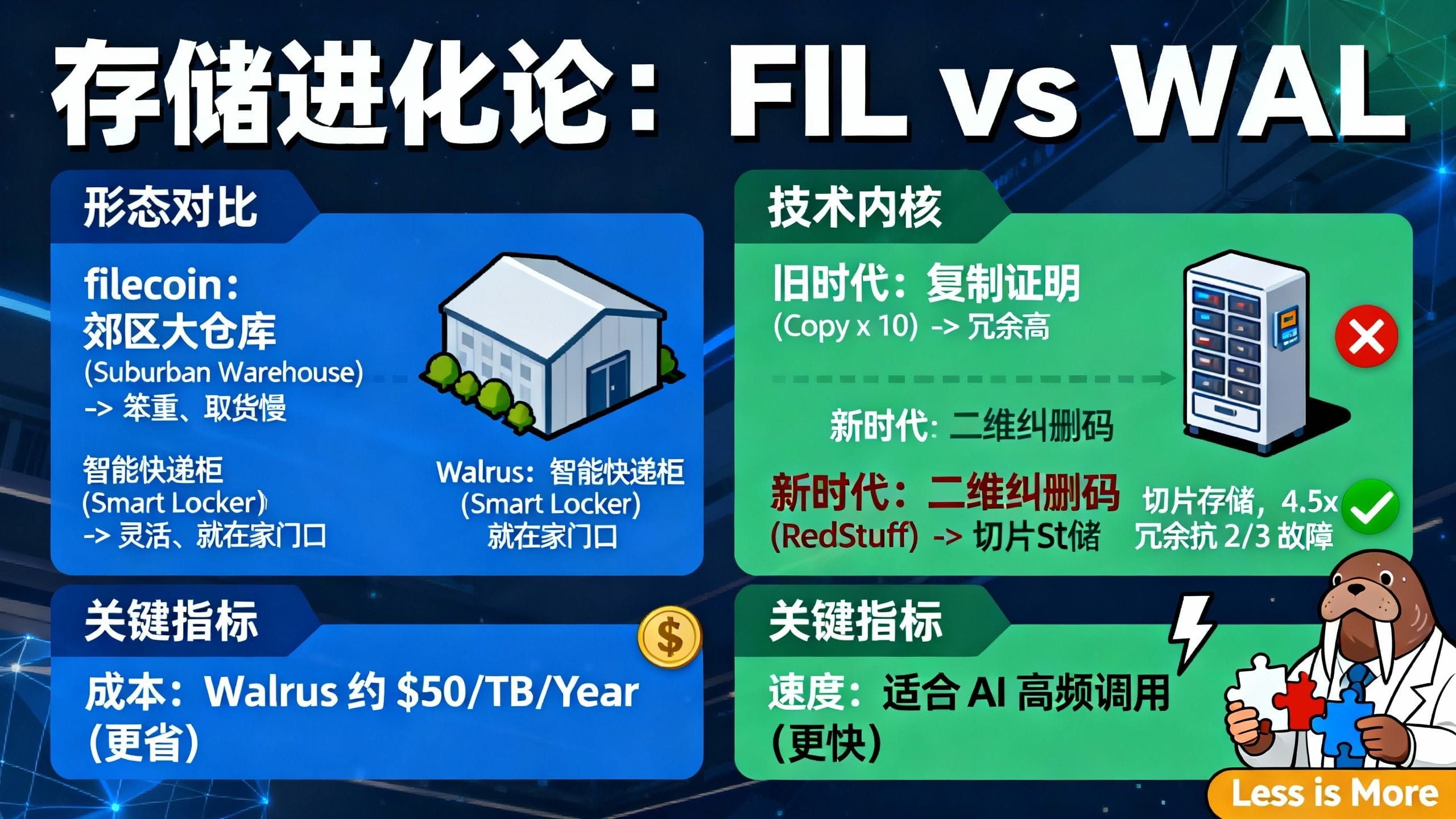
In the storage track of Web3, we have heard too many grand narratives: Filecoin wants to be the 'eternal library of human data,' and Arweave aims to be the 'indelible history book.' These visions are beautiful, but the reality is harsh. For developers and ordinary users, the user experience is often: it's easy to deposit, but retrieving feels like constipation, and the costs are absurd. It's like storing furniture in a huge warehouse in the suburbs; while it's safe, every time you want to get a chair, you have to drive for three hours and fill out five forms. The emergence of Walrus is precisely to solve this problem—it does not aim to build a bigger warehouse but to construct a row of 'smart delivery lockers' for on-demand access in the vibrant streets of Web3 (Sui ecosystem).
I. Pain Points: Why Do We Need 'Dimensionality Reduction Strikes'?
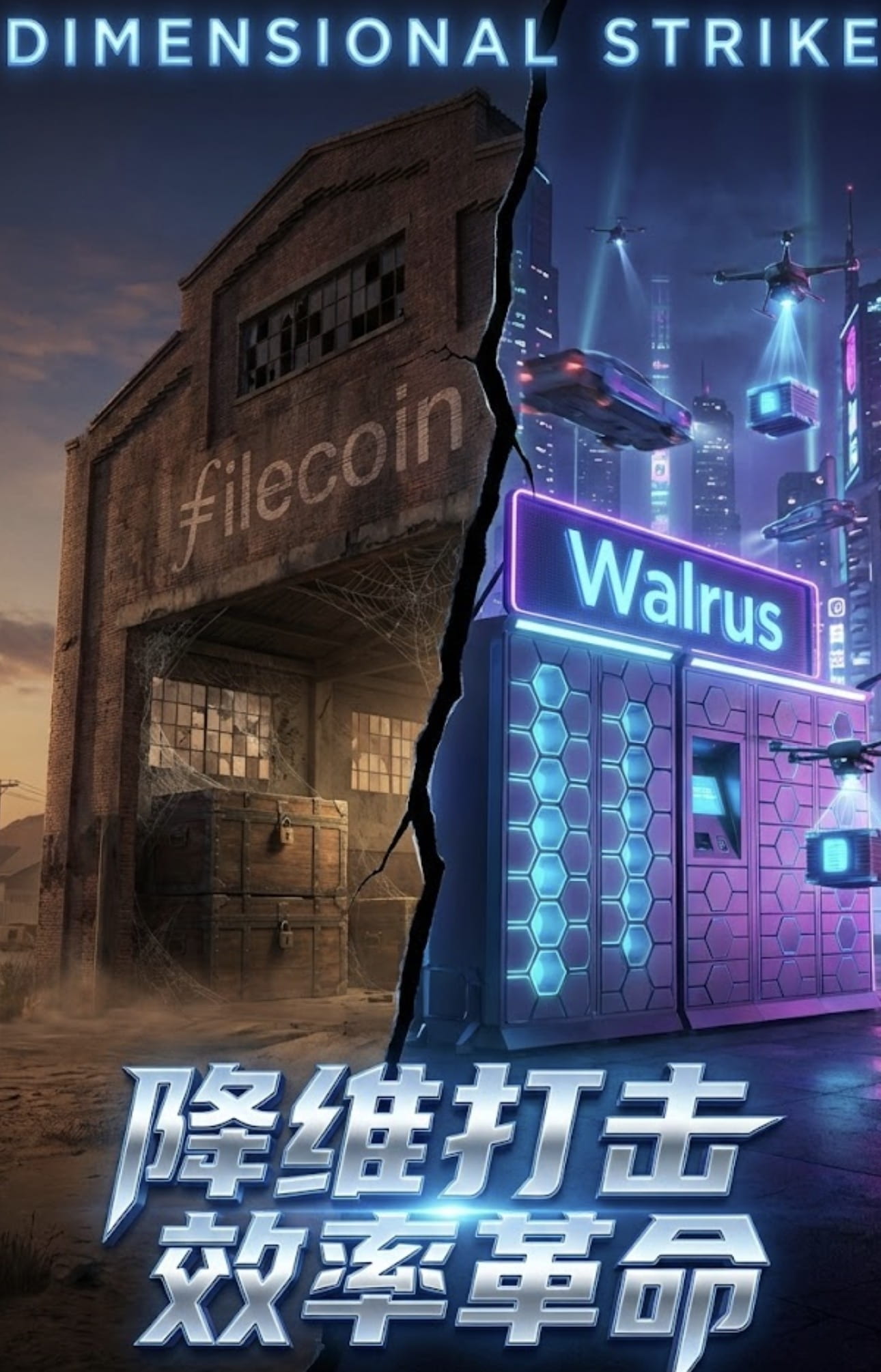
Many people ask: 'Since there is already Filecoin, a leading player with a market value of hundreds of billions, is there still a need for Walrus?'
The logic of this question is like asking: 'Since we have ocean freighters, why do we still need SF Express?'
Walrus is not aimed at cold archived data (those materials that are not viewed for decades), but rather at 'hot data' and 'warm data'.
Look at the current Filecoin; its core mechanism is 'proof of replication' and 'proof of space-time'. Simply put, in order to ensure data is not lost, miners need to make many complete copies of a file and continuously prove to the network, 'I still have it'. This leads to huge hardware redundancy and wasted computing power. It's like renting a container to store a key and hiring ten bodyguards to watch it every day.
This model may be useful for archiving human civilization, but for high-frequency interactive dApps, NFT markets, and AI training, it is simply a disaster. Walrus keenly captured this point; it is not just doing storage but creating a 'logistics system for data'.
II. Core Technology Unveiled: RedStuff—Storing Data by 'Cutting It Up'.
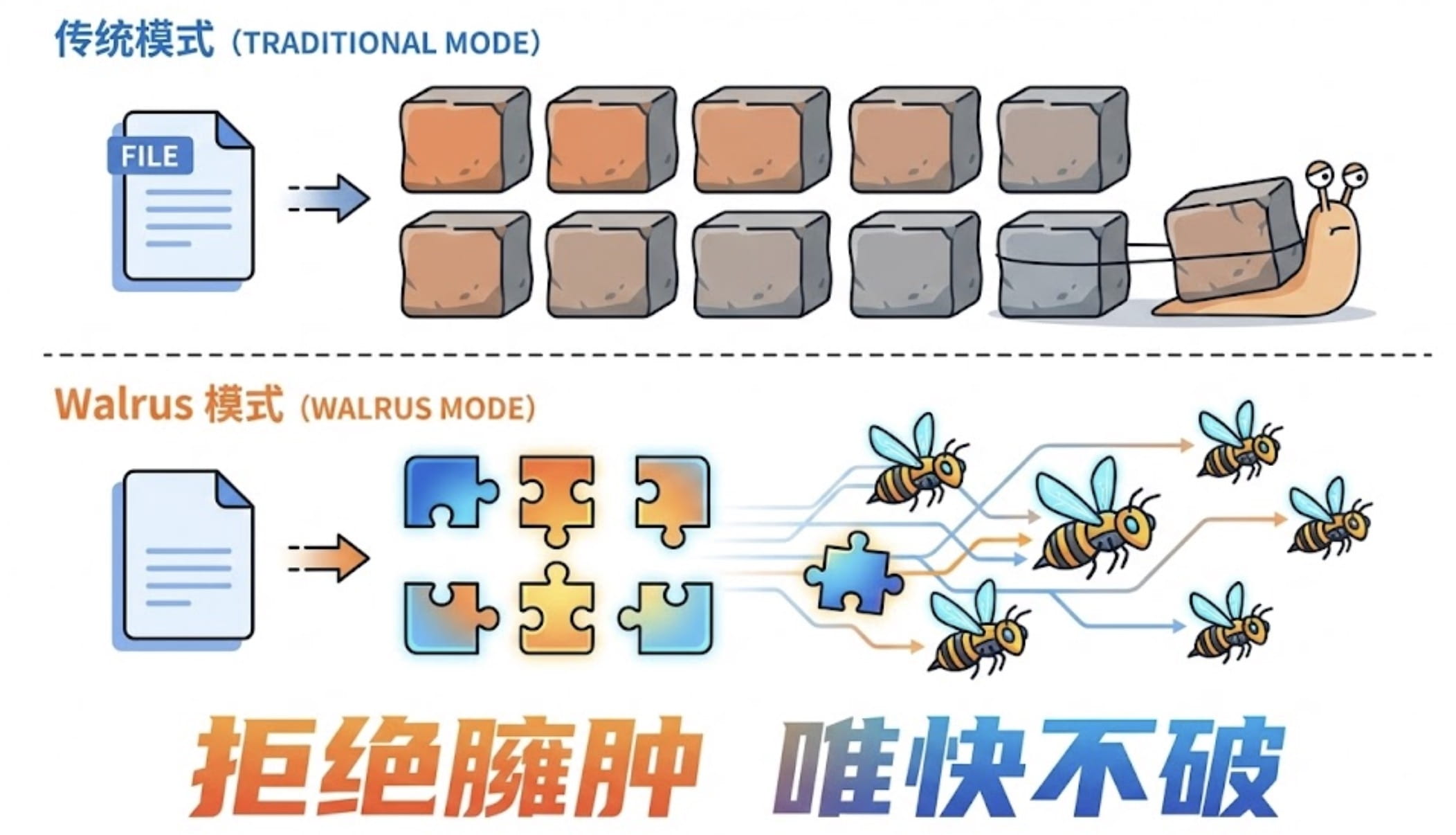
Why does Walrus dare to call itself a 'smart locker'? Its confidence comes from its core technology: RedStuff (an innovative algorithm based on two-dimensional erasure codes).
1. Say goodbye to heavy 'full replication'.
In traditional storage networks, in order to prevent data loss due to node failures, a 'multiple copy redundancy' strategy is usually adopted. For example, a 1GB file may require 10 copies to be stored in the network, occupying 10GB of space. This is not only expensive but also extremely slow to synchronize.
The two-dimensional erasure code technology adopted by Walrus is completely different in logic. It is not like moving an entire block of stone but more like playing with LEGO bricks. Walrus cuts that 1GB file into countless encrypted small fragments and generates a small number of verification pieces through mathematical algorithms.
2. The miracle of 4.5 times redundancy.
These fragments are evenly distributed across the nodes in the network. The amazing part is that you do not need all nodes to be online. According to Walrus's white paper, even if 2/3 of the nodes in the network evaporate (due to failure or malicious attack), the remaining fragments can still be mathematically reversed to completely restore the original file.
To achieve this level of fault tolerance, Walrus only requires about 4.5 times storage redundancy. Compared to traditional networks, which typically have costs exceeding 10 times, Walrus has achieved a true 'dimensionality reduction strike' in cost and efficiency. This means that Walrus's nodes are lighter, respond faster, and are like a locker right downstairs in your building, ready to open with a scan.
III. Cost and Experience: The Impact of 50 USD for 1TB a Year.
No matter how well you talk about technology, in the end, it all comes down to the bill.
Due to Walrus significantly lowering the hardware threshold and redundancy costs, the prices it can offer are extremely disruptive. It is currently estimated that the cost of storing 1TB of data on Walrus for a year is about 50 USD (specifics depend on network parameter fluctuations).
This is more than 80% cheaper than centralized cloud services like AWS S3, and it is also more advantageous than the actual landing cost of Filecoin (considering hidden costs like packaging and retrieval).
More importantly, there is 'programmability'. Arweave focuses on 'store once, never delete', which is suitable for storing history but not for storing privacy. Walrus supports data modification and deletion. This is crucial for RWA (real-world assets on-chain) and enterprise-level applications—when users request to exercise their 'right to be forgotten' or update asset status, Walrus's 'locker' mode allows you to flexibly replace items in the box, rather than worrying about a welded safe.
IV. An Inevitable Choice in the AI Era: We Need Faster 'Lockers'.
If the first half of Web3 is finance (DeFi), then the second half must be AI + DePIN.
Training and inference of AI models require high-frequency calls to massive datasets. If this data exists in Filecoin's 'suburban warehouse', the time cost of retrieving data alone is enough to make AI dumb.
Walrus perfectly matches the high throughput of the Sui public chain; it is like a high-speed cache layer prepared for AI.
Imagine the future AI Agent reading the latest market data on Walrus, making decisions at the millisecond level, and then writing the results back to Walrus. The whole process is smooth, low-cost, and decentralized. This scenario can only be met by a 'smart locker'; the old 'suburban warehouse' can only gaze in admiration.
V. Conclusion: Do not use old maps to find new continents.
The market always has inertia; many people are still immersed in the narrative of the last bull market, believing that the storage track's pattern has been established. But the history of technology tells us that when Nokia fell, it didn't even say goodbye.
Walrus is not attempting to completely eliminate Filecoin; they belong to different ecological niches. However, as Web3 transforms into high-frequency, application-oriented, and AI-oriented today, we clearly need a lightweight, efficient, and low-cost storage layer.
When we shift from 'stockpiling data' to 'using data', the value of Walrus will show exponential growth. As an investor, would you prefer to guard an old warehouse in the suburbs full of dust, or would you prefer to invest in a smart locker in the bustling city center? The answer is obvious.



