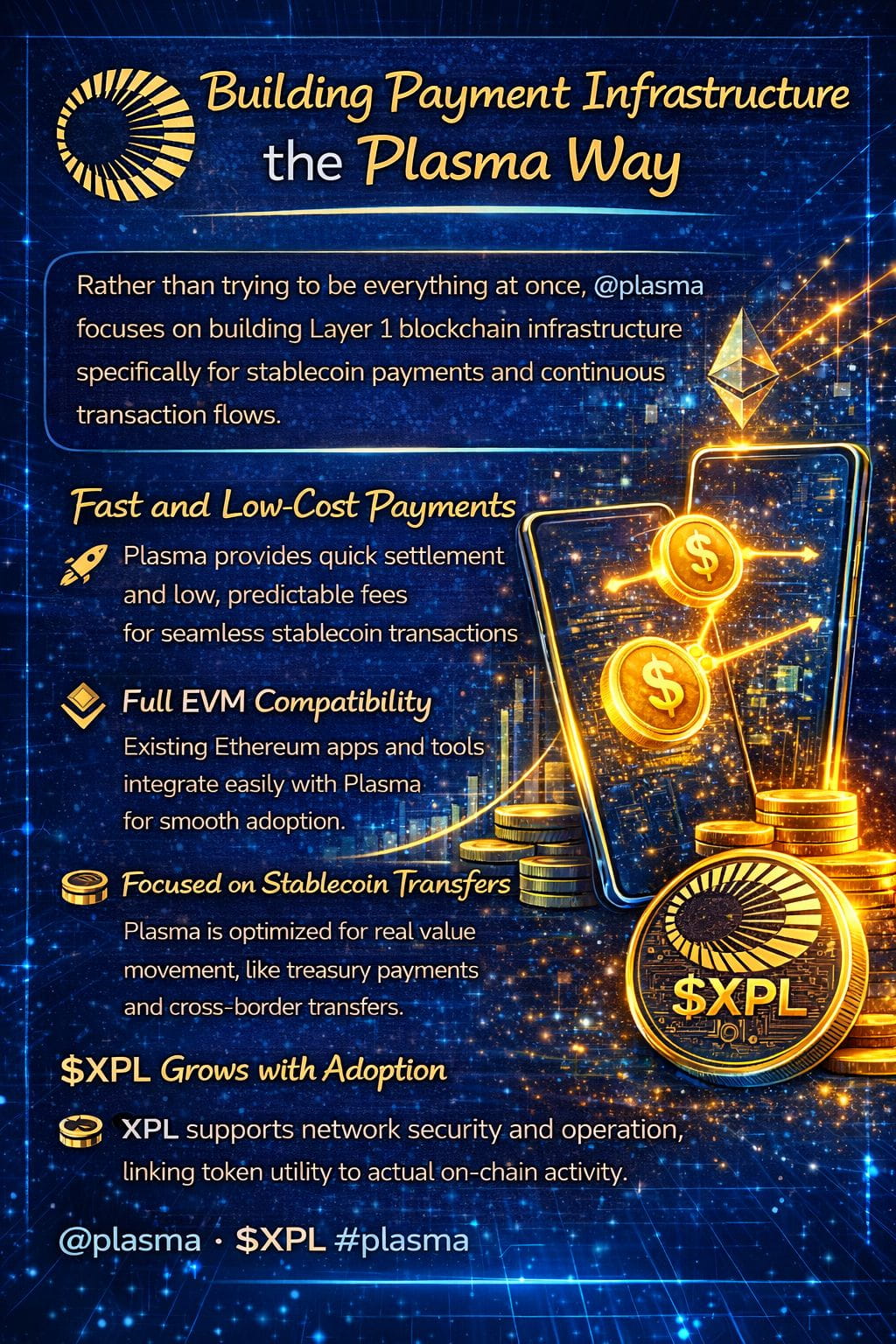
Many blockchains aim to be everything at once, which often results in network congestion and rising costs. @undefined follows a more targeted strategy by designing its Layer 1 specifically for stablecoin payments and continuous transaction activity. This focus shapes how the network is built and how it is meant to be used.
At the core of Plasma’s design is fast finality and low, predictable fees. These features are critical for payment use cases where transactions must settle quickly and consistently. Plasma is structured to support high transaction throughput without compromising reliability, making it suitable for frequent value transfers rather than occasional on-chain actions.
Plasma is fully EVM compatible, which significantly reduces friction for developers. Existing Ethereum-based smart contracts, wallets, and tools can be deployed with minimal changes. This allows teams to build or migrate applications quickly while benefiting from a network optimized for payment flow instead of congestion-driven fee spikes.
Stablecoin settlement is a primary focus of the chain. Plasma is optimized for real financial movement such as treasury operations, cross-border transfers, and ongoing settlement needs. By avoiding unnecessary complexity, the network stays aligned with practical usage rather than experimental features.
The $XPL token supports network security and operational functions. Its role is directly connected to how the network runs and scales, tying token utility to actual on-chain activity as adoption grows.
Through a payment-first design, EVM compatibility, and performance-focused architecture, @undefined is working toward blockchain infrastructure that fits real economic use. The emphasis is on reliability, efficiency, and long-term usability rather than short-lived trends.
@CryptoNewsHQ @Plasma #Plasma $XPL