

I often see two completely different voices. The first voice says that dusk_foundation is part of the privacy track; when the market for privacy coins arrives, it will take off. The second voice says that privacy in this direction is too difficult for compliance, institutions will not use it, and in the end, it will still be a small circle enjoying itself. Both sides speak very absolutely and miss some key points. I want to break it down in a debate-style writing and be more specific.
Start from the perspective of supporters. Supporters will say that institutions need privacy, and securities cannot be completely transparent. The positioning of dusk_foundation exactly addresses the pain points of institutions. I agree with this, but I want to add a point: what institutions want is not black-box privacy, but rule-verifiable privacy. The difference is significant. Black-box privacy makes it impossible for regulators to audit, while rule-verifiable privacy allows regulators to verify whether transactions occur according to the rules without exposing all details to the entire network. If supporters only shout 'privacy,' they can easily mislead themselves. The correct way to phrase it should be that dusk_foundation treats privacy as part of the compliance process, aiming to make the market operate more like a real market, rather than like an anonymous chat room.
The views of opponents are usually sharper. They will say that compliant finance is too slow to land, the market cannot wait, and the ecosystem finds it difficult to thrive. I also acknowledge its slowness, but slow does not mean ineffective. Compliant finance has never taken off due to a wave of traffic; it resembles a migration project. The characteristics of a migration project are that early progress may not look stimulating, but once a certain node is successfully run, adoption will show stickiness. Once institutions migrate their processes and systems, they will not casually migrate away because it is more costly to move out than to move in. Many of the things that dusk_foundation is doing now are like paving the way for a migration project, such as incorporating interoperability and data standards into the framework, making cross-ecosystem channels predictable tools, promoting the mainnet in phases, and making staking and security budgets more suitable for long-term maintenance.

Next, let's discuss the core issue that is often overlooked. Is the DUSK token economy really serving institutional-level infrastructure? Here I believe its design is more inclined towards institutional-level rather than short-term narratives. Its transaction fees are priced in LUX, forming a minimal unit relationship with DUSK, and on-chain fees enter block rewards for redistribution, meaning that the more the network is used, the more stable the returns on the security budget will be. Its issuance and new release follow a 36-year decay model, halving every four years, with strong early releases and gradual slowdowns later on. The purpose is clear: first pull up network participation and security budgets, then gradually shift the system from inflation subsidies to real usage and fee-driven motivations. The economic model of institutional-level infrastructure often looks like this, not pursuing short-term sudden scarcity but pursuing long-term sustainable security budgets.
Opponents may continue to question that the long-term model sounds good, but where does the demand come from? This is the key. Demand must come from real on-chain behavior, not from trading on exchanges. The recent actions of dusk_foundation correspond precisely to the three types of demand.
The first category is cross-ecosystem scheduling demand. The bidirectional bridge connects the mainnet and external ecosystems, with a fixed cost of 1 DUSK, and time is predictable. As long as there are scenarios in the ecosystem that require frequent scheduling of assets, this will lead to continuous consumption. Continuous consumption resembles infrastructure demand more than one-time popularity.
The second category is security budget demand. The minimum staking threshold is 1,000 DUSK, with a maturity period of two epochs, and there is no additional waiting period for exit, while a soft penalty mechanism constrains node behavior. This design encourages broader participation while setting real costs for bad behavior. More critically, over-staking allows smart contracts to also participate in staking, making staking productizable, leading to delegated services, automated pools, and even staking derivative structures. Productization means lower participation thresholds, more stable lock-up structures, and more resilient network security budgets. If this demand takes off, it will provide long-term support for DUSK.
The third category is the usage demand brought about by compliant asset links. Interoperability and data standardization make issuance, trading, settlement, and data publishing closer to replicable templates. Once a template is reused, on-chain activities will shift from sporadic to continuous, and transaction fees and resource consumption will increase.
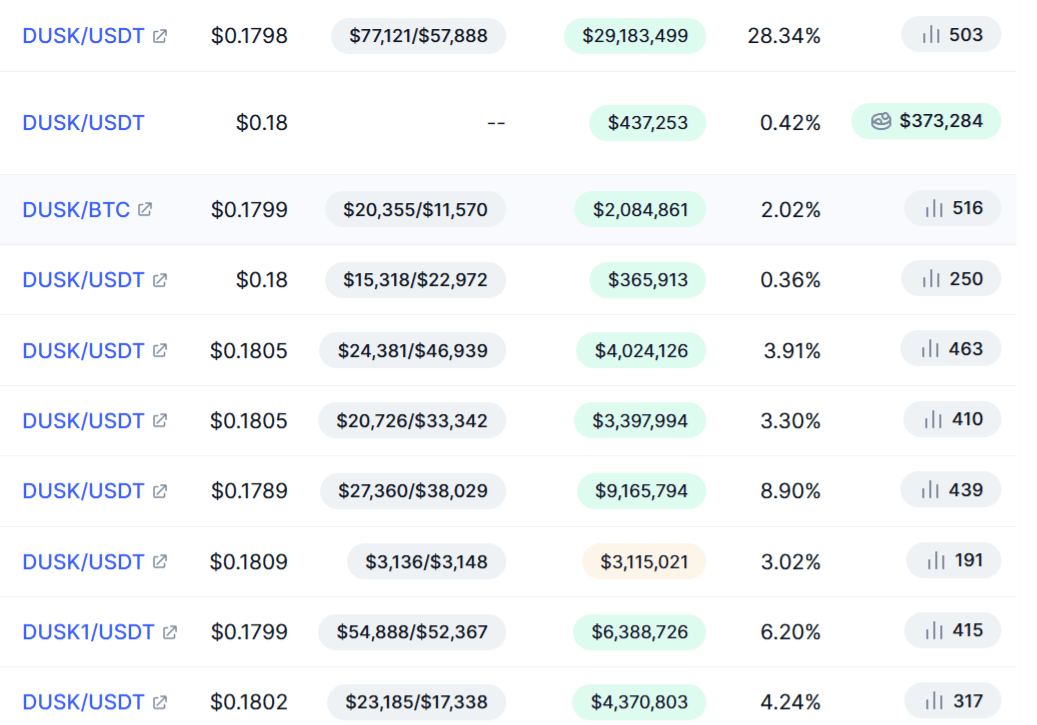
Looking at market data as external context will be more realistic. By late January 2026, the trading volume of DUSK had shown a significant increase in the short term, and the price had experienced substantial intraday fluctuations. Many people will use this to prove its popularity, while others will use it to argue that it is too speculative. I prefer to see it as a reminder. Popularity can come, but popularity is not the answer. The answer is whether there are lasting habits of usage, ongoing staking participation, increased cross-ecosystem scheduling frequency, and continuous actions of compliant asset links after the heat. As long as these do not remain, popularity is just a splash. As long as these remain, popularity may turn into a tide.
So my conclusion regarding this debate is as follows. The dusk_foundation is not selling a purely privacy narrative; it is more like building the three essentials needed for institutional-level infrastructure: verifiable rules, controllable cross-ecosystem settlement, and trustworthy data input. The long-term value capture of the DUSK token also relies more on the continuous on-chain behaviors brought by these three essentials. You can choose not to participate because this path is indeed slow, but if you want to assess its long-term potential, do not apply the emotional templates of privacy coins to it; instead, use the continuity indicators of infrastructure to monitor it. How often is the bridge used? Is staking participation stable? Does the compliant asset link continuously generate settlements and data actions? Visible continuity is the most scarce thing for institutional-level projects.
