


In global finance, an asset’s significance is determined not only by its intrinsic value but by its utility within the system. Locked in a vault, an asset is static; made liquid and programmable, it becomes the foundation for credit, complex instruments, and the velocity of capital. Dedicated settlement blockchains like Plasma create a new kind of vault—cryptographically secure, globally accessible, and optimized for speed and finality. The question becomes: which assets should populate this settlement layer to maximize both financial utility and systemic stability?
Stablecoins naturally serve as the transactional medium, but their collateral role is inherently constrained by their peg. They represent a claim on a specific unit of value, not a store of value itself. To mature into a fully functioning financial environment, a settlement layer requires a premier, non-correlated, and credibly scarce asset. Bitcoin is uniquely positioned to fill this role. Integrating BTC through a trust-minimized bridge introduces more than another token—it brings a foundational financial primitive: programmable, yield-bearing, deeply liquid Bitcoin collateral.
The process begins with the bridge. Native BTC is locked, and a representative token (bBTC) is minted on Plasma through cryptographic verification against Bitcoin’s blockchain. Bitcoin is no longer a siloed asset; it becomes a live, composable object within a state machine featuring sub-second finality and full EVM compatibility. bBTC conforms to ubiquitous standards like ERC-20, making it transferable, usable in smart contracts, and integrable into complex financial operations. Plasma does not see “Bitcoin” per se; it sees a verifiably backed token its virtual machine can manipulate according to pre-defined logic. Bitcoin is transformed from a static store of value into a versatile financial primitive.
The most immediate application of bBTC is as collateral. Users can deposit bBTC into lending protocols, unlocking stablecoin liquidity without selling their BTC. Sub-second finality ensures instant, frictionless access to capital. bBTC can also serve as the reserve for synthetic assets, supporting institutional-grade constructs like tokenized equities or commodities. Moreover, it underpins derivatives and structured products, enabling rapid, secure settlement in futures, options, swaps, or complex stablecoin payouts collateralized by bBTC.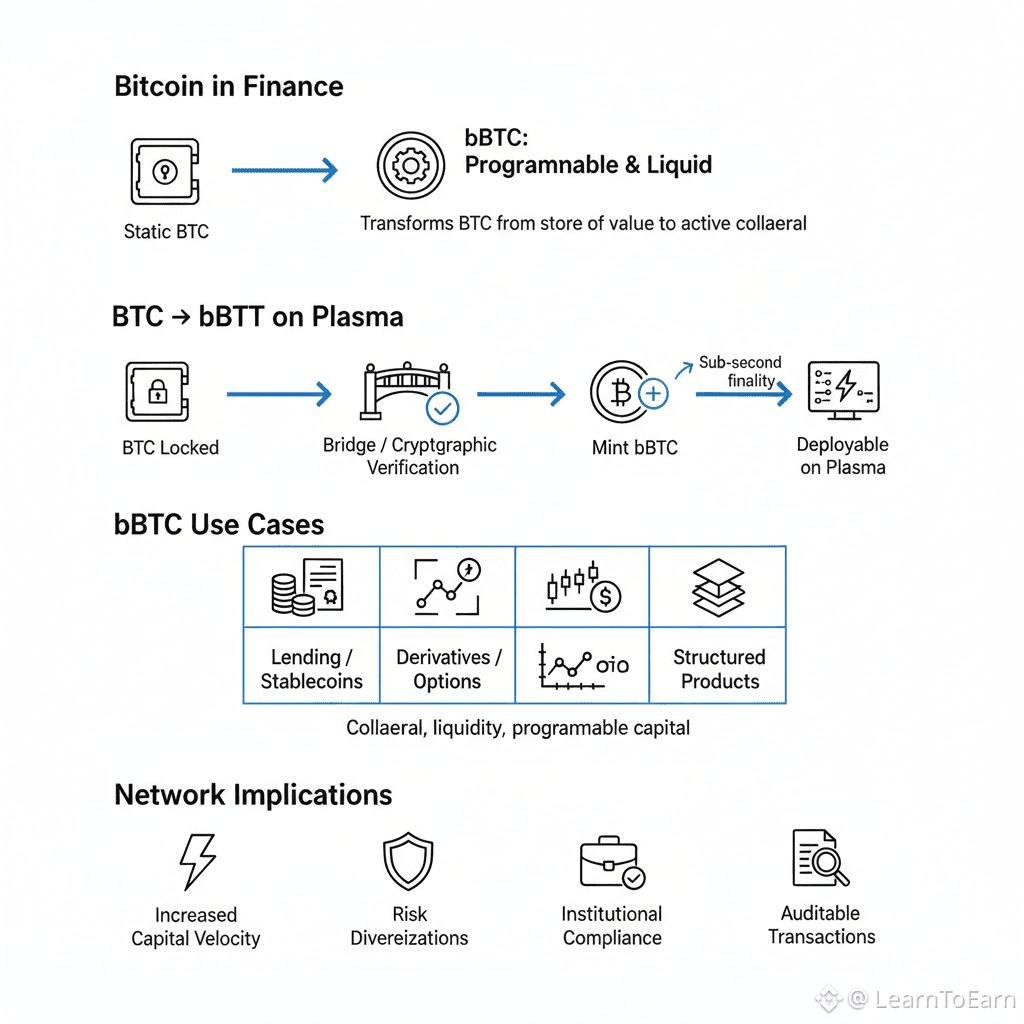
The implications for network dynamics are profound. Dormant Bitcoin capital is activated, enhancing velocity and capital efficiency within the Plasma ecosystem. The presence of an exogenous, high-quality collateral asset diversifies risk, strengthening credit systems reliant on the network. For institutions, this creates a programmable, auditable pathway to deploy Bitcoin in compliant financial operations, from lending desks to structured products.
Philosophically, this represents a shift in Bitcoin’s narrative—from “digital gold in a vault” to an active reserve in a functioning financial system. Plasma, with its stablecoin-centric design and Bitcoin-anchored security, provides the speed, certainty, and liquidity to realize this vision. The stablecoin layer facilitates transactions, while the Bitcoin layer provides foundational capital. Together, they form a cohesive, robust financial system where assets are actively employed with unprecedented speed and cryptographic certainty, transforming the network from a mere payment rail into a foundational layer for a fully integrated financial architecture.
The evolution of blockchain infrastructure has always been a delicate balancing act, a story of trade-offs between scalability and security, decentralization and finality, flexibility and specialized efficiency. True innovation does not emerge from ignoring these tensions but from deliberately choosing what to prioritize. Plasma exemplifies this approach by designing a Layer 1 blockchain with a singular, transformative goal: the settlement of stable digital assets.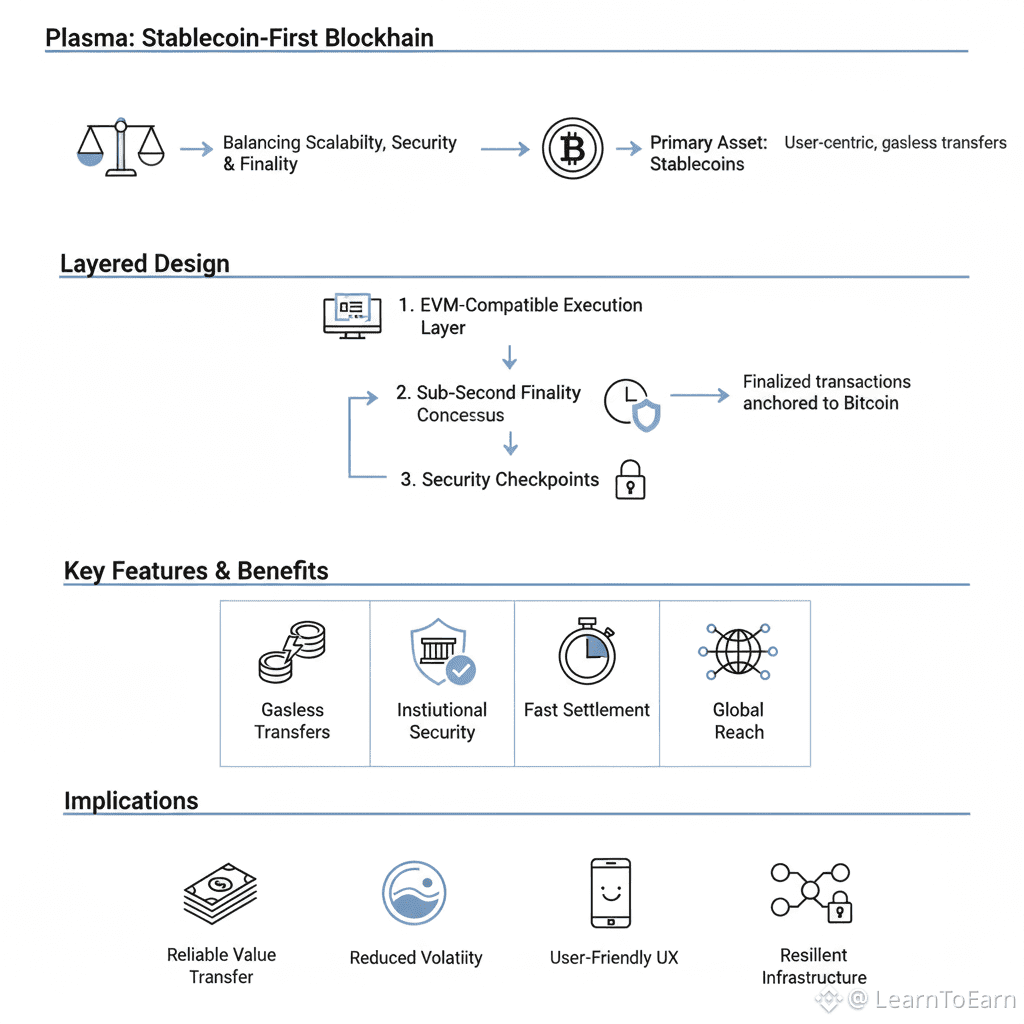
At the core of Plasma’s philosophy is the recognition that the transactional layer of the future will rely on stablecoins rather than volatile native tokens. This is more than an assumption; it is a guiding principle that shapes every architectural decision and carries deep technical and economic consequences. The network achieves a careful synthesis of two critical elements. Full EVM compatibility, powered by a high-performance execution client, ensures that the entire ecosystem of smart contracts and developer tools can migrate seamlessly, preserving both capital and innovation. Simultaneously, a consensus mechanism engineered for sub-second finality addresses the demands of financial settlements, where counterparty risk must be eliminated almost instantly. These components are not afterthoughts—they form the foundation upon which all specialized features are built.
Plasma reimagines user experience around the stablecoin itself. Gasless transfers for major stablecoins remove the friction of acquiring and managing separate native tokens, a feature particularly impactful in retail payment contexts. By tying the network’s economic layer directly to the assets it settles, the “stablecoin-first” gas model creates a fee market insulated from the volatility of unrelated cryptocurrencies, further streamlining transactions for end-users.
Security architecture is another defining element. Plasma anchors checkpoints of its canonical history onto Bitcoin, creating a novel form of security inheritance. Any attempt to rewrite or censor finalized transactions would require compromising the Bitcoin blockchain itself—a task that is both prohibitively expensive and operationally implausible. Unlike a two-way peg sidechain, this one-way export of cryptographic proof to the most neutral and immutable ledger in existence significantly enhances neutrality and censorship resistance, attributes essential for infrastructure serving global finance.
The practical implications are wide-ranging. Institutions gain a settlement layer that is both highly performant and credibly secure, addressing longstanding hurdles to blockchain adoption for real-world value transfer. Retail users experience an interface as intuitive as digital banking, with the added benefits of rapid finality and global reach.
Ultimately, Plasma signals a maturation in blockchain design. It moves beyond the “one-chain-fits-all” paradigm toward purpose-built architectures. By centering every choice—user experience, security, and performance—around stablecoin settlement, it demonstrates how blockchains can evolve from speculative platforms into resilient, efficient layers capable of supporting the global movement of value.
The architectural promise of a blockchain dedicated to stablecoin settlement is profound: a high-throughput, sub-second finality environment where digital dollars, euros, and pesos move with native efficiency, anchored in security to Bitcoin. Yet this vision raises a critical question. In a financial ecosystem defined by multi-asset portfolios and complex strategies, does a singular focus on stablecoins risk creating a silo? Or can the system’s foundational strengths—its speed, finality, and Bitcoin-anchored security—be extended to incorporate Bitcoin itself without compromising its core principles?
The answer lies in a trust-minimized Bitcoin bridge—a structural extension, not a peripheral feature. This bridge enhances the network’s utility while rigorously upholding its commitments to neutrality and censorship resistance. It is a careful translation of Bitcoin’s value and security properties into a purpose-built settlement environment.
Stablecoin settlement layers achieve optimal efficiency when friction is minimized. But the global financial landscape is not composed solely of fiat-pegged assets. Bitcoin exists as a reserve, collateral, and store-of-value benchmark. For institutions building payment rails or complex products, and for retail users in high-adoption markets, the ability to mobilize BTC within a fast, final environment is powerful. It allows Bitcoin to serve not only as a security anchor but also as a liquid, composable asset within the settlement engine itself.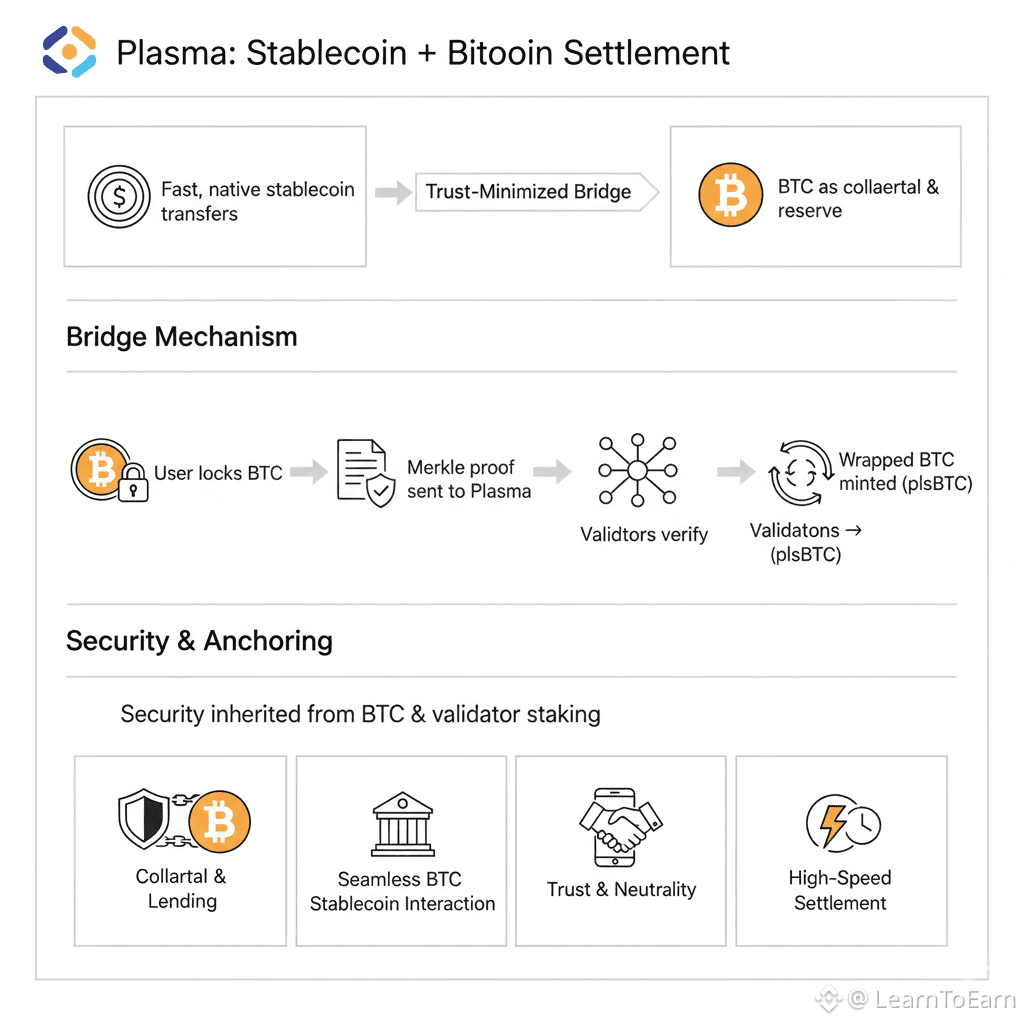
Historically, cross-chain bridges have been a frequent point of failure, introducing custodial risks, centralized actors, and complex attack surfaces. Embedding such vulnerabilities into a system prized for its security would be an architectural contradiction. The bridge, therefore, must be trust-minimized, relying not on external actors but on the network’s existing security principles.
Plasma’s security model commits periodic state roots—a cryptographic fingerprint of its history—to the Bitcoin blockchain. A trust-minimized Bitcoin bridge integrates with this mechanism. When users lock BTC in a provable Bitcoin transaction, the resulting Merkle proof is relayed to the Plasma network. Validators verify it against Bitcoin block headers, using an anchored light client derived from the same checkpoints committed to Bitcoin. Upon successful verification, a representative token (e.g., plsBTC) is minted on Plasma at a 1:1 ratio. Redeeming BTC follows the reverse path: burning the token generates a cryptographic proof, which the Bitcoin script verifies against the checkpointed Plasma state before releasing BTC. By design, the security of bridged assets rests on the same validators securing Plasma, enforced through staking and the prohibitive cost of compromising both chains.
The implications are significant. Institutions gain a unified settlement layer where BTC acts as instantly usable collateral for lending, derivatives, or stablecoin settlement. Retail users experience seamless interaction between their stablecoins and BTC holdings without reliance on third-party bridges. The protocol preserves neutrality: any user can lock BTC and mint the wrapped asset through a permissionless cryptographic process, maintaining censorship-resistant access.
In essence, a trust-minimized Bitcoin bridge is not an optional enhancement to Plasma’s stablecoin settlement vision—it is its natural evolution. By rigorously applying its core security principle, the network safely imports Bitcoin’s liquidity and value into a high-performance settlement environment. The result is a cohesive ecosystem where the premier store-of-value and the premier transaction medium coexist, secured by a single, elegant, and deeply anchored model, advancing blockchain design from better stablecoin chains to fully integrated, secure financial infrastructure.


