
We live in a world where cortisol levels often exceed common sense. Is your heart racing as if you're looking at a chart with a 100x leverage a second before liquidation? Do your palms sweat before an important meeting, an interview, or a first date? Welcome to the club. We tend to think that being nervous is normal. That it's 'part of our nature.' But let's be honest: in 99% of cases, your nervousness is a bug, not a feature. It doesn't help you escape from a saber-toothed tiger; it hinders you from negotiating, taking exams, and making well-thought-out decisions. The fear of failure, the fear of looking foolish—this is the fuel that burns your nervous system. To stop being a hostage to your own emotions, you need to not just 'breathe,' but reprogram your consciousness.
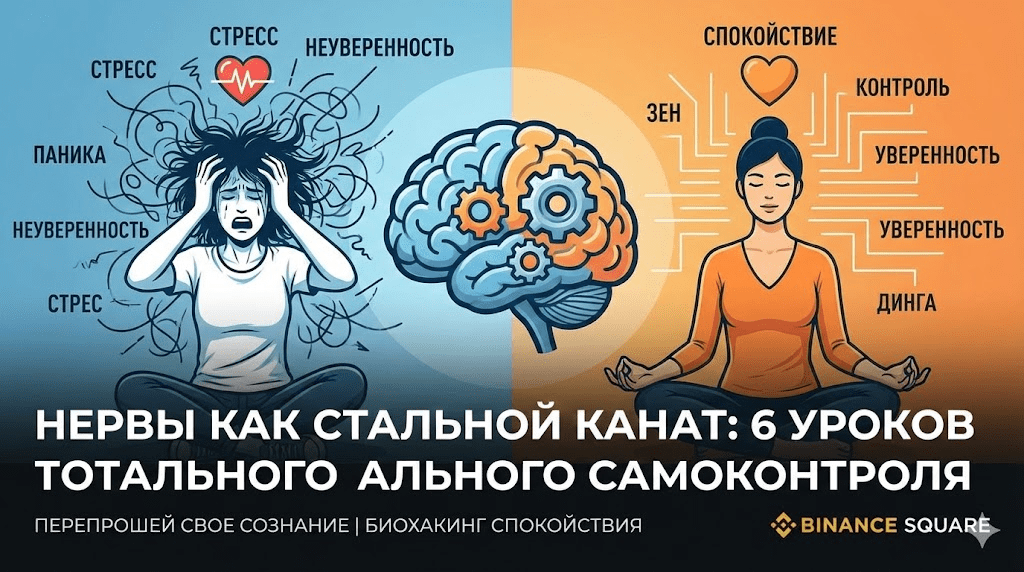
Let's break down 6 fundamental lessons supported by modern psychology and neurophysiology that will transform you from a neurotic into a stoic.
Lesson 1. Understand the nature of the enemy: A bug in the security system
The first step to control is deconstructing your feelings. What happens when you’re nervous? Trembling hands, tachycardia, "fog" in your head, an obsessive desire to smoke or fiddle with something in your hands. This is an ancient "fight or flight" response triggered by the amygdala in your brain. But ask yourself: does this cocktail of adrenaline and norepinephrine help you during a report delivery or a conversation with your boss?
The answer is clear: NO. Nervousness is an evolutionary remnant in the context of social stress.
It decreases your cognitive abilities (IQ literally drops in the moment).
It makes your facial expressions and intonation uncontrollable, revealing your uncertainty.
It depletes dopamine and energy reserves, leading to chronic fatigue.
Embed this in your subconscious: the tendency to be nervous is not your "character." It’s just a bad habit of neurons, reinforced over the years. If you can learn to drive a car, you can learn not to react to stress with hormone release. Your mantra: "I cannot afford to be nervous. It robs me of money, status, and health. I am deleting this program."
Lesson 2. Scaling: The "Zoom Out" effect
Recall the last time you panicked. A call to the boss? An unpleasant phone call? Traffic on the way to the airport? In the moment, it seemed like a catastrophe of cosmic proportions. Now apply the technique that traders call "Zoom Out" (zooming out the chart).
Look at your problem in the context of your entire life. Will this altercation on public transport matter in a year? And in 10 years? In the scale of your ambitions, your global goals and strategies, these events are just market noise, volatility that isn’t worth paying attention to.
Psychologists recommend practicing "Stoic dichotomy": clearly separate things into those you can control and those you cannot. You cannot control the mood of the examiner or traffic jams. Being nervous about it is like shouting at the rain. Focus on your goals. As soon as you shift your focus from the current problem to the long-term perspective, the level of tension drops to zero.
Lesson 3. Biohacking calmness: How to hack the system before the start
So, the hour "X" has come. An important interview, a public speech, or the deal of the century. You understand intellectually that being nervous is silly, but your body betrays you with shaking. Here, logic is powerless; you need to work with physiology.
Don’t try to "calm down" by sheer willpower. Use the "vagus nerve" — the main switch in your body from stress mode to relaxation mode. The fastest way to activate it is through breathing.
The "Box Breathing" technique:
This method is used by special forces fighters ("Navy SEALs") to maintain composure in combat.
Inhale through your nose for 4 counts. (Inflate your belly, use your diaphragm, not your chest!).
Hold your breath for 4 counts.
Exhale through your mouth for 4 counts.
Hold after exhaling for 4 counts.
Why does this work? Holding your breath raises CO2 levels in the blood, which paradoxically dilates blood vessels and calms the brain, while a slow exhale activates the parasympathetic nervous system. Just 3-5 minutes of such practice before an event — and your pulse will return to normal, and your thoughts will clear up. Dismiss the scripts of failure from your mind. Breathe.
Lesson 4. The feedback principle: Fake it till you make it
You are at a meeting. Breathing normally, but tension hangs in the air. Your task is to play the role of an absolutely calm person. This is necessary not only to deceive your opponent but also to deceive your own brain.
There is a proven connection between the body and the brain: not only do emotions shape posture, but posture also shapes emotions.
Remove stress markers: Stop clicking your pen, biting your lips, shaking your leg. Freeze.
Occupy space: Open your shoulders, don’t cross your arms. These are so-called "power poses" that can boost testosterone levels and reduce cortisol.
Slow down: Haste is panic’s best friend. Speak a little slower than usual, move smoothly. The illusion of time control gives real control over the situation.
When you consciously control your facial expressions and gestures, your brain receives a signal: "Everything is going according to plan, we are safe." The inner storm calms down, obeying external discipline.
Lesson 5. Stop-loss for emotions: The art of exit
The meeting is over. Successful or not — it doesn’t matter. But many people are still "haunted" for several hours or days. Rumination begins — endless chewing over thoughts: "I should have said it this way...", "Why did he look at me like that?".
This is a destructive process that burns your energy for nothing. Learn to set a "stop-loss" on your worries.
The 5-minute rule: Give yourself 5 minutes to analyze the situation, draw conclusions, and close this mental terminal.
Physical reset: Stress accumulates in the muscles. After a tense event, take a walk, stretch, or simply tense all your muscles and then relax them suddenly (progressive relaxation).
The event is over. Living in the past means stealing time from your future.
Lesson 6. Competence is the best sedative
The most reliable way to avoid nervousness is to be prepared for anything. Nervousness often arises from uncertainty about one's own competence. "What if I'm asked about something I don't know?".
If you go into an exam knowing the subject 100%, you’re not nervous — you’re eagerly awaiting the chance to shine. If you go into negotiations knowing all the numbers and arguments, you dominate.
The best antidote to fear is preparation. Invest time in your knowledge and skills. When you know you are a professional, there’s simply no reason to be anxious. Confidence based on facts is unshakeable.
In summary: Your calmness is your main asset
Stopping nervousness doesn’t mean becoming an unfeeling robot. It means taking back control of your own life. Composure, discipline, and the ability to see the bigger picture are the qualities that distinguish leaders from the crowd.
These skills are critically important not only in everyday life but also in finance management. Emotions are the main enemy of the investor. Those who succumb to panic lose, while those who maintain icy calm and stick to their strategy take it all. Learn to control yourself, study the market, and make informed decisions. Perhaps right now, while keeping a clear mind, it’s worth looking into fundamental assets like $BTC, $ETH, and $BNB, or paying attention to dynamic ecosystems like $SOL and $SUI. Even in zones of high volatility, where $DOGE or $PEPE live, or in private assets like $ZEC and technical solutions based on $POL, the one with the strongest nerves wins.
#Psychology #SelfDevelopment #StressManagement #CryptoMindset #LifeHacks


