

The change in the status of stablecoins in the on-chain world is not accomplished by any single major event, but is a result that gradually emerges over long-term use. Initially, they existed merely as a medium of exchange, used to reduce volatility risks and improve capital turnover efficiency. However, as the frequency of use continues to rise, stablecoins have gradually evolved from 'tool-type assets' into one of the most important value carriers on-chain.
Today, the transfer behavior of stablecoins has already covered a large number of non-investment scenarios. Cross-platform fund scheduling, cross-regional payments, and value transfers between on-chain and off-chain systems all rely on stablecoins to be completed. These transactions do not pursue high returns nor depend on complex contract logic; they are closer to payment and settlement activities in real finance. It is precisely in these high-frequency, low-tolerance usage scenarios that stablecoins begin to pose new demands on the underlying infrastructure.
However, the design assumptions of the current mainstream blockchain systems have not been synchronized with these adjustments. The vast majority of Layer1s still build economic models and system incentives around native tokens, treating stablecoins as passive assets running on top of them. This structure does not pose significant issues when the scale of stablecoins is small, but as stablecoin transaction volumes continue to grow, their incompatibility begins to accumulate gradually.
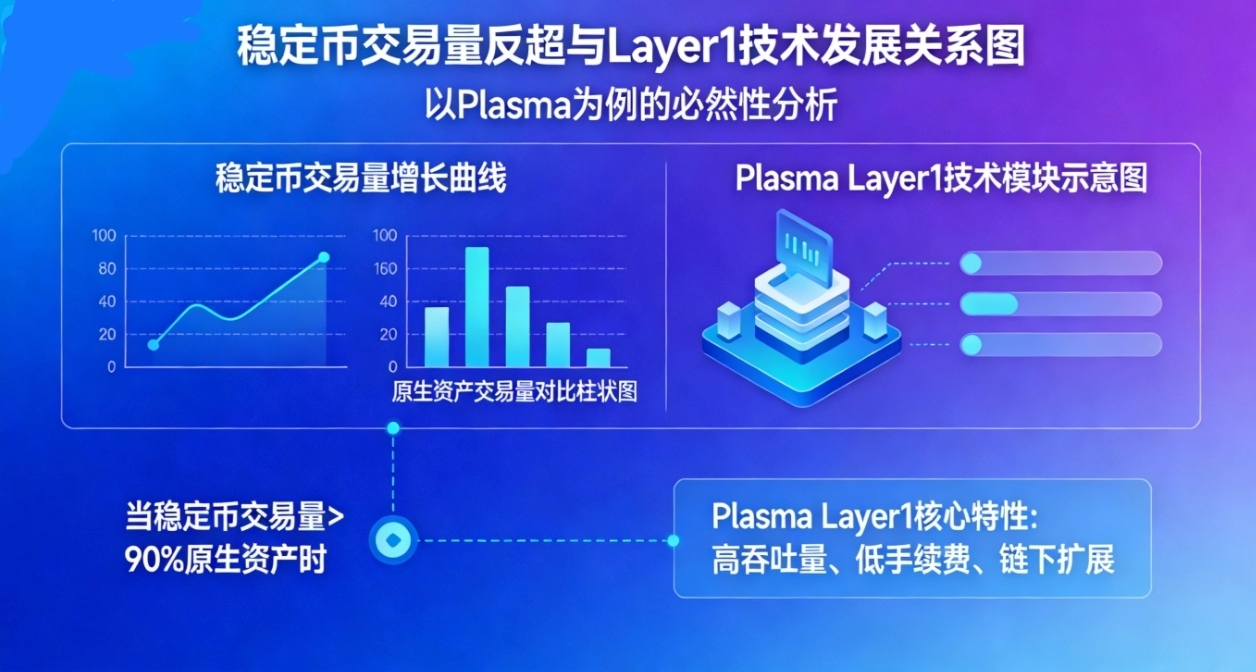
In the context of expanding settlement demand, a key contradiction is forming: stablecoins bear functions close to that of real currencies, yet their operating environment still adheres to system rules designed for speculation and application interactions. The ambiguity of transaction confirmations, the instability of fee structures, and the unpredictability under system load will convert into substantial trust costs as the scale of stablecoin usage expands.
It is precisely under this contradiction that Layer1s like Plasma, which center on stablecoin settlement as their core goal, become inevitable. It is not a new narrative appearing out of thin air, but a response to the failure of existing system assumptions. When stablecoin transaction volumes surpass native assets as a norm, the underlying infrastructure must redefine its priorities. Continuing to view settlement demand as a subsidiary function will only amplify system friction.
The emergence of Plasma is essentially a shift in the system's focal point. It does not attempt to solve the stablecoin issue at the application layer but directly sinks the problem into the underlying design. By placing settlement determinacy, fee stability, and system neutrality at the core of its design, Plasma responds not to short-term market preferences but to the reality that the structure of stablecoin usage has already changed.
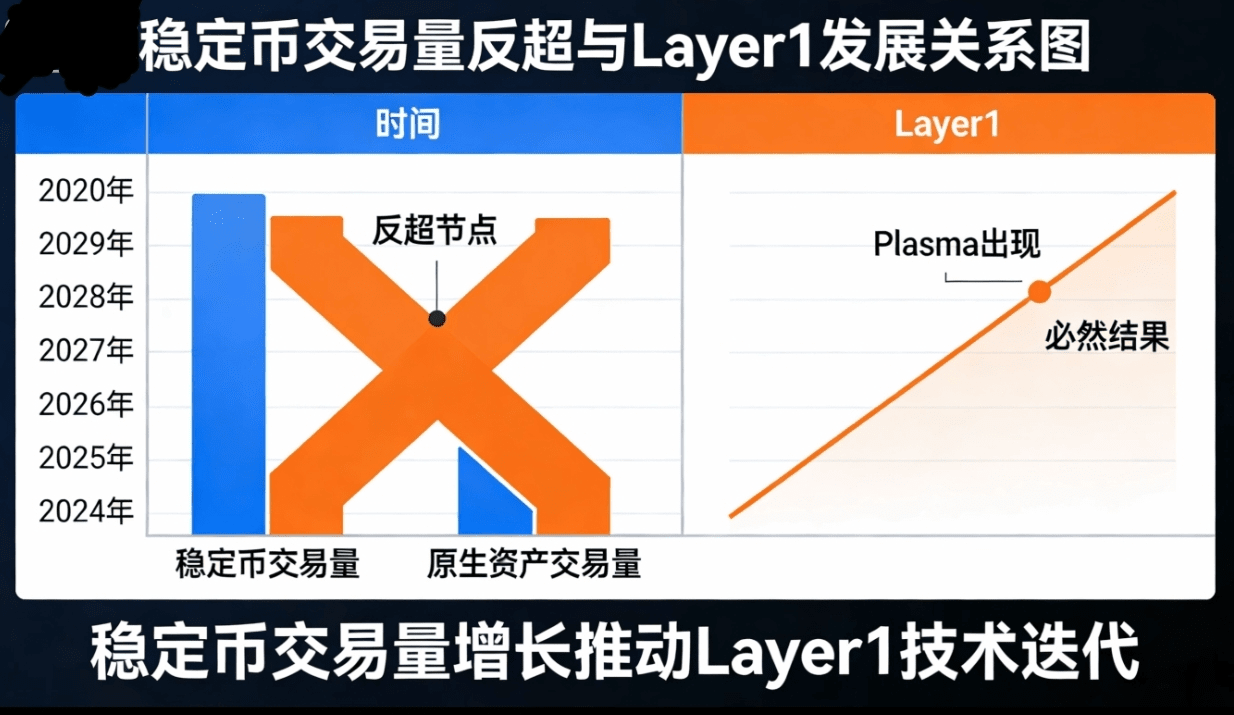
This change has obvious irreversible characteristics. The appeal of stablecoins comes from their stability and predictability, and these characteristics have long-term demand in the real world. As long as this demand exists, stablecoins will not revert to a marginal role. Accordingly, the settlement networks serving stablecoins cannot long depend on systems not designed for them.
It is worth noting that Plasma is not the only possible answer, but it represents a clear direction: settlement demand is rising from the application layer to the infrastructure layer. In this direction, any attempts to maintain the old structure through local optimization can only delay the exposure of the problem, without fundamentally solving the incompatibility.
From a long-term perspective, the evolution of infrastructure often follows the same rules. When usage patterns undergo fundamental changes, new underlying systems will inevitably emerge to adapt to new demand structures. The continuous growth of stablecoin transaction volumes is a direct reflection of this change. The existence of Plasma is not a denial of the existing public chains but a complement to their design boundaries.
Understanding this helps to place Plasma back in the correct context. It is not competing with other Layer1s for the same competitive metrics, but responding to a trend that has taken shape but has not yet been fully digested. As stablecoins continue to expand, and settlement demand accumulates, the differentiation of the underlying systems will be inevitable. In this process, Layer1s centered on settlement will no longer be optional but an inevitable product of infrastructure evolution.
Plasma emerges precisely at this juncture.

