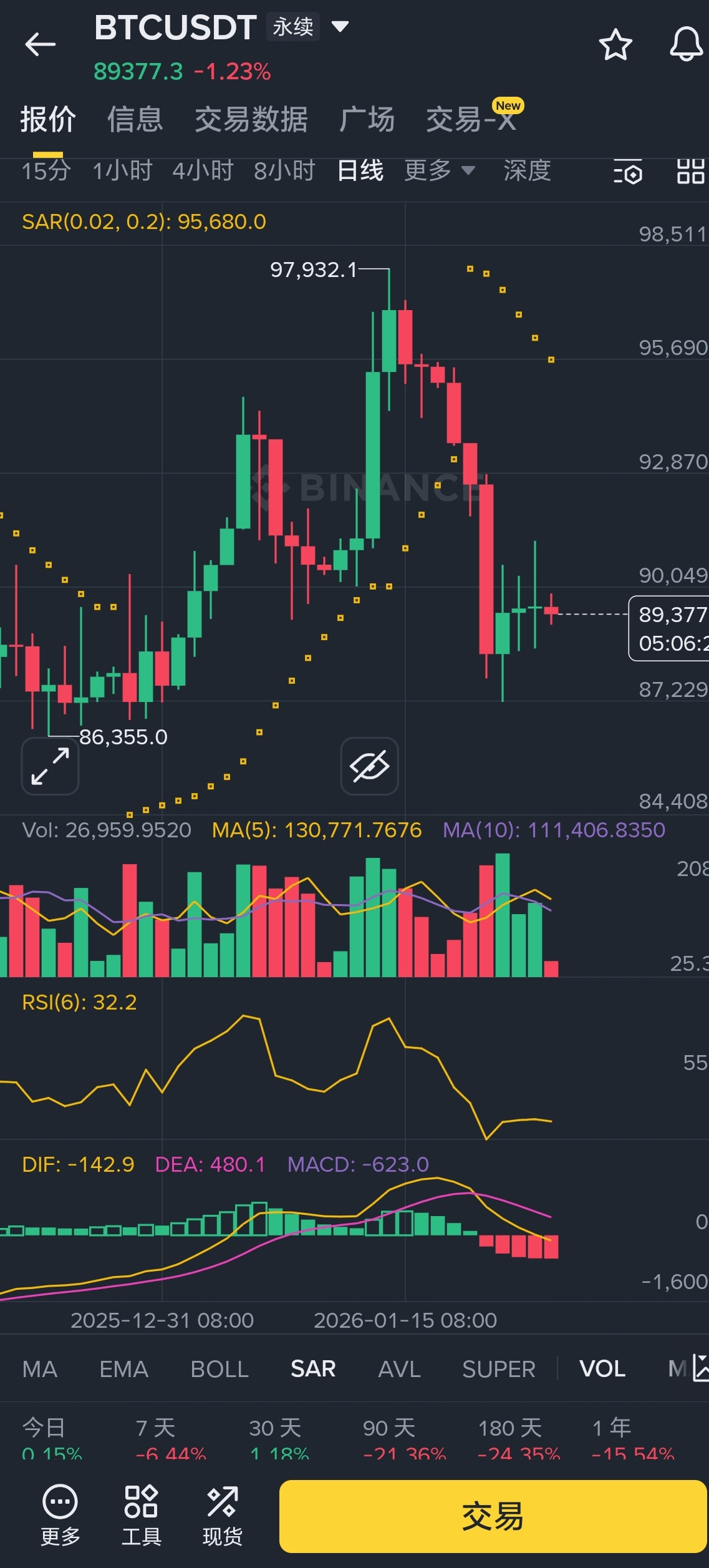
Current price 89,377 USDT (down 1.23%), daily K-line is in a clear correction channel: Price trend: rapidly fell from the high point at the end of December 2025 (around 97k-98k), recently oscillating downwards in the 89k-90k range, forming a descending channel. Lowest reached 86,355 (marked in the figure), currently close to the 89k support.
Key indicators: MA5/MA10 death cross downward, short-term moving average pressure is obvious.
RSI(6): 32.2, has entered the oversold area (<30 is extremely oversold), suggesting a possible short-term oversold rebound, but no bottom divergence has formed yet.
MACD: DIF/DEA death cross, green bars expanding, bearish momentum is strong.
SAR indicator: 95,680 (parabolic turn indicator upwards, but prices are significantly below, confirming a downward trend).
Volume: Recent increase in volume followed by a decrease, showing reduced selling pressure, but insufficient buying.
Support/Resistance: Support: 88,000-88,500 (recent low point dense area), 86,000 (previous low marked in the chart), 84,000 (stronger psychological level).
Resistance: 90,000-92,000 (short-term moving average pressure), 95,000-98,000 (previous highs).
Overall technical outlook is bearish, with a high probability of continued downward movements in the short term, but oversold indicators suggest a potential technical rebound.
Latest market data (January 25, 2026, early morning) confirms that prices are still fluctuating within the narrow range of 89,000-89,700, consistent with the overall chart.
International news dynamics impact (Key US-Iran situation) The current Bitcoin correction is highly correlated with the geopolitical tensions in the Middle East: US-Iran tensions escalate: The Trump administration continues to threaten military action against Iran (including targeting leadership), ongoing domestic protests in Iran, currency collapse (rial devaluation), and increased US military presence in the Middle East. Oil prices have surged significantly due to supply concerns (WTI close to $60, a multi-month high). The market fears that a limited conflict or proxy attacks could trigger global risk aversion.
Impact on Bitcoin: Short-term negative dominance. When geopolitical risks rise, Bitcoin behaves more like a 'risk asset' (linked to the stock market) rather than a reliable safe haven (like gold). Recent tensions have caused BTC to drop from over 97k to below 89k, accompanied by liquidations and sell-offs. The domestic use of cryptocurrency in Iran has surged (reaching $7.8 billion in 2025, mainly shifting towards Bitcoin as a safe haven), but global market sentiment remains cautious.
Other macro factors: Fed policy expectations are loose (interest rates may fall to 3% in 2026), uncertainty in Trump's policies, which is bullish for risk assets in the long term, but short-term overshadowed by geopolitical risks.
Subsequent trend prediction for the short term (a few days to a week): biased towards oscillating downward or narrow consolidation. Technical oversold + shrinking volume may lead to a rebound testing 90k-92k, but if a negative event suddenly occurs between the US and Iran (e.g. US military strikes or Iran blocking the strait), it could easily break below 88k and test 86k or even lower. Probability: Downward 60%, rebound 40%.
Medium-term (one week to one month): Depends on the evolution of the US-Iran situation. If tensions ease (successful mediation or Trump pulling back), combined with an oversold rebound + macro loosening, BTC is expected to rise to 92k-95k or even return to the 98k high. If it escalates into a protracted conflict, risk aversion may intensify, potentially leading to a deep adjustment to the 80k-84k range (similar to historical geopolitical events).
Overall advice: Current market sentiment is cautious (buyers are waiting), it is not advisable to heavily pursue long positions. Focus on key events: Trump's latest statements, Iran's responses, oil price trends, and US stock performance. Short-term operations can wait for confirmation of support at 88k or a breakthrough at 92k to determine direction. In the long term, most forecasts for 2026 remain optimistic (target 130k-200k), but geopolitical black swans should be watched.